// NATURE NEWS — SPAZIO & SCIENZA
Researcher, heal thyself: meet the scientists studying their own diseases
Josie Glausiusz is a science journalist based in Israel. BlueSky: @josiegz.bsky.social
Search author on:
PubMed
Google Scholar
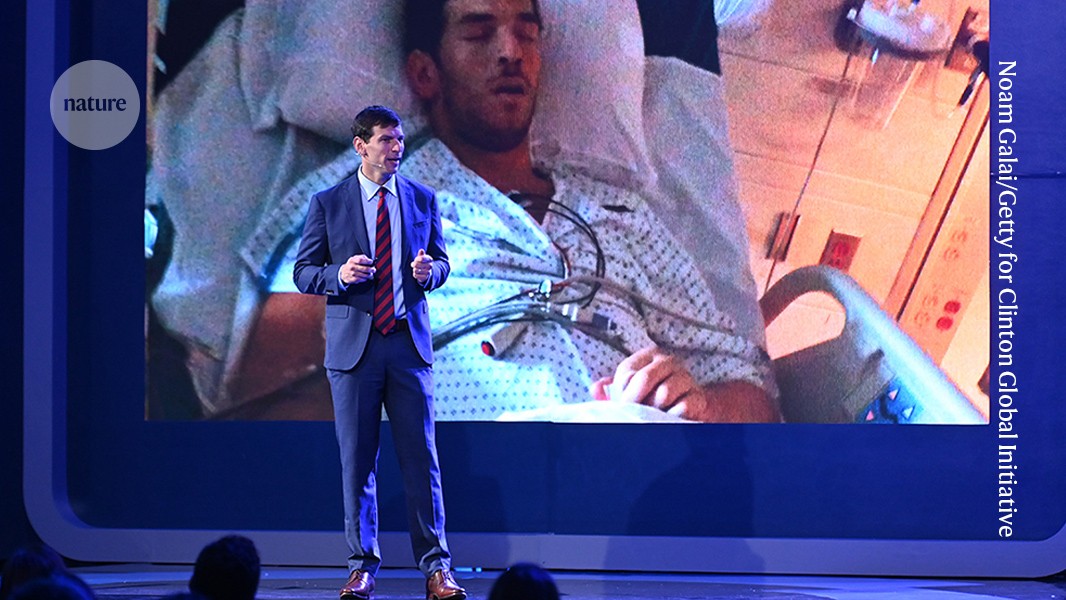
David Fajgenbaum discovered how to repurpose a drug to treat his own rare disease and has dedicated much of his career to repurposing drugs. Credit: Noam Galai/Getty Images for Clinton Global Initiative
As a child, molecular biologist Francesca Granata had episodes of skin pain so excruciating that she could not bear even a hug from her mother. The pain, which felt like boiling water scalding her skin, would relent only after ten days spent in a darkened room. Yet doctors suggested repeatedly that her pain was psychological. “A lot of physicians said things like, ‘You are so beautiful, why are you here?’” she recalls.
“Deep down, I knew something was wrong,” Granata says. In 2003, at age 16, she consulted Orphanet, now a database for patients and medical professionals, and began reading it alphabetically, one syndrome at a time. She was still perusing it as a 21-year-old undergraduate student at the University of Milan in Italy when a lecturer in biochemistry described porphyrias. This group of rare genetic disorders is caused by an accumulation of porphyrins, the building blocks of heme, a component of oxygen-carrying haemoglobin. Certain forms of the condition can result in burning or itching skin.
Granata skipped to the letter ‘p’ in Orphanet and found a reference to dermatologist Gianfranco Biolcati, a specialist in porphyrias at the San Gallicano Dermatological Institute in Rome. She travelled there in 2008, where Biolcati diagnosed her with erythropoietic protoporphyria (EPP), an inherited condition in which protoporphyrins accumulate in red blood cells, causing acute, searing skin sensitivity to light, and potentially, liver disease.
“After years without a diagnosis, erythropoietic protoporphyria has become not only my disease, but also the focus of my work,” Granata explains. In 2011, as a master’s student at the Policlinico of Milan research hospital, she decided to pursue a research career in the field of porphyrias. She is now a specialist there in rare haemotological diseases and inflammation. In parallel, Granata founded Vivi Porfiria, a patient-advocacy organization in Italy created to “give a voice to people living with porphyria, raise awareness and promote early diagnosis”. In 2018, she co-founded the International Porphyria Patient Network, a global patient-advocacy group to connect national porphyria organizations and promote international collaboration.
Francesca Granata has created patient advocacy groups to raise awareness of porphyrias, rare genetic disorders, and is driven to find a cure for herself and others. Credit: Francesca Granata & Valentina Brancaleoni
It might seem unusual for scientists to study rare diseases that they have, but researchers who choose this path often cite altruism as their impetus. Those interviewed by Nature’s careers team say that their personal experience with an illness enables them to empathize with other patients, driving them to find better therapies for themselves and others. Some choose to advocate for their community and a better understanding of the challenges faced by those who have a rare syndrome. Although they recognize that there is potential bias in studying their own disease, they also point out that they are less conflicted in other ways because they have a personal stake in the science. Many feel empowered by their increased understanding of the disease and deeply fulfilled by their pursuit of new or improved treatments for illnesses with no known cure.
For Granata, her own pain “drives my soul, my person” to find drugs or make other discoveries that can increase the quality of her life and those of other people with EPP.