// HACKER NEWS — CYBERSECURITY
A new ceiling for Λ: the de Bruijn–Newman constant
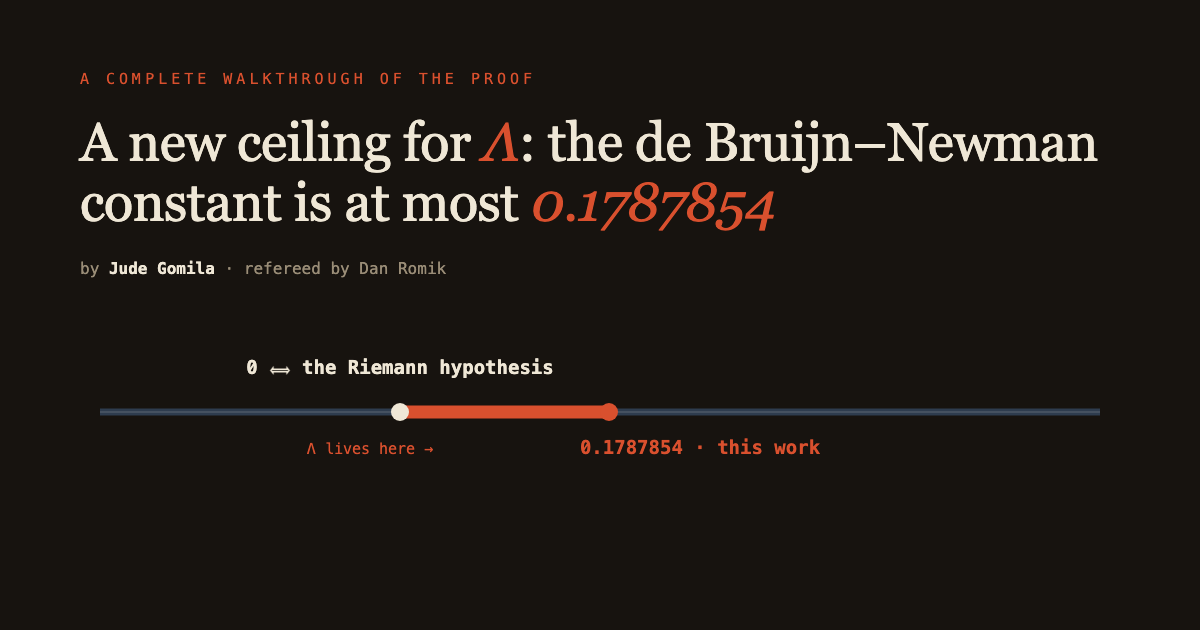
I'm Jude Gomila and I've been exploring the zeta function in private since 2025. This post is part of a series of posts on discoveries obtained from human/ai collaboration. This post is about the de Bruijn–Newman constant Λ — a single real number with this property: the Riemann hypothesis holds exactly when Λ ≤ 0. Nobody can prove that yet, but its known ceiling can be lowered, and this is my computer-assisted proof taking it from 0.2 to 0.1787854, unconditionally, with no unproved conjecture anywhere in the chain. I'll walk you through the whole proof, step by step. Every claim links back to my audit repository and the independent review record. Feedback, bugs and upgrade comments are welcome as GitHub issues.
= 129/800 + 87677/5,000,000: an exact rational, obtained by exact arithmetic from 3,149,013 + 883 + 1 machine-checked interval certificates.
The primes 2, 3, 5, 7, 11, 13, … are the atoms of arithmetic: every whole number factors into primes in exactly one way, so facts about primes become facts about all numbers. Individually they are irregular — no known rule produces the next prime from the ones before it. Counted in bulk, they obey a law: the number of primes up to x stays close to a single smooth curve (the prime number theorem, proved in 1896). The open question is the size of the error — how far the true count can stray from the curve. That error term is what the Riemann hypothesis governs, and it is why RH matters: sharpen the error term and you sharpen hundreds of results in number theory that depend on it.
In 1859 Bernhard Riemann explained where that hidden order comes from. He took Euler's identity, which connects the primes to a single function of one complex variable,
extended it to the whole complex plane, and discovered that the wobble of the prime count around its smooth curve is governed — exactly, via an explicit formula — by the locations of the zeros of this function. Each zero contributes one wave to the error; the zero's height sets the wave's frequency and, crucially, its horizontal position sets the wave's amplitude. Riemann observed that every zero he could examine sat on one vertical line, Re s = ½, now called the critical line — the position giving the smallest possible amplitude — and remarked it was “very probable” all of them do. That remark is the Riemann hypothesis. Its concrete content: the prime-count error up to x never exceeds roughly √x, the same size as the wobble of a fair coin flipped x times. The primes are allowed to look random; RH says they are never allowed to drift with a bias.
The wave description is an actual formula, and you can run it below. The slate staircase counts prime powers (a cousin of the staircase above, weighted so the mathematics is exact), and the vermillion curve is Riemann's formula built from the smooth trend plus one wave per zeta zero. Drag the slider and watch thirty zeros carve the primes:
It has now been open for 167 years. It is part of the eighth of Hilbert's problems (1900) and is one of the Clay Millennium Prize problems today; hundreds of theorems across number theory and beyond are proved conditionally, “assuming RH.” Its zeros have been checked by computer into the trillions — every one on the line — but a check is not a proof. The way forward is to turn the question into a number that can be moved — and that is exactly what Λ is.
Λ (defined properly in the next chapter) repackages the Riemann hypothesis as a statement about one real number: RH holds if and only if Λ ≤ 0 (a proved equivalence, established in Chapter 1). That reformulation has three consequences. First, progress becomes measurable: a yes/no conjecture has no partial credit, but an upper bound on Λ can shrink: ½ → 0.22 → 0.2 → and now 0.1787854. Second, since 2018 we know Λ ≥ 0, so Λ is confined to the interval from 0 to the current ceiling, and RH is the statement that Λ sits at the left endpoint; every improvement to the ceiling is measured distance toward the answer.