// ARS TECHNICA — MODA & SOCIETÀ
The Porsche 911 GT3 Touring punches above its weight class
The “everyday” GT3 delivers, despite looming regulations and an ever-inflating price tag.
The GT3 occupies a singular place in the 911 lineup. Whereas the range-topping Turbo S piles on power, technology, luxury, and all-weather capability, the GT3 has always pursued something more elemental: a lighter weight, more focus, and a finely honed setup that puts the driver at the center of the experience.
Porsche has expanded the GT3 formula since the model’s debut in 1999, adding the more extreme GT3 RS to the lineup in 2003 and the slightly more reserved GT3 Touring in 2017, along with the GT3 S/C earlier this year. While the concept behind the drop-top S/C requires some mental gymnastics to make sense of it, the Touring’s original premise was refreshingly simple: Take the standard GT3—including its naturally aspirated 4.0 L flat-six and track-tuned chassis—and replace the fixed rear wing with the deployable spoiler from the Carrera. The result is a subtler version of the homologation car that recaptures the classic 911 silhouette without giving up the hardware that makes a GT3 a GT3.
Fresh from its 992.2 mid-cycle update, the latest GT3 Touring sticks closely to that original design. Its 4.0 L flat-six still spins to 9,000 rpm and produces 502 hp (375 kW) and 331 lb-ft (449 Nm), sending its output exclusively to the rear wheels through either a seven-speed PDK dual-clutch automatic or six-speed manual gearbox. Massive brakes, rear-axle steering, a GT3-specific suspension, active sport exhaust, and plenty of other road course-oriented hardware remain standard.
There is, however, an important wrinkle: that 331 lb-ft figure is actually 15 pound-feet lower than the outgoing model. Stricter European emissions and noise regulations forced Porsche to add two catalytic converters and two gas particulate filters to the exhaust. To offset the resulting flow restriction, engineers borrowed the cylinder heads and camshafts from the GT3 RS to reach a peak horsepower number that matched the 992.1 GT3. Porsche also shortened the final-drive ratio by 8 percent, trading a bit of top speed for harder acceleration.
The result is a car that feels just as rapid out in the real world as its predecessor. The manual GT3 Touring’s top speed falls from 199 to 194 mph (320 km/h to 312 km/h), but its 0-60 mph (0–100 km/h) time remains the same as the outgoing car at 3.7 seconds (when equipped with the PDK, the GT3 Touring reaches 60 mph in 3.2 seconds and tops out at 193 mph/310 km/h). If anything, the shorter gearing makes the engine’s enormous rev range easier to exploit without requiring speeds that would attract unwanted attention from law enforcement.
The 992.2 update also gives the Touring a little more of its own identity. Both GT3 variants get reworked fascias, aerodynamically optimized suspension trailing arms, GT3 RS-derived anti-dive suspension geometry, and revised steering calibration. But Porsche now also offers Touring-specific options, like the new $37,310 Leichtbau package fitted to this test car.
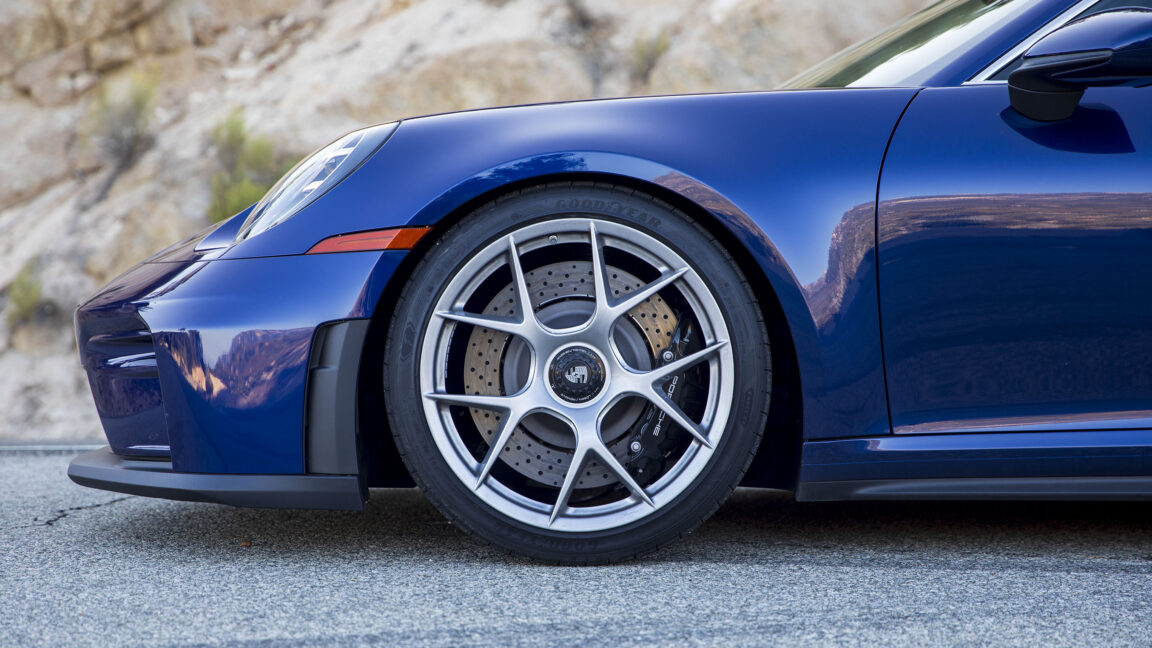
The German term means “lightweight construction,” a philosophy that is already evident in the GT3’s extensive use of weight-saving measures. In manual-equipped Touring form, the car has an official curb weight of just 3,239 pounds (1,470 kg), and the Leichtbau package takes the pursuit of lightness even further. The treatment swaps the standard roof skin, anti-roll bar, drop links, and rear-axle shear plate for carbon-fiber components, trades the forged alloy wheels with forged magnesium rollers that save 19 pounds of rotating mass, replaces the standard interior door panels with lightweight units, and outfits manual-equipped examples with the shorter gear lever from the 911 S/T.
The Touring’s more road-focused mission seems to have had some influence on the 992.2 GT3’s overall tuning as well: A revised suspension strut bump-stop design allows for more spring travel than the outgoing car, thereby reducing wheel-load fluctuations and the fr