// HACKER NEWS — CYBERSECURITY
Does the Sumerian King List Align with Paleoclimate Events?
The Sumerian King List starts with eight kings who ruled before the flood. Their reign lengths are enormous and unusually regular. Three examples are 28,800 years, 36,000 years, and 43,200 years. Most are integer multiples of 3,600, and all eight are multiples of 600. Their total is 241,200 years.
The input sequence tested here is the ETCSL composite antediluvian list:
The transliterations follow the composite text cited below. Like the post-flood sections of the King List, the antediluvian list is a textual tradition with variants, so the table is an analysis input rather than a claim about literal historical reigns.
One speculative interpretation treats these numbers as a distorted memory of prehistory. Under this hypothesis, the reign boundaries encode real climate shifts, eruptions, impacts, or sea-level changes. After rescaling and anchoring the list to a proposed flood date, the boundaries should coincide with dated events in the geological record.
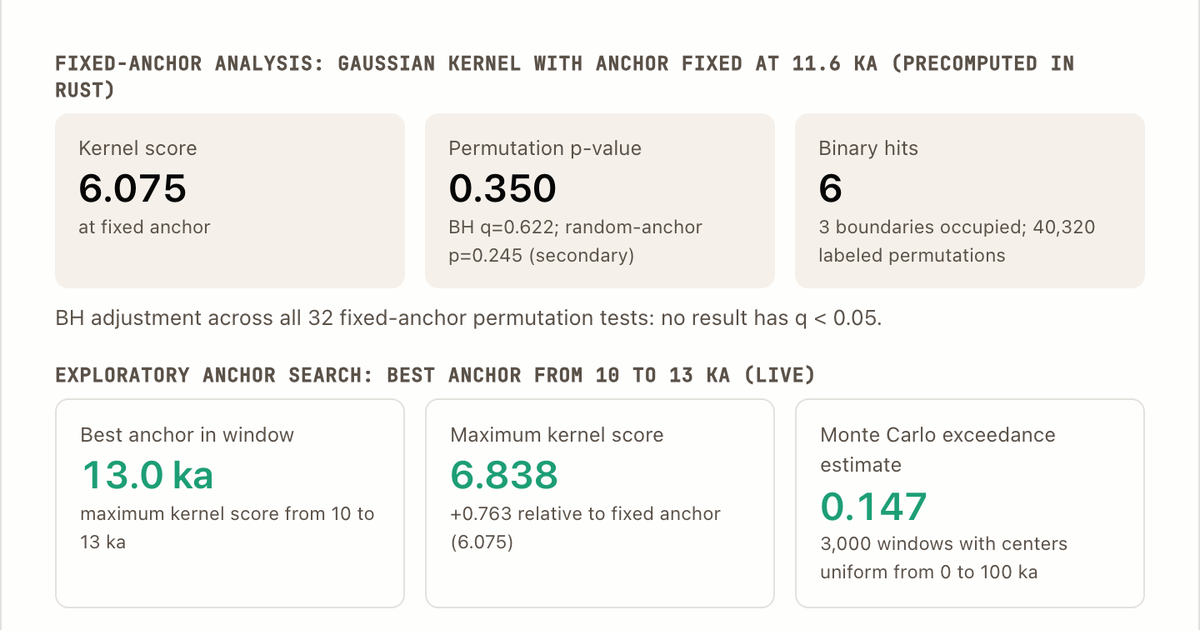
Here, I test that idea with an exploratory analysis. The explorer rescales each chronology to a fixed 241.2 ka span, anchors one boundary, and compares the resulting dates with a catalog of Quaternary events. I use 11.6 ka BP, or about 11,600 years ago, as an analyst-chosen anchor near the Younger Dryas termination. The King List does not provide that date or suggest this paleoclimate interpretation.
Finding matches is easy. With nine boundaries and freedom to change the anchor or bandwidth, chance alignments are common. The relevant question is whether the observed Sumerian reign order scores unusually high under a clearly defined null model.
A credible alignment would need to meet three conditions.
First, the text must determine which boundary to anchor. The Sumerian King List places the flood after the eighth reign, so I anchor the end of the antediluvian sequence. The text does not assign that boundary an absolute date. I use 11.6 ka BP as an analyst-chosen date near the Younger Dryas termination.
Second, the Sumerian sequence should look unusual next to other ancient chronologies. I compare it with a sequence derived from Biblical patriarchal ages, seven god and demigod reigns from the Manethonian fragment preserved in the Excerpta Latina Barbari, and the first eight listed Kish I rulers. These are examples for comparison, not independent statistical controls, and I do not test whether one chronology outperforms another. They show how readily unrelated ancient sequences can produce apparent matches under the same procedure.
Third, a credible result should remain significant after accounting for the tested chronologies, catalog tiers, and bandwidths. None does.