// HACKER NEWS — CYBERSECURITY
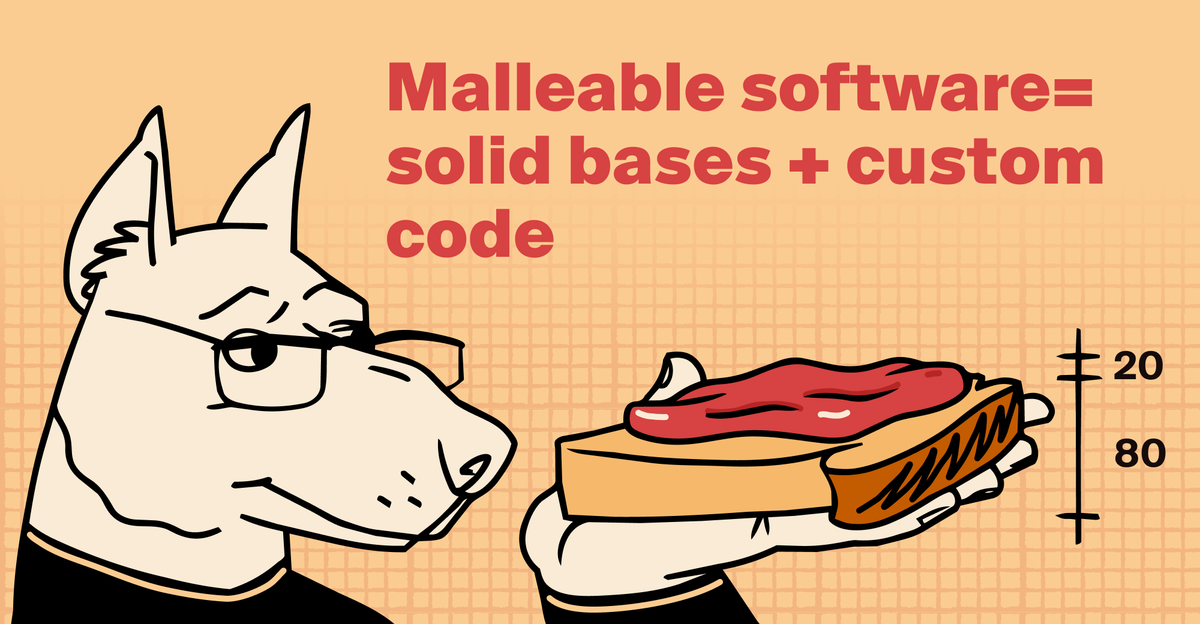
Malleable software = solid bases and custom code
In 2019 I bet on the no-code revolution. That bet aged so-so. Here is the new one.
I joined the productivity tools market in 2004 and have had the luxury of observing its dynamics for 22 years now. From time to time the market changes and I write a holistic "visionary" article. The last one was in 2019 when I bet on the no-code revolution. Now it's time to write a new piece, because the market is experiencing tectonic shifts that will change its landscape enormously.
Everyone knows that AI lowered the barrier, so now anyone can build software. You can't vibe-code a full OS (yet), but you can easily vibe-code small apps to solve personal problems. Things get more complex when you add "collaboration" as a dimension. If you work alone it's relatively OK to break things and move forward until you're happy with the app, but if you work in a team it becomes harder to implement all the needed bells and whistles to cover collaborative use cases. You suddenly need data storage with relations, concurrent editing, notifications, changes history, permissions, etc.
It raises an interesting question: where is the hot spot of malleable software in the AI age? Should we always start from scratch in Codex? Or should we have some solid base that can be tailored via custom code?
Imagine you have a small mushroom farm that employs 10 people (don't worry, we will grow champignons here (for now)) and are looking for software to run all operations. Most likely you are using Google Sheets, since the market is too small to have specialized software (ha! no market is too small).
You have several options. The irony is that… none of the options are ideal.
What is happening in the productivity tools market? It seems the ideal solution is to have a solid base covering 80% (databases, permissions, history, collaboration, notifications, etc.) and let users mix these things and extend via custom code.
As a result, many vendors are heading in this direction, closing the gaps in missing areas. And while vibe-code and low-code tools are adding more solid bases, malleable tools should add more extension points.
In the past the only solid bases you had were a compiler and an OS — everything else was your problem. Beautiful time of true hackers!
Now we have the luxury of higher abstractions. The most interesting question is: where to stop? For example, a specialized tool without any customization is as solid as it gets, but the lack of customization is exactly what makes it unusable in many cases. With Codex your solid base is almost non-existent, but you have enormous expression power and can build almost whatever you want (expression power is how far you can bend the tool to do exactly what you need).