// HACKER NEWS — CYBERSECURITY
We Let AI Agents Rewrite a 92M-Message-a-Day Service in Go
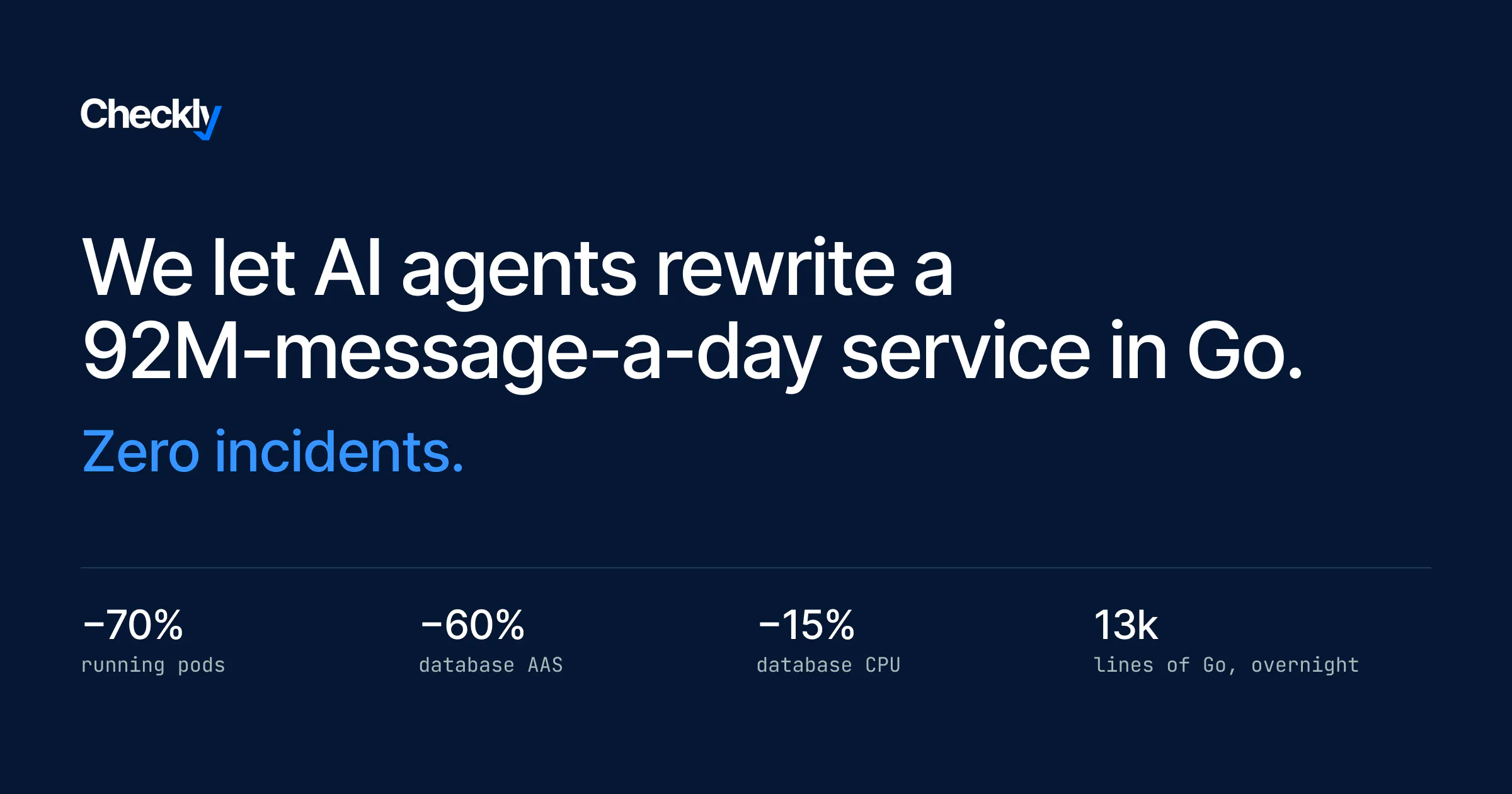
Our Results Daemon processes about 92 million messages a day. We recently rewrote it from Node.js to Go, and we let Claude Code write it.
We wanted to know whether we could trust an agentic rewrite for a critical, high-throughput production service rather than a prototype. It shipped with zero incidents, a 70% reduction in running pods, and a lighter database load. Go's stronger type system also proved a better fit for agents than JavaScript, adding protection against regressions and letting us ship faster and with more confidence.
What made it work was the test harness we built before the agent wrote a line. Here's how we designed it, and the principles you can reuse on your own legacy services.
Checkly is a monitoring platform that runs synthetic checks, automated scripts that emulate real users, and uptime checks that confirm a system component is operational. A runner component executes all of these and produces a result that has to be processed, stored, and alerted on.
Since we introduced uptime checks, and with the company's overall growth, the volume of checks run on our platform has doubled over the last year. Some components started degrading under that load. The most notable one was Results Daemon, a Node.js component written in vanilla JavaScript.
Results Daemon is a background worker. It consumes results from our runner, writes them to databases, determines the check outcome, issues alerts, and schedules retries as needed. It also publishes WebSocket updates to our CLI and UI. In total, this component processes approximately 92,000,000 messages every day, around 40,000,000 of them check results and the rest WebSocket publishes.
At that scale, it was becoming a bottleneck. It paged our on-call engineers more often, and limited type safety made every change harder to land safely. So we decided to rewrite Results Daemon in Go using agentic engineering.
We built the harness before we started the rewrite. If an agent is going to write the code, something other than a human reviewer has to define what correct means.
With the architecture settled, the next step was building actual test cases. Results Daemon's outputs depend on two things:
From there it followed quickly that behavior coverage depends directly on the diversity of the inputs. A harness that covers every combination of check result and configuration covers every possible code path, with zero coupling to the implementation. That gave us our first principle: