// HACKER NEWS — CYBERSECURITY
Icy Moons Are Ocean Worlds
If you’ve ever spent time with an 11-year-old during their dinosaur phase, you know the feeling of having everything you thought you knew upturned by a pitiless pedant. Science moves on and leaves whatever we learned in school hopelessly out of date. The dinosaurs I grew up with were slow thinking and cold-blooded monsters. They came in muted shades of ugly brown and green, like Subarus. I was taught that the brontosaurus was so chunky it had to spend its life submerged in marshes to help buoy its weight, while the T-rex staggered around on its back feet like Godzilla, waving its little arms.
But starting in the 1990’s, dinosaurs started to get cooler—suddenly they were running fast, covered in feathers, hunting in packs. The T-Rex got upgraded to a high-speed, warm-blooded killing machine. The dinosaur entertainment complex rolled out a whole new set of small, intelligent hunter-killers. And at some point the brontosaurus got cancelled and doesn’t even exist anymore, subdivided into three new dinosaurs I had never heard of.
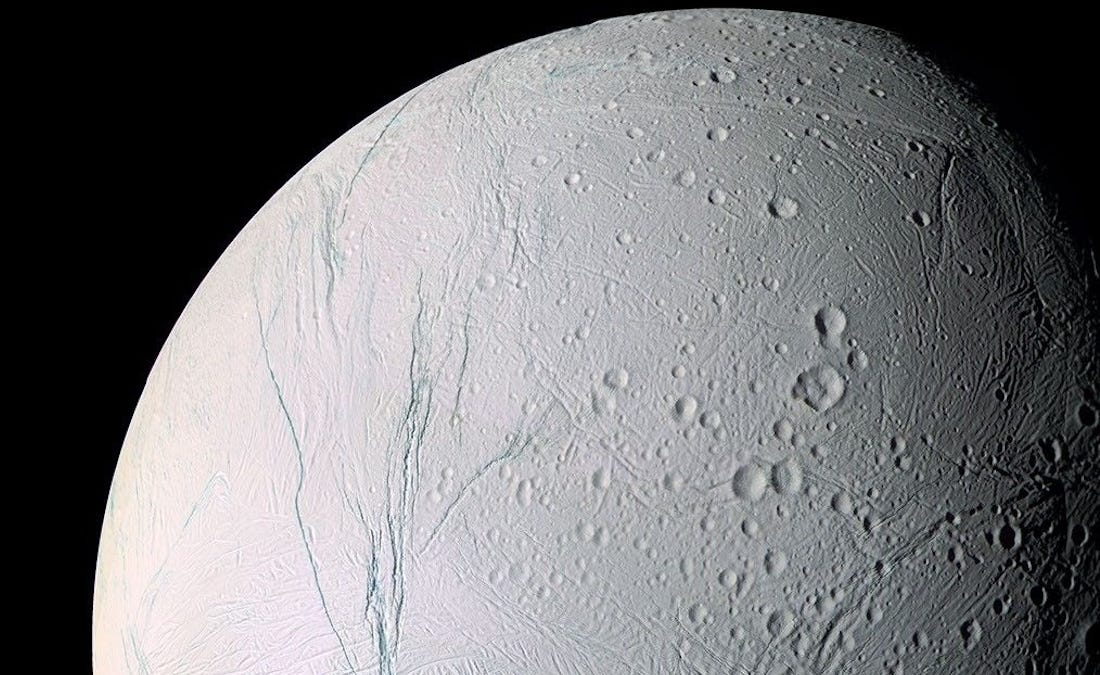
Something similar has happened to the frozen worlds of the outer solar system. In a series of glow-ups, they’ve gone from being a sort of Space Antarctica of interest only to the most spectrumy of ice nerds, to a series of water worlds that are the most likely environment in our solar system to harbor life. Even poor Pluto, demoted from planethood back in 2006, has been revamped to a candidate ocean world, with the implication that the thousands of Pluto-like objects still undiscovered in the Kuiper belt may be harboring secret seas of their own. Today you can hardly swing a telescope without pointing it at a celestial body hiding a warm underground ocean.
This remarkable transformation in our understanding is the result of just three missions: Voyager, Galileo, and Cassini—along with some computer modeling and hard staring by the Hubble and Webb space telescopes.
As of this writing, six icy worlds (Europa, Enceladus, Titan, Mimas, Callisto and Ganymede) are confirmed to have vast underground oceans of liquid water, and a bunch more (Dione, Pluto, Miranda, Ariel, Triton, Oberon) are on the waitlist.
Of the six worlds so far shown to have underground oceans, three are moons of Jupiter, and three are moons of Saturn.
Europa is the OG ocean world and a bit of a celebrity for that reason. When Voyager flew through the Jupiter system in 1979, scientists were amazed to discover active volcanoes on Io, confirming a prediction published just a week earlier (!) that tidal heating could substantially warm the inner moons of Jupiter. Since Europa was the next moon out from Io, it stood to reason that tidal heating might be at work there too, an impression reinforced by the craterless smoothness of its surface. But whether Europa was an actual ocean world, or just covered in warm convecting ice, was not definitively settled until 2000, when magnetic evidence for an ocean became overwhelming.
The radiation environment around Europa is punishing; an astronaut standing on the surface would get a fatal dose in about a day.1 But the same radiation means the ice crust is enriched in molecular oxygen and peroxides (created when water molecules are split by radiation) that may cycle down into the planetary ocean, creating a rich potential environment for life.
Hubble has seen plumes coming out of Europa, but the observations remain tentative. Hopefully Europa Clipper will settle the matter when it arrives at the moon in 2031.
Ganymede, the next furthest moon out after Europa, is kind of a reverse Pluto. By all rights it should be a planet—it’s bigger than Mercury and has its own magnetic field—but Fate has placed it in orbit around Jupiter, and that is where it is going to stay. Ganymede is not a tectonically active world like Europa, and its ocean is locked away under a hundred miles or more of ice. But despite the gruff exterior, the moon shows surface signs of an active past, and contains enough rock (with its car