// NATURE NEWS — SPAZIO & SCIENZA
Daily briefing: Psilocybin blocks side-effect of chemotherapy in mice
Search author on:
PubMed
Google Scholar
Hello Nature readers, would you like to get this Briefing in your inbox free every day? Sign up here.
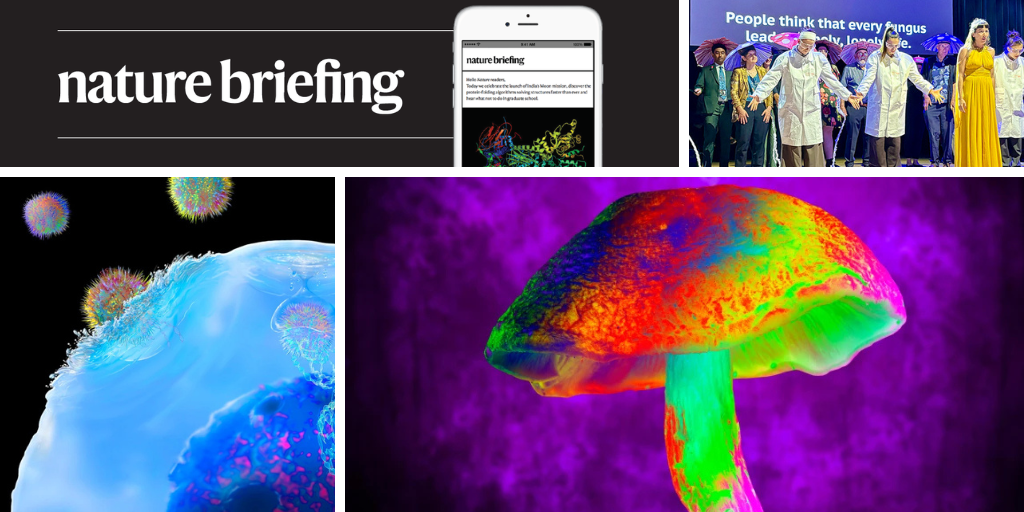
Studies in mice suggest that psilocybin, one of the psychoactive compounds in magic mushrooms, could prevent the chemotherapy side effect called neuropathy.Credit: Victor de Schwanberg/SPL
The psychoactive compound psilocybin seems to protect mice from a debilitating side-effect of chemotherapy called neuropathy. As many as 60% of people treated with platinum-based chemotherapy drugs can experience neuropathy, which causes a constant feeling of burning, or pins and needles, in their hands and feet. Just two doses of psilocybin administered before chemo completely prevented the adverse effect in mice, which could argue for expanding the use of psychedelic compounds beyond the conventional uses in mental-health conditions such as depression, says oncologist and study co-author Moran Amit.
Sixteen people with autoimmune conditions have had their symptoms relieved by a treatment that produces disease-fighting immune cells inside their bodies. Researchers used a modified virus to deliver the genetic instructions for making chimeric antigen receptors (CARs) on participants’ T cells. These CAR T cells target antibodies produced by other immune cells, which attack the body’s own healthy tissue in autoimmune diseases. The findings are a proof of concept for in vivo CAR-T-cell therapy, says clinician-researcher David Simon, which is cheaper and faster to produce than is lab-made CAR-T.
Results from a small clinical trial show that the drug daraxonrasib (Rasonque) could be an effective treatment for lung cancer. The findings come just one week after the US Food and Drug Administration (FDA) approved the medicine for the treatment of advanced pancreatic cancer. A larger study in which people with lung cancer are randomly assigned to receive daraxonrasib or standard chemotherapy is now under way, the results of which could inform the FDA’s decision to approve the drug as a lung cancer treatment.
Nobel prizewinners in economics, physics and medicine, dressed as mushrooms, joined soprano Serafina Giannoni in performing a fungi-themed opera at the satirical Ig Nobel ceremony in Zurich. (Flora Graham/Nature)
The tongue-in-cheek celebration of science known as the Ig Nobel prizes took place last night in Switzerland — the first time in its 36-year history that it was held outside the United States, which the organizers say “has become unsafe for our guests to visit”. The winners included an economics prize for research showing that wealthier individuals take more from a bowl of sweets meant for children than did less-wealthy people; a physics prize for a splash-proof urinal; and a peace prize for evidence that people value friends who are mean to those that they dislike.
Last night, the Ig Nobel prize ceremony lived up to its promise to “first make people laugh, and then make them think”. I’ve watched past events online, but it was another thing entirely to experience traditions such as ‘the paper aeroplane deluge’ in person. I wasn’t sure about my choice of a front-row seat when I realized that many of those planes were heading for the back of my head, but it paid off when I caught one of the pairs of autographed cotton underpants thrown into the audience by the winners of this year’s Ig Nobel in soil science, who buried hundreds of similar pants to investigate soil health.
The prizes are handed out by winners of the other Nobel prize (the Swedish one), who also receive gifts in turn. This year, these included pairs of the aforementioned underpants — and the sight of Swiss astrophysicist Michel Mayor, on his home turf, gamely wearing them on his head made the trip even more worthwhile.