// NATURE NEWS — SPAZIO & SCIENZA
Daily briefing: Gene-therapy deaths put spotlight on trials in China
Search author on:
PubMed
Google Scholar
Hello Nature readers, would you like to get this Briefing in your inbox free every day? Sign up here.
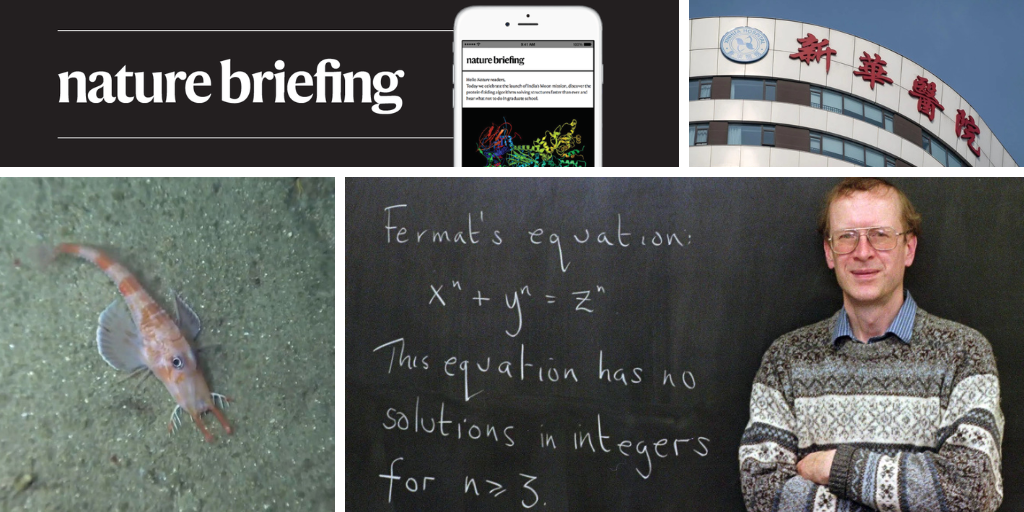
Mathematician Andrew Wiles completed his proof of Fermat’s last theorem in 1994, more than 350 years after Pierre Fermat proposed it.Credit: AP Photo/Charles Rex Arbogast/Alamy
An advanced prototype of the artificial-intelligence chatbot Claude has produced a 13-million-line, computer-checked proof of Fermat’s last theorem in just 11 days. That a machine could formalize the landmark proof — a project that was expected to take humans around a decade — “just completely blew my mind”, says number theorist Alex Kontorovich. The result shows that AI will play an increasingly important part in creating algorithmically checkable versions of mathematicians’ work, and hints that such technology could soon scrutinize the entire library of mathematical knowledge.
There are more than 400 million cases of unintentional, acute pesticide poisoning every year, finds a new estimate — meaning that an estimated 46% of farmers worldwide are being poisoned. The analysis suggests there are 11,000 pesticide-related deaths annually, with nearly 60% of these in India. And that’s not taking into account long-term health impacts that are not immediately felt, such as a possible link with Parkinson’s disease.
The deaths of two children in separate gene-editing trials in China raise questions about oversight and could have a profound effect on the country’s biomedical industry, say researchers, ethicists and legal scholars. The two trials involved breaches of ethics and lacked transparency, and the deaths — one of which was only revealed after an investigation by Science and Retraction Watch — will probably prompt the introduction of stronger regulations for gene-therapy trials, researchers say. But a balance must be struck, says legal scholar Hank Greely. “We can’t make ethics so tight that no research can ever possibly be done,” he says.
Both trials fast-tracked as investigator-initiated trials (IITs). These enable researchers in China to test therapies quickly without supervision from the country’s drug regulator, and are widely considered to be a driving force behind China’s rising competitiveness in biomedicine. News of the deaths comes only months after the government introduced stricter rules for IITs of new biomedical technologies, which mandate that only certain hospitals may host such trials and which grant regulatory agencies the power to suspend or terminate trials if there are technical or ethical concerns.
This deep-sea fish, spotted by researchers in the northern South China Sea, can do a wicked moonwalk. The armoured searobin (Scalicus engyceros) “boasts a striking shrimp–fish hybrid body appearance”, says marine researcher and study co-author Han Tian. And it can walk sideways and even backward, a movement that has never been observed in other fishes. (The Independent | 5 min read)
Reference: Ocean-Land-Atmosphere Research paper (Kedong Yin)
In April, the UK Biobank — one of the largest and most comprehensive health-tracking studies in the world — fell victim to what appeared to be a massive data leak, with data on hundreds of thousands of participants available for sale on the internet. The open nature of this world-leading health-dataset has made it valuable to researchers, but also vulnerable. Now, as the resource plans to begin reopening, scientists are getting a glimpse of how it will try to tighten security, and what impacts that will have on the research.