// HACKER NEWS — CYBERSECURITY
GPT-6 Astra, Looped Transformers, and Hidden Reasoning
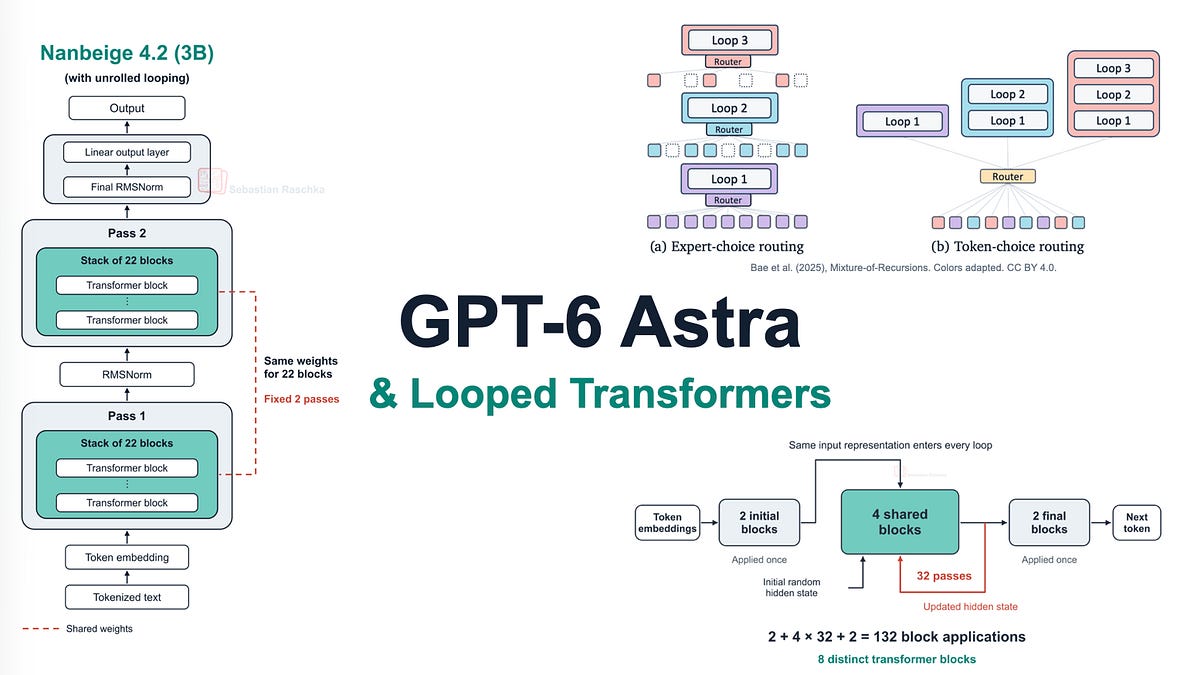
A lot has happened in the last few weeks. I am sure that OpenAI’s GPT-6 Astra is top of mind for everyone right now. In particular, thoughts on its performance, the looped transformer/recurrent depth aspects, and rumors that Astra is “hiding” its reasoning trace (i.e., chain of thought).
So, in this article, I want to start with some brief impressions of Astra and some thoughts on where all this is headed. Then, I will discuss, in detail, what “looped transformers” are, and how (or rather, if) this relates to hiding chains of thought.
Lastly, after covering the basics of the looped transformer, I wanted to highlight some new insights from recent research papers on the topic.
First things first. Before getting into the architecture rumors and related research literature, let me briefly summarize some GPT-6 Astra observations and tidbits.
Last week, OpenAI’s new GPT-6 Astra was released with a big fanfare. I used it over the past couple of days, and it’s an exceptionally good model, likely the best I’ve used as of this writing. But what, exactly, has it improved, and how?
Astra is the best model I’ve used so far, and it’s disproportionately good at 3D rendering and animation tasks (relative to other models). With that, I mean that while it leapfrogs its GPT-5.6 predecessor in practically all categories (writing, math, coding, and more), it especially does so when it comes to graphical demos.
We can see this also reflected in the benchmarks. For instance, GPT-6 Astra is really good at math and coding, as shown below.
One of the highlights (not shown in the figure) is that Astra also achieves 99.9% on the ARC-AGI-3 benchmark (GPT-5.6 Sol only 7.8%), which measures a mix of solving logic puzzles and generalization. However, the math, coding, and computer use benchmarks are more interesting because they are closer to real-world use.
Coming back to the Artificial Analysis Coding Agent Index v1.4 (lower right in the previous figure), which blends several agentic coding tasks, GPT-6 Astra is clearly at the frontier, but it doesn’t pull ahead by leaps and bounds. This can also be seen in the general Artificial Analysis Intelligence Index shown below, which blends different types of tasks, not just coding tasks.
Now, the big advantage of Artificial Analysis benchmarks is that they are independent and thus may be a bit more trustworthy than self-evaluated benchmarks by model developers.