// NATURE NEWS — SPAZIO & SCIENZA
Foaming photopolymers as a high-resolution biomimetic printing platform
Nature
(2026) Cite this article
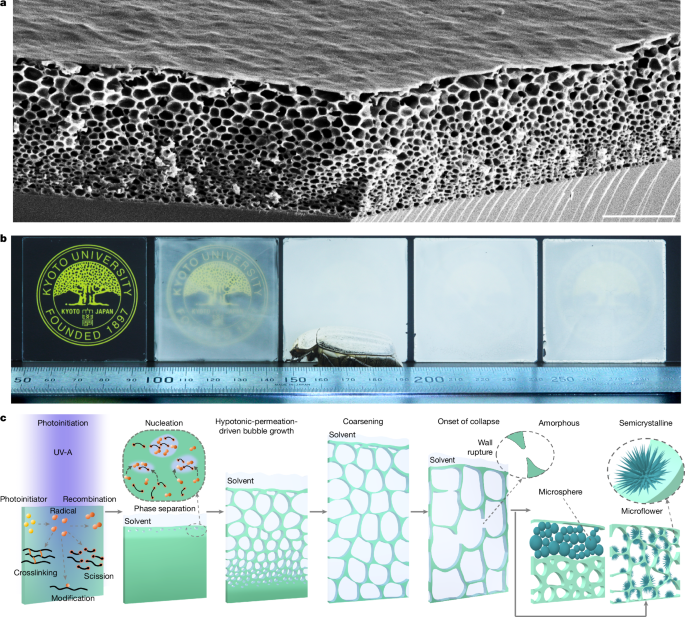
Nature creates a diverse range of foam-like materials, from bones to banana peels, through a rich orchestration of physical and biochemical processes across hierarchical length scales1. Here, we introduce deep-foam photolithography, a spatially controlled, light-induced foaming process in which a photosensitized polymer film is exposed to deeply penetrating UV-A light, which initiates the production of both scission and crosslinked polymers throughout the depth of the film. Hypotonically driven case II permeation2 of a weak solvent triggers pore nucleation, expansion and a controllable viscoelastic collapse to create foams through a localized solubilization of polymer fragments within a crosslinked network. The resemblance to amorphous structural whites in nature enables inkless printing in white and greyscale; the resolution is high enough (about 20,000 dots per inch) to generate diffractive colour. This uniquely allows the printing of mechanically expanded and collapsed foams with high aspect ratios (20×); controlled collapse creates hierarchically rough surfaces with lotus-like super-hydrophobicity. Deep-foam photolithography is applied to both films and fibres, using a range of amorphous and semi-crystalline polymeric materials. Patterning μm-level spatial differences in foamability, wettability, optical properties and local thickness enables high-resolution printing, microfluidics and picolitre capture of liquids and colloidal matter.
This is a preview of subscription content, access via your institution
Access Nature and 54 other Nature Portfolio journals
Get Nature+, our best-value online-access subscription
Prices may be subject to local taxes which are calculated during checkout
All data are available in the main text or the Supplementary Information. Source data are provided with this paper.
Wegst, U. G. K., Bai, H., Saiz, E., Tomsia, A. P. & Ritchie, R. O. Bioinspired structural materials. Nat. Mater. 14, 23–36 (2015).
Article
CAS
PubMed
Google Scholar
Thomas, N. L. & Windle, A. H. A theory of case II diffusion. Polymer 23, 529–542 (1982).