// NATURE NEWS — SPAZIO & SCIENZA
A serpin–myeloid axis in pancreatic cancer heterogeneity and immune evasion
Nature
(2026) Cite this article
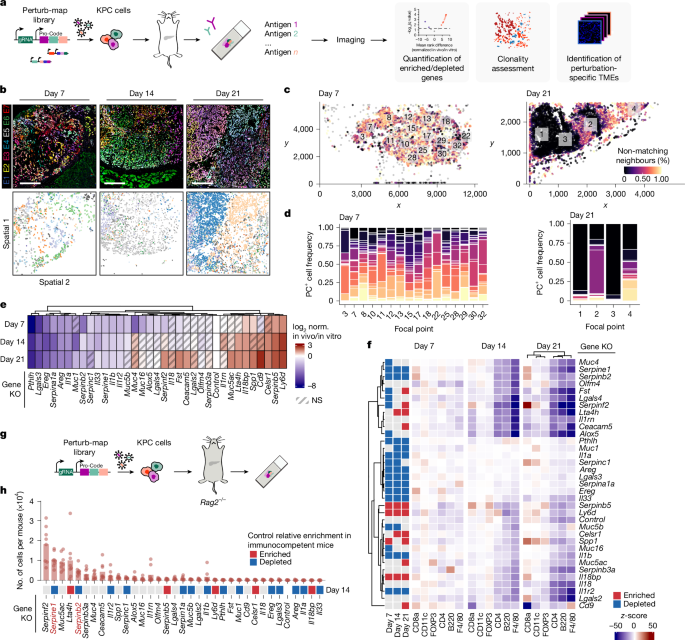
Pancreatic ductal carcinoma (PDAC) is characterized by a highly immunosuppressive, extracellular matrix-rich microenvironment, yet tumours display marked heterogeneity1,2,3,4. This raises the question of whether immune resistance is a global tumour property or is organized within spatially restricted niches. Here, using Perturb-map spatial functional genomics, we determine how different genes shape the growth and cellular environments of PDAC clones across space and time. This analysis revealed early gene-driven remodelling of local immune neighbourhoods preceding late-stage spatial clonal dominance. We identify SERPINE1 (encoding plasminogen activator inhibitor 1 (PAI1)) and SERPINB2 (encoding PAI2) as dominant regulators of tumour microenvironment control and immune evasion. These serpins promote stabilization of fibrin-rich extracellular matrix niches that spatially retain and programme macrophages towards immunosuppressive states while excluding cytotoxic T cells. Loss of Serpine1 or Serpinb2, or pharmacological inhibition of PAI1 or CD18, improves tumour control in mice and synergizes with anti-PD-1. Multimodal spatial analysis of patient tumours revealed that immunosuppressive niches form around rare SERPINB2- and SERPINE1-expressing PDAC subpopulations, dominated by SPP1+/MARCO+ macrophages. These findings identify cancer-derived SERPINE1 and SERPINB2 as local spatial organizers of immune suppression, linking tumour-intrinsic heterogeneity to local microenvironmental control and immunotherapy resistance in PDAC.
PDAC is one of the most lethal malignancies, with a five-year survival of only 13% (ref. 5). Although immunotherapies have improved the outcome of several types of cancer, they have shown limited efficacy in PDAC. The composition of the tumour microenvironment (TME) is a key factor in immunotherapy resistance, with T cell infiltration being one of the strongest correlates of immunotherapy response. Although a fraction of PDACs are almost completely devoid of CD8+ T cells, in those where T cells are present, they are frequently exhausted. This is believed to be due to an enrichment of immunosuppressive immune and stromal cells, and to the deposition of a dense extracellular matrix (ECM), which can obstruct T cell infiltration and cytotoxic activity1,2,3,4.
Precisely how PDAC establishes its immunosuppressive TME is still poorly understood, but evidence points to the critical role of tumour-derived extracellular factors2,6. Although single-cell and spatial profiling studies have identified candidate receptor–ligand interactions and other extracellular mediators7,8,9,10,11, the functional contribution of many of these remains unclear. Spatial transcriptomics suggests that many of these ligands are produced by spatially localized tumour cell populations within distinct niches, raising the possibility that altered expression of soluble TME regulators is a driver of clone selection.
Here we sought to identify extracellular factors that promote PDAC growth and immune evasion. Using Perturb-map, a spatial functional genomics platform12,13, we found that remodelling of the local immune niche precedes, and is likely to drive, differences in clonal fitness and spatial dominance. We identified Serpine1 (encoding PAI1) and Serpinb2 (encoding PAI2) as major regulators of immune escape under adaptive immune pressure. These factors promote macrophage retention and polarization, establish localized immunosuppressive niches, and limit anti-tumour T cell activity. Genetic or pharmacological disruption of this pathway improved tumour control and sensitized PDAC to PD-1 blockade. Our findings identify serpins as active organizers of immunosuppressive tumour niches characterized by fibrin accumulation and establish leveraging the serpin–fibrin–macrophage axis as a potential strategy to dismantle immunosuppressive microenvironmental architecture and enhance the efficacy