// HACKER NEWS — CYBERSECURITY
Who People Talk to When They're Struggling
This post has been unlocked through a generous grant from the Lilly Endowment for the Association of Religion Data Archives (ARDA). The graphs you see here use data that is publicly available for download and analysis through link(s) provided in the text below.
Who do you talk to when you’re struggling? When it feels like you’re carrying the weight of the world and there’s no way out of the mess you’re in—who can you turn to for an honest conversation? I’d bet that for a lot of us, the answer is “no one.” Many Americans are suffering in silence, without a spouse, a close friend, or even a co-worker they can lean on when times get tough. The loneliness epidemic has real casualties. Of that, I am absolutely sure.
I saw a video on Reddit a couple of weeks ago that got me thinking about this. It was posted in “HumansBeingBros,” a subreddit that exists to make you feel a little better about the world. A motorcyclist comes upon a man walking down the middle of the road, clearly in distress. The rider stops his bike, turns around, and engages with the man—at one point even asking if he needs a hug.
Later in the video, the two of them are sitting against a fence on the side of the road. Here’s the part I love: whoever uploaded it blurred the man’s face and captioned the moment with just a few words—”talked about his struggles.” No details. I can really appreciate that. We don’t need to know what the man was dealing with. He deserves his privacy. The video ends with the police arriving to offer him a ride home.
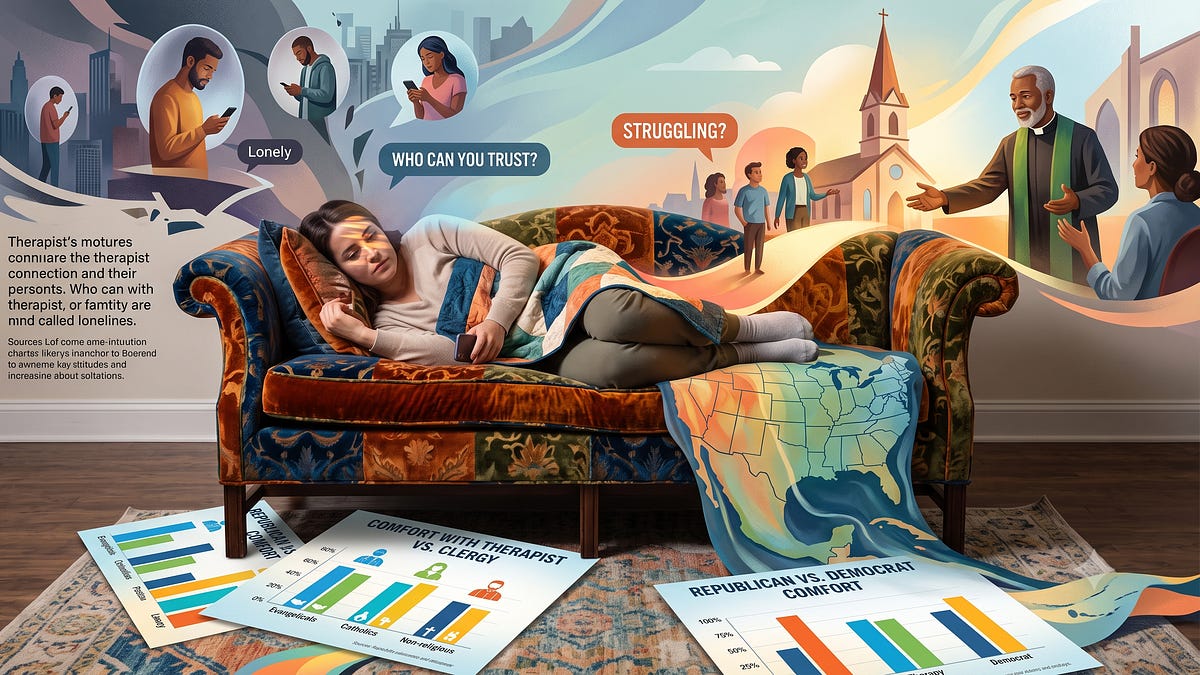
But it left me with a question: who can people actually talk to in an open and honest way? I’ve got some data from Pew that speaks directly to this. It’s a simple battery of questions from American Trends Panel 142, hosted on the ARDA. The preamble is straightforward: “How comfortable would you be talking about your mental health and emotional well-being with each of the following?” Then respondents rated several options:
Let’s start with the share of each religious group who said they were extremely or very comfortable talking about their mental health with each of those individuals.
One thing that is crystal clear from this data is that people truly rely on their spouses or partners when it comes to being honest and open about what’s happening in their lives. Among every religious group, the spouse scores the highest, often by a wide margin. The response levels are remarkably consistent, too: most are within a few points of 80%. An interesting outlier is the LDS community—nearly 90% say they are very or extremely comfortable sharing mental health issues with their spouse.
The other groups follow a consistent rank ordering. Close friends, mental health therapists, and immediate family members all rank similarly, typically in the 50-60% range for most religious traditions. At the bottom are co-workers and neighbors, who score poorly; people generally aren’t willing to be vulnerable around them.
But there was one blip in the data worth digging into: the responses regarding comfort levels with religious or spiritual leaders. For most respondents, this doesn’t rank high. Only about a third of non-evangelical Protestants, Catholics, and LDS members feel very or extremely comfortable speaking with their pastor about their struggles. But for evangelicals, that number jumps to 56%—putting clergy in the same neighborhood as immediate family or close friends.
That outlier led me to compare two specific options: speaking with a mental health therapist versus a member of the clergy. I wondered if certain religious groups favored one over the other. The graph below explores that comparison.