// NASA BREAKING NEWS — SPAZIO & SCIENZA
NASA’s Webb Reveals Dynamic Panorama of Star Formation
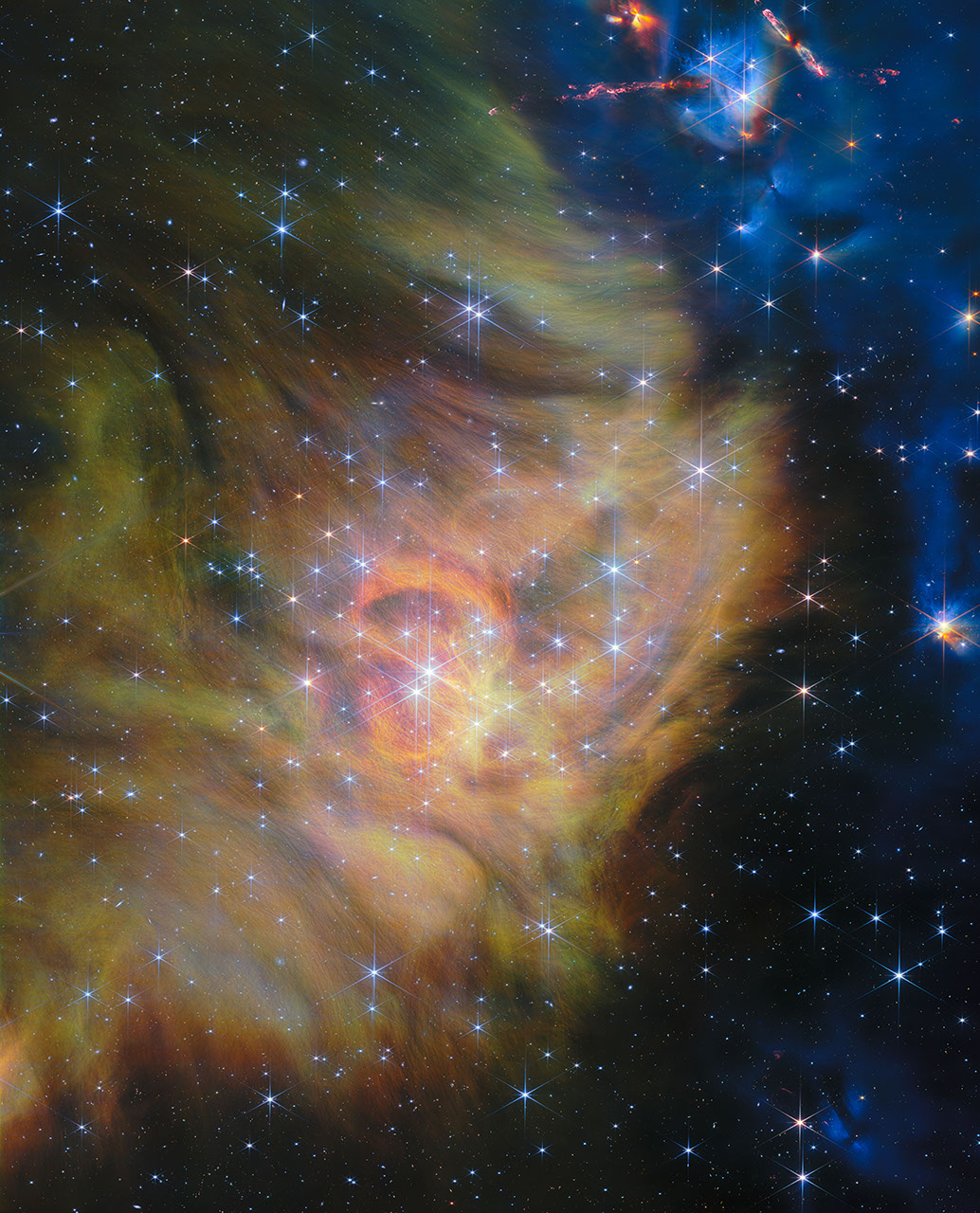
This starry view of the nearby star-forming region IC 348 is one of the largest images released to date from NASA’s James Webb Space Telescope. Using Webb, astronomers searched IC 348 for brown dwarfs, which are less massive than the smallest stars. The researchers discovered brown dwarfs just twice the mass of Jupiter, bringing the study of these curious objects into a new mass range and revealing new insights about the star formation process.
The star-forming region IC 348 is located just 1,000 light-years away in the constellation Perseus. In regions like IC 348, cold clouds of molecular hydrogen gas collapse to form new stars, creating glowing, sculpted scenes like this one. The star-formation process can create widely varied objects, from massive stars that expire after only a few million years in core-collapse supernova explosions to the smallest and most common stars, which are long lived and produce powerful stellar storms.
The smallest stars weigh in at around 8 percent of the Sun’s mass. Below this mass lies a strange class of objects called brown dwarfs. Brown dwarfs form in the same way stars do, through the collapse of molecular clouds. However, unlike stars, the cores of brown dwarfs never become hot enough to fuse ordinary hydrogen into helium (though many briefly fuse deuterium, or heavy hydrogen, early in their lives).
What’s still not clear, and what researchers hoped to learn by using Webb’s sensitive instruments to study IC 348, is how small the smallest objects created by the star-formation process are. In other words, how small is the smallest brown dwarf?
Researchers seeking to answer this question first used Webb to study IC 348 in 2022, when they discovered brown dwarfs with masses as low as three to four times the mass of Jupiter. Now, the same research team has used Webb to probe even deeper into this region in search of even smaller brown dwarfs.
The team used Webb’s NIRCam (Near-Infrared Camera) in 2024 to capture the warm glow of young brown dwarfs and newborn stars seen in this new image of IC 348. After selecting candidate brown dwarfs based on their colors and brightness, they followed up with Webb’s NIRSpec (Near-Infrared Spectrograph) in 2025 to conduct spectroscopic observations to study the masses of the brown dwarfs.
These deep Webb observations revealed something remarkable to the researchers: brown dwarfs with masses as low as just twice the mass of Jupiter or only 0.19 percent of the Sun’s mass — far smaller than theory predicts brown dwarfs should be. These are the least massive brown dwarfs known and their existence poses a challenge to models of how stars form.
In addition to the discovery of these unexpectedly lightweight brown dwarfs, the Webb observations contained even more surprises. One of the lightest newfound brown dwarfs showed signs of a disk, suggesting that small planets could be forming around an object that is itself only the mass of a planet.
While inspecting the spectra of IC 348’s brown dwarfs, the research team also found a feature they attributed to an unidentified hydrocarbon — molecules made only of hydrogen and carbon atoms. This specific feature has only been seen in the atmospheres of the lowest-mass brown dwarfs, suggesting that these extreme objects might exist in a spectral class of their own.
The stars and brown dwarfs of IC 348 aren’t the only attractions in this image. A brilliantly detailed collection of protostars occupies the upper right corner. Several of these protostars are accompanied by Herbig-Haro objects, which are luminous regions that form when jets from growing newborn stars crash into the gas and dust around the star.