// NATURE NEWS — SPAZIO & SCIENZA
These bizarre, much-coveted microbes are revealing the origins of complex life
Elizabeth Quill is a freelance writer based near Washington DC.
Search author on:
PubMed
Google Scholar
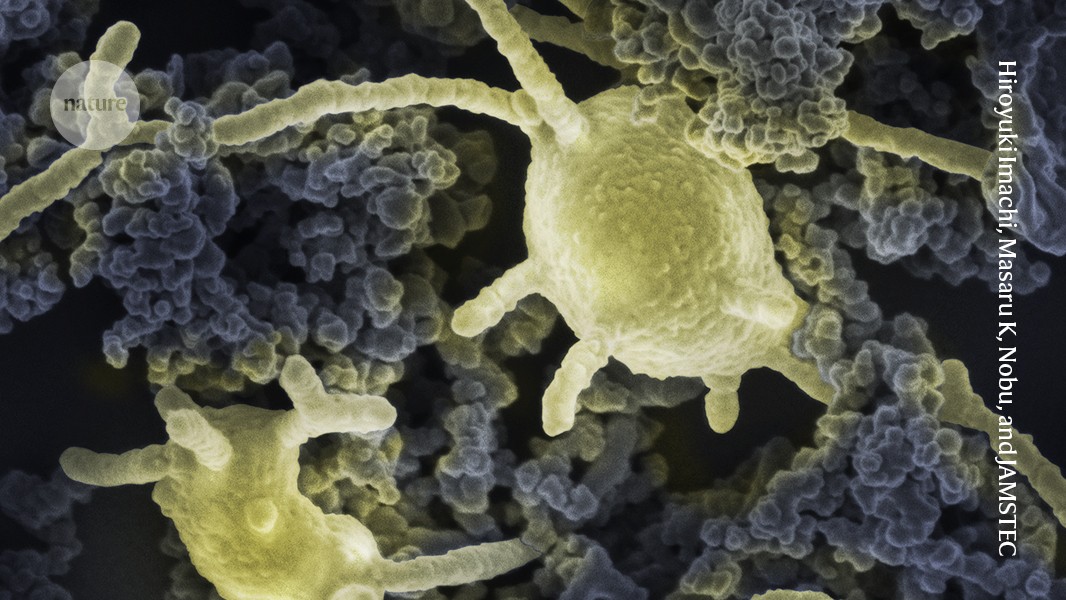
By culturing Asgard archaea, researchers can observe their remarkable features. Credit: Hiroyuki Imachi, Masaru K, Nobu, and JAMSTEC
Over two days in June, Emily Aguilar-Pine drove 2,500 kilometres from Bozeman, Montana, to Austin, Texas, with one of microbiology’s most coveted organisms in the back of her mother’s SUV. Inside some protective packaging, labelled ‘hopes and dreams’, was a small bottle containing about 30 millilitres of what looked like clear liquid, but that in fact held a type of Asgard archaeon, single-celled organisms named after the realm of the Norse gods. At night, ‘Skadi’, short for what is provisionally called Skadiarchaeum cthulhuensis, hung out in the hotel room with Aguilar-Pine. “It was with me at all times,” she says.
The trickster microbes that are shaking up the tree of life
Researchers discovered Asgard archaea in 2015 from DNA in sediments plucked from the bottom of the North Atlantic1. The find changed scientists’ views on the origin of eukaryotes — the complex life forms that include everything from protists to plants, animals and fungi. Researchers knew that eukaryotes had emerged from prokaryotes, single-celled organisms that include bacteria and archaea, and the evidence strongly suggested a close relationship with archaea. But analysis of the Asgard genomes has since pointed to these archaea specifically as the ancestral line of all eukaryotes. Most researchers who study the issue now consider there to be only two domains of life on the planet; eukaryotes are but a branch of archaea and everything else is bacteria.
What’s known about Asgard archaea has come mostly from their DNA. Scientists have been sequencing all the genetic material that they can find in environmental samples and piecing together the microbial genomes within. Although hundreds of Asgard species have been identified in this way2 from a variety of ecosystems around the world, the microorganisms are present in such low abundance that it is difficult to isolate them for study. But researchers who have persisted are now establishing relatively stable cultures — with enough Asgard cells that they can be seen under a microscope.
The Asgard Nerearchaeum marumarumayae.Credit: Dr Matthew D Johnson, Dr Bindusmita Paul and Associate Professor Debnath Ghosal
The first cultures were reported3,4 in 2020 and 2022, with four more announced5–7 since the start of 2025. There are at least a few more that have not yet appeared in the literature, including Skadi, which Aguilar-Pine learnt to care for from a PhD student, Stavros Trimmer, at Montana State University in Bozeman before taking samples back with her to the University of Texas at Austin. And researchers are working on more Asgard archaea, encouraging the fickle, slow-growing cells to proliferate, often over the course of several years. The pay-off is worth it, they say.
“Asgard are by far the coolest thing to happen to microbiology in the last 30 to 40 years,” says microbiologist Paul Carini at the University of Arizona in Tucson, whose laboratory is working with an unpublished culture that originated in an estuarine environment in Oregon. Scientists are now studying the surprising shapes, features and behaviours of these cells — and are turning up clues about what made the transition to complex life possible.