// NATURE NEWS — SPAZIO & SCIENZA
Continuous-wave laser absorption spectroscopy of the thorium-229 nucleus
Nature
volume 657, pages 626–631 (2026) Cite this article
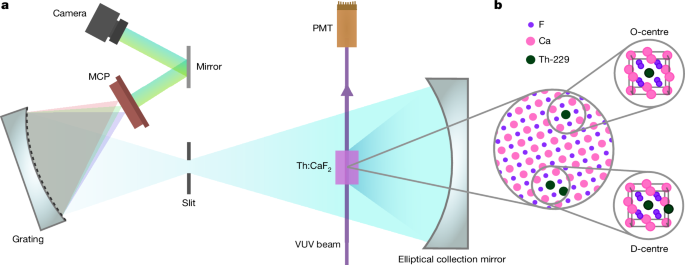
The low-energy nuclear transition in thorium-229 (Th-229) has been excited in thorium-doped crystals with laser light1,2,3, opening the path towards a highly stable and robust solid-state optical nuclear clock4. The required laser radiation at 148-nm wavelength has so far been produced using pulsed laser systems, in which only a small fraction of the incident photons has been resonant with the narrow nuclear transition. Here we show that the nucleus can be excited with a continuous-wave (CW), narrow-bandwidth, solid-state laser source5 at sub-nanowatt power and that the nuclear resonance signal can be detected in absorption rather than fluorescence. This eliminates the slow nuclear fluorescence decay from the detection process, allowing for clock operation with fast signal acquisition. We characterize two different thorium centres in a calcium fluoride (CaF2) crystal and measure the isomeric shift between them. One of the centres shows a very small static electric crystal field gradient <0.1 V Å−2 compared with gradients in the range of 100 V Å−2 observed previously3,6. This indicates a centre with high symmetry of the ions surrounding the thorium nucleus, promising nuclear resonance lines that are nearly independent of the lattice spacing.
The 8.4-eV low-energy nuclear transition of Th-229 is investigated for the application as an optical nuclear clock of very high accuracy and stability1,2,3,4,6,7,8. The nuclear resonance may be examined with thorium ions in an ion trap in vacuum or inside a transparent crystal. In solids, Th-229 becomes a test case for laser Mössbauer spectroscopy that is sensitive to the interaction between the nucleus and its environment3,6. In the first experiments on laser excitation of Th-229, the required coherent vacuum ultraviolet (VUV) radiation at 148-nm wavelength was generated using four-wave mixing (FWM)1,2,6,9 or high-harmonic generation (HHG)3 of pulsed laser sources. In these experiments, only a small fraction of the VUV photons were in resonance with the thorium nuclei.
For the sources based on FWM, the spectral width was several orders of magnitude wider than the nuclear linewidth in the host crystals used1,2,6. For the HHG source using a femtosecond frequency comb, the crystal-field-broadened nuclear linewidth in the range 10–100 kHz was well resolved10, but on the order of 105 non-resonant comb modes were present, whereas only a single mode contributed to the signal3,10. Laser excitation was detected by observing the nuclear fluorescence, slowly decaying with a time constant of about 600 s after blocking the radiation impinging on the crystal. Exploiting the full potential of a Th-229 solid-state nuclear clock requires a laser source with a linewidth comparable with the crystal-field-broadened linewidth and a fast, sensitive and robust detection method. These requirements can be fulfilled with the use of a narrow-linewidth CW laser, which—in contrast to HHG—combines the full laser power within the nuclear transition and therefore enables direct laser absorption spectroscopy with much higher signal-to-noise ratio, as demonstrated in this work.
Coherent VUV light can be generated through frequency conversion of laser radiation starting at longer wavelengths. The task is complex because only a few nonlinear optical materials are transparent in the VUV spectral region and have the properties for phase-matched frequency conversion. Recently, two different CW laser sources at the nuclear resonance wavelength of Th-229 have been reported: an all-solid-state system based on three consecutive steps of second-harmonic generation (SHG)5 starting from an infrared diode laser at 1,187 nm and a system based on FWM in cadmium vapour11. Although the FWM system produced about 100 times higher VUV power, the solid-state system is more compact and requires the frequency stabilization of only one single laser at a tech