// NATURE NEWS — SPAZIO & SCIENZA
Transcriptional activation of plant immunity by salicylic acid
Nature
(2026) Cite this article
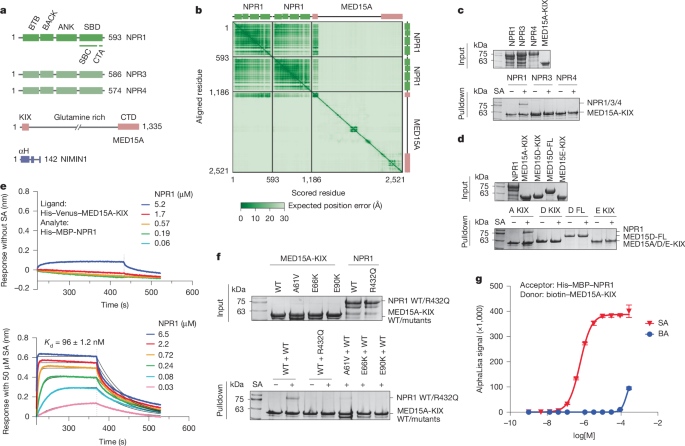
The plant defence hormone salicylic acid (SA) triggers systemic acquired resistance by signalling through its receptor, NON-EXPRESSOR OF PATHOGENESIS-RELATED GENE 1 (NPR1), leading to widespread transcriptional reprogramming1,2. However, the molecular mechanism by which NPR1 senses SA and activates transcription remains unresolved. Here we show that SA stabilizes the SA-binding domain (SBD) of NPR1 and allosterically promotes its interaction with MED15A, a subunit of the Mediator complex. Leveraging the NPR1 proxiome and AlphaFold structural predictions, we identify a direct interaction between NPR1 and the kinase-inducible domain interacting (KIX) domain of MED15A. We show that recombinant NPR1 recruits MED15A in an SA-dependent manner, and that MED15A binding reciprocally enhances the affinity of NPR1 for SA. Cryo-electron microscopy and hydrogen–deuterium exchange mass spectrometry reveal that SA and the MED15A KIX domain cooperatively potentiate NPR1-SBD for ternary complex formation by stabilizing its SA-binding core via separate interfaces. We further demonstrate that NIMIN1, a repressor of the SA–NPR1 pathway, antagonizes SA signalling by competing with MED15A for the same NPR1-SBD docking site and allosterically blocking hormone binding. In line with previous genetic evidence establishing a critical role of MED15A in SA signalling, our findings provide a mechanistic resolution to the longstanding question of how SA promotes transcriptional activation during plant immune responses.
Facing constant challenges from pathogens, plants have evolved sophisticated immune responses to defend against these threats3. SA is a plant defence hormone that accumulates both locally and systemically in response to pathogen infection and has a critical role in establishing systemic acquired resistance4,5,6. At elevated levels, SA induces the expression of numerous pathogenesis-related (PR) genes, orchestrating a comprehensive transcriptional reprogramming that is essential for effective disease resistance. Early genetic studies in Arabidopsis thaliana have identified NPR1 as the master positive regulator of SA-dependent immunity7,8,9. Loss-of-function npr1 mutants are SA insensitive and fail to mount PR gene expression, thereby suffering from increased susceptibility to pathogens. Recent biochemical studies have revealed that NPR1, along with its paralogues NPR3 and NPR4, directly senses SA and functions as a hormone receptor10,11,12. At the sequence level, the NPR proteins share an N-terminal broad-complex, tramtrack and bric-à-brac (BTB) dimerization domain followed by a BTB and carboxyl-terminal Kelch (BACK) domain, a central TGA-binding ankyrin (ANK) repeat domain and a C-terminal SBD13 (Fig. 1a). Despite their high sequence homology, these SA receptors control transcription via assumed opposing mechanisms. Although NPR1 positively promotes SA-induced expression of defence genes, NPR3 and NPR4 act as transcriptional repressors, whose repressive activity is relieved upon SA binding1,2.
a, Domain composition of A. thaliana NPR1, NPR3, NPR4, MED15A and NIMIN1. b, The AlphaFold predicted aligned error plot of the MED15A–NPR1 dimer interaction. c, Affinity pulldown assay assessing the SA-dependent binding of His–Venus-tagged NPR1, NPR3 and NPR4 to His–MBP-tagged MED15A-KIX. d, Affinity pulldown assay assessing the interaction between His–Venus-tagged NPR1 and the KIX domain of MED15 paralogues as well as the full-length MED15D (MED15D-FL) that are fused with His–MBP. e, Biolayer interferometry assay assessing the NPR1–MED15A-KIX interaction in the absence and presence of SA. His–Venus–MED15A-KIX was immobilized on Venus nanobody-coated streptavidin probes. The black curves are the fitting curves. The vertical dashed lines are the shift time points from association to dissociation. Kd, dissociation constant. f, Affinity pulldown assay assessing the effect of mis-sense mutation