// NATURE NEWS — SPAZIO & SCIENZA
Heterogeneous photonic integration of single-crystalline nanomembranes
Nature
volume 657, pages 638–645 (2026) Cite this article
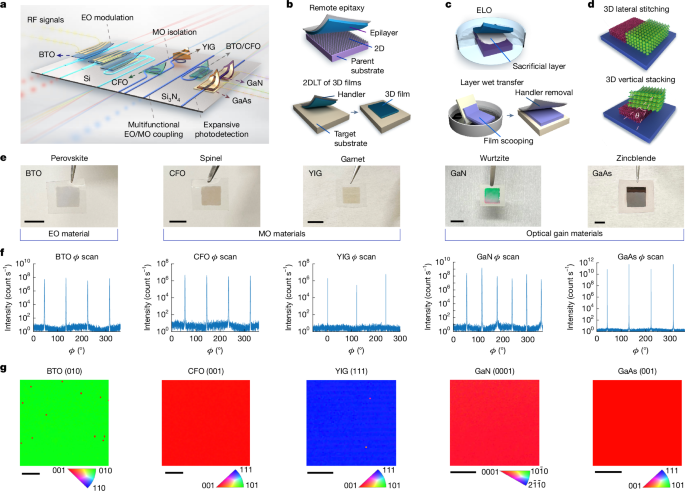
Despite the growing maturity of silicon (Si) and silicon nitride (SiN) for integrated photonics, a single material platform is unable to meet the diversifying requirements posed for photonic integrated circuits1,2. Essential optical functionalities can be attained by the heterogeneous integration of functional materials into established photonic platforms3,4. However, stringent lattice-matching constraints severely hinder the quality of heteroepitaxial material grown on dissimilar optical substrates5. Here we obviate this limitation by exploiting free-standing single-crystalline nanomembranes enabled by advanced epitaxy and layer lift-off techniques6,7,8,9. We present a versatile framework making use of photonic van der Waals (vdW) integration10 to infuse desired functionalities into Si and SiN photonics. By transferring single-crystalline thin-film barium titanate (BTO) to Si chips, we experimentally demonstrate ultraefficient electro-optical modulation, with a large Pockels coefficient r42 over 1,290 pm V−1 and a 3-dB electro-optical bandwidth of more than 23 GHz, enabled by well-defined BTO crystallographic orientation and quality. We also report ultracompact non-reciprocal magneto-optical isolators by vdW integration of cobalt ferrite (CFO) nanomembranes into Si microrings, with a Faraday rotation coefficient θF of 33,800° cm−1. To exemplify the capability of coalescing diverse functional materials into arbitrary photonic templates, we laterally stitch gallium arsenide (GaAs)11,12 and gallium nitride (GaN) single crystals13,14 on top of SiN photonics to realize expansive photodetection from ultraviolet to near-infrared wavelengths15. Multifunctional ring resonators for simultaneous electro-optical and magneto-optical modulations are also demonstrated by constructing vertical CFO/BTO heterostructures16,17, leading to new opportunities for advanced hetero-integrated optoelectronic applications and beyond.
This is a preview of subscription content, access via your institution
Access Nature and 54 other Nature Portfolio journals
Get Nature+, our best-value online-access subscription
Prices may be subject to local taxes which are calculated during checkout
Source data are provided with this paper. 3D schematic illustrations in Fig. 1 were created by Autodesk 3ds Max. Experimental data were plotted using MATLAB (MathWorks Inc.). Further data that support the findings of this study included in the main text and Supplementary Information are available from the corresponding authors on request.
Riemensberger, J. et al. A photonic integrated continuous-travelling-wave parametric amplifier. Nature 612, 56–61 (2022).
Article
ADS
CAS
PubMed
Google Scholar
Tran, M. et al. Extending the spectrum of fully integrated photonics. Nature 610, 54–60 (2022).