// NATURE NEWS — SPAZIO & SCIENZA
A methanogen hydrolase reveals the structure of archaeal peptidoglycan
Nature
(2026) Cite this article
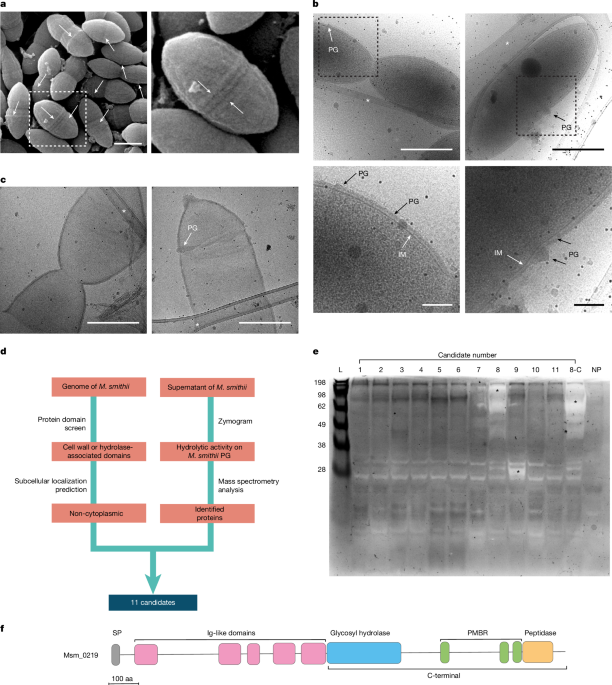
Peptidoglycan (PG) is a near-universal and essential feature of bacterial cell walls and a major antimicrobial target1. Although archaea generally lack PG2, a PG-like polymer (pseudomurein or archaeal PG) was described decades ago in a major clade of methanogenic archaea3,4,5,6,7,8, yet it has remained poorly characterized, owing to the lack of dedicated analytical tools. Here we identify and characterize ArmA from Methanobrevibacter smithii, a dominant member of the human gut microbiome9, as the first glycosyl hydrolase specific for archaeal PG. ArmA-mediated digestion reveals an unexpected architecture that revises the prevailing model of archaeal PG. The glycan backbone comprises N-acetylglucosamine/N-acetylgalactosamine linked to a previously undescribed sugar, which we name N-acetylarmosamine. Glycan strands alternate β(1,4) and β(1,3) linkages, and the stem peptide is attached by means of an amide bond to the N-acetylarmosamine succinyl group. ArmA has dual enzymatic activity, cleaving both glycosidic linkages and peptide crosslinks. Phylogenetic analyses show that ArmA homologues are restricted to PG-bearing archaea, and we confirm activity across diverse methanogens. We further demonstrate that ArmA is required to complete cytokinesis, cleaving archaeal PG at the site of cell division. Together, these findings overturn a 50-year-old paradigm on archaeal PG structure and establish ArmA as a critical tool that parallels the impact of muramidases in bacteria, enabling biochemical and genetic interrogation of methanogen cell-wall biology. Finally, given the ecological and biotechnological importance of methanogens10,11, our results open new avenues for targeted intervention.
This is a preview of subscription content, access via your institution
Access Nature and 54 other Nature Portfolio journals
Get Nature+, our best-value online-access subscription
Prices may be subject to local taxes which are calculated during checkout
All data supporting the findings are available within the main paper and its Supplementary Information. The MS proteomics data have been deposited to the ProteomeXchange Consortium through the PRIDE partner repository with the dataset identifier PXD052257. Raw data of LC–MS/MS analysis of arcPG digest are available from the University of California, San Diego at ftp://massive-ftp.ucsd.edu/v13/MSV000102506/. Raw data used to make Extended Data Fig. 6 are provided as Source data. Source data are provided with this paper.
Vollmer, W., Blanot, D. & De Pedro, M. A. Peptidoglycan structure and architecture. FEMS Microbiol. Rev. 32, 149–167 (2008).
Article
CAS
PubMed
Google Scholar
Albers, S.-V. & Meyer, B. H. The archaeal cell envelope. Nat. Rev. Microbiol. 9, 414–426 (2011).