// NATURE NEWS — SPAZIO & SCIENZA
Daily briefing: The mystery of the ‘little red dots’
Search author on:
PubMed
Google Scholar
Hello Nature readers, would you like to get this Briefing in your inbox free every day? Sign up here.
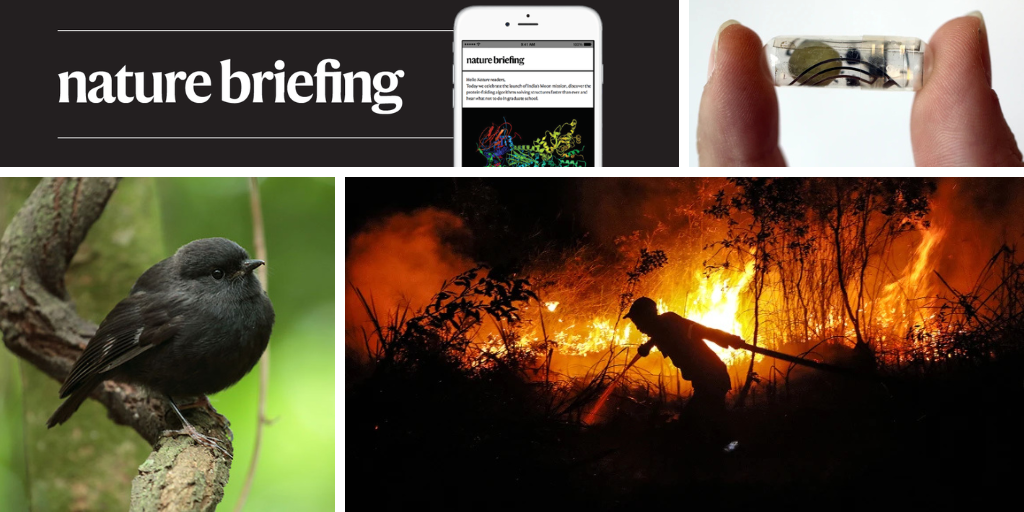
This ingestible capsule, tested in pigs, contains a biodegradable paper battery (large brown circular structure) and a radio-frequency identification (RFID) tag (black lines).Credit: Mehmet Say
A battery made with a substance similar to edible rice paper can power ingestible medical devices, and breaks down into materials that can be absorbed by the body after use. The tiny power source uses electrodes made of magnesium and molybdenum trioxide — two micronutrients that the body needs in small amounts — and a biodegradable ionic liquid as an electrolyte. The battery has so far been tested in pigs, with the hope that it could one day be used to provide electricity for ingestible personalized devices in people.
A treatment that adds chemical tags to the genome of the hepatitis B virus (HBV) can shut down the virus’s gene activity and prevent it from producing viral particles. The therapy, which achieved promising results in experiments on human liver cells and in mice, could be used to treat chronic hepatitis B, a lingering liver infection that affects more than 250 million people worldwide. A clinical trial to test the treatment in people is already under way, with the first participant receiving an intravenous infusion in January this year.
Researchers have recorded a rare instance of a food-stealing behaviour called kleptoparasitism in a common bottlenose dolphin (Tursiops truncatus). The team filmed the dolphin, known as Bubbles, repeatedly chasing individual bigeye trevally fish (Caranx sexfasciatus) until they threw up — and then eating the vomit. Bubbles might have originally intended to eat the fish, but decided that the vomit was an easier meal, says marine ecologist and study co-author Asia Armstrong. Or, it might have wanted the sick all along, since trevally are large and would be tough for a dolphin to chew.
New Zealand’s Bird of the Year is the karure, or black robin (Petroica traversi), and you can see why: this little creature is small, dark and handsome. This tenacious species has bounced back from just five birds in 1980 — only one of which was a fertile female — to 350 adults living on two islands free of invasive pests. Hats off to Old Blue, mother of her kind. (CNN | 5 min read) (Dave Boyle)
“A serious El Niño caught the world off guard in 1982, when reliable early-warning systems barely existed,” writes climate scientist Zeke Hausfather, who maintains a real-time dashboard that includes data about the weather event. “In 2026, there is no such excuse.” Governments have only a few weeks to act to prepare, for example, for drought in southern Africa. Priorities include distributing drought-tolerant and early-maturing crop varieties in high-risk areas and expanding programmes that provide support when harvests fail.
A study of people who lived their early life during post-war sugar rationing in the United Kingdom found that they had lower risks of all-cause dementia, Alzheimer’s disease, depression and anxiety than people born after rationing ended. A separate study found they were much less likely to develop certain cancers later in life. Even in adulthood, low-sugar babies continued to consume less sugar and had healthier diets overall. “This suggests that the level of sweetness people are exposed to very early in life may shape their taste preferences for a long time,” says economist Weilong Zhang, who co-authored the latter study.
People | 4 min read & The Conversation | 6 min read