// NATURE NEWS — SPAZIO & SCIENZA
Nepal’s floods expose issues with climate-disaster funding — firmer policies are needed fast
Uttam Babu Shrestha is director of the Global Institute for Interdisciplinary Studies, Kathmandu, Nepal.
Search author on:
PubMed
Google Scholar
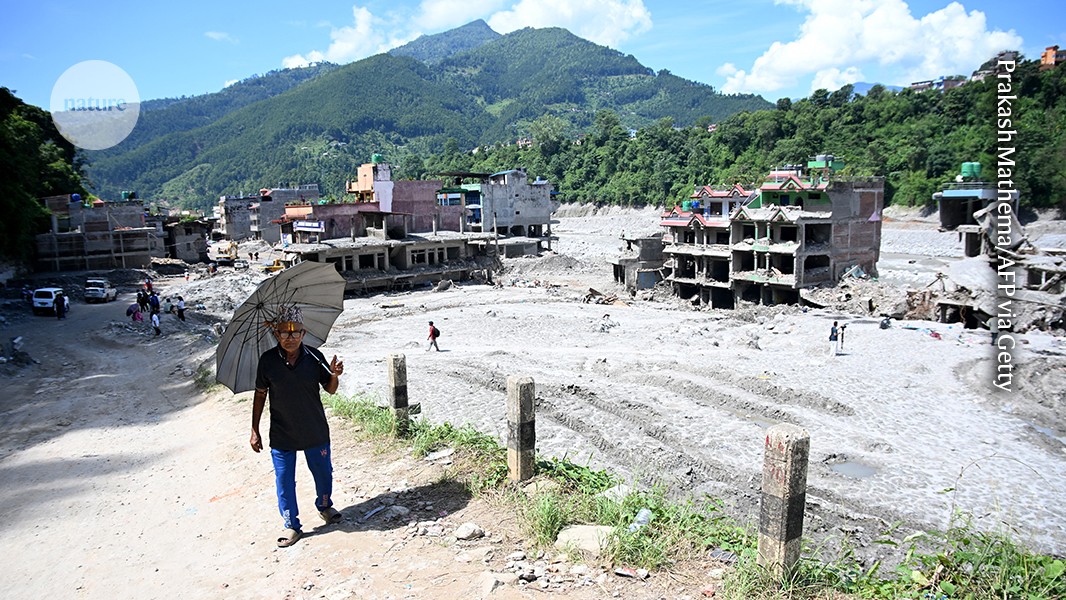
Flash floods in Nepal — triggered by a glacial collapse — have caused devastating damage.Credit: Prakash Mathema/AFP via Getty
On 26 August, a ‘tsunami’ of water, mud and boulders swept through the Rasuwa region of Nepal, killing more than 1,400 people and leaving about 6,000 more missing. The government estimates that reconstruction will cost almost US$5 billion — roughly 10% of Nepal’s gross domestic product.
The question now, as the nation starts to rebuild, is where that money will come from. It’s too much to be borne by one small country, especially because Nepal has contributed only 0.01% of global carbon emissions. The Rasuwa disaster marks the first big operational test for the United Nations’ Fund for responding to Loss and Damage, intended to help countries that are vulnerable to climate change to cover the costs of the resulting loss of jobs, lives and infrastructure.
One month on from the disaster, an arrangement for Nepal has yet to be made. Five days after the floods, Nepal’s government formally asked the fund for urgent financial support. It responded that Nepal’s request would be approached with “urgency, compassion, and careful consideration”. But no further announcement has been forthcoming.
Established in 2022, the loss and damage fund is in its infancy but this slow response is concerning. One of the fund’s main roles is to provide finance quickly to support humanitarian action in emergencies. Yet, it currently has no rapid-access pathway through which a country can apply for funding outside scheduled application windows.
What’s more, the fund has not yet laid out a framework for how it will weigh up the role of climate change in any disaster, and how that might affect funding decisions. That needs to be addressed urgently before another catastrophe ensues.
As an environmental scientist, I have spent more than 20 years studying change in the Himalayas. I know how important it is for countries such as Nepal to obtain climate finance quickly and fairly when disaster strikes. Rasuwa must set a precedent for future emergencies.
The fund should take two steps in response to the disaster in Nepal. First, it should provide an immediate emergency allocation to cover the costs of urgent humanitarian actions and essential services. This could be decided using a streamlined assessment of need and vulnerability; established evidence already shows that global warming played a part in the risk of this disaster. Second, within a few years, on the basis of a more-extensive assessment, it should provide finance for reconstruction and long-term recovery.