// NATURE NEWS — SPAZIO & SCIENZA
Stephen Hawking biography explores an ‘exceptionally clear, uncluttered mind’
Neil Turok is the Higgs Chair of Theoretical Physics at the University of Edinburgh, UK.
Search author on:
PubMed
Google Scholar
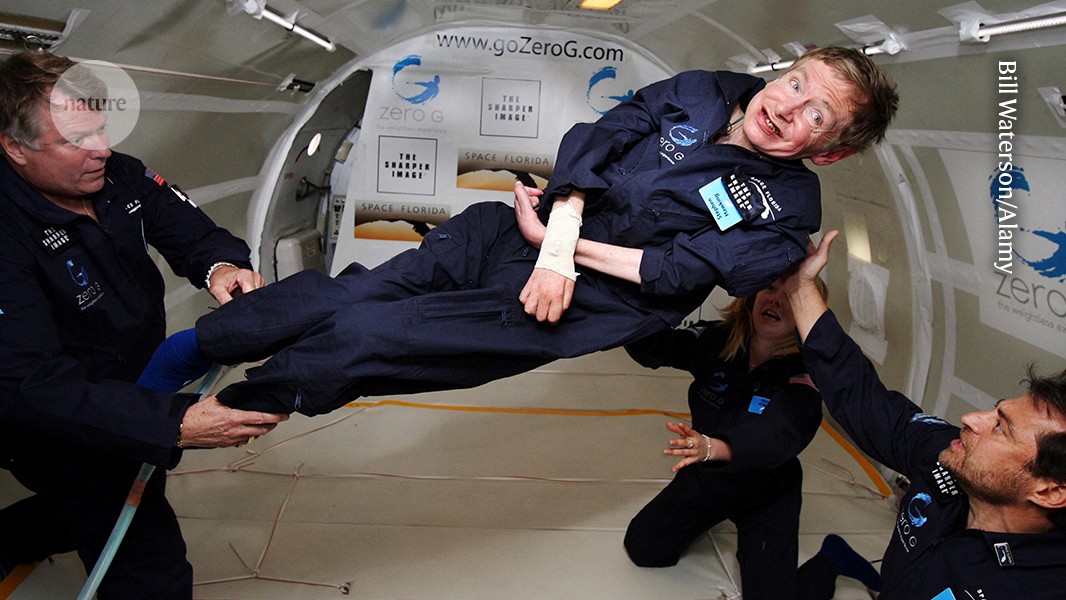
Stephen Hawking (centre) experiencing zero gravity during a test flight. Credit Bill Waterson/Alamy
Hawking: His Life and Work Graham Farmelo John Murray (2026)
Stephen Hawking was an extraordinary person. The mathematical physicist who transformed our theories of gravity, black holes and the Universe overcame serious physical disability to become one of the most influential scientists of the twentieth century. Despite having to speak through a computer, he was one of the world’s most famous science communicators.
Although the theories that Hawking developed have yet to be verified empirically, the questions he asked and the methods he used still set the agenda in physics. Moreover, his courage and concern for humanity made him an icon for people struggling against adversity.
Graham Farmelo’s meticulously researched and highly readable biography of Hawking is dedicated to “anyone thinking of giving up on life”. It tells the fascinating story of how Hawking surmounted his physical limits to make groundbreaking contributions to science and then popularize them. His sociable character, sense of humour and ability to forge friendships — which were all central to his success — are well described in the book.
Hawking’s insights and determination remain an inspiration for many people who knew him. I was fortunate to become a close friend in 1996, when I worked alongside him at the University of Cambridge, UK, and like many others benefited from his warm and generous spirit.
How Stephen Hawking flip-flopped on whether the Universe has a beginning
Farmelo’s book captures Hawking’s deep commitment to his students and colleagues — how kind and supportive he was to them and how they helped him in return. It also provides a balanced account of the many ups and downs in Hawking’s life, including the break-up of his two marriages and the constant danger he lived in because of his fragile health. Just as he started his PhD and felt he had found his life’s calling, he was diagnosed with motor neuron disease and given two or three years to live. In the end, he defied the odds and lived to 76 years old.