// NATURE NEWS — SPAZIO & SCIENZA
Restoring hearing in people with a rare form of deafness
Laurie Udesky is a freelance journalist in San Francisco, California.
Search author on:
PubMed
Google Scholar
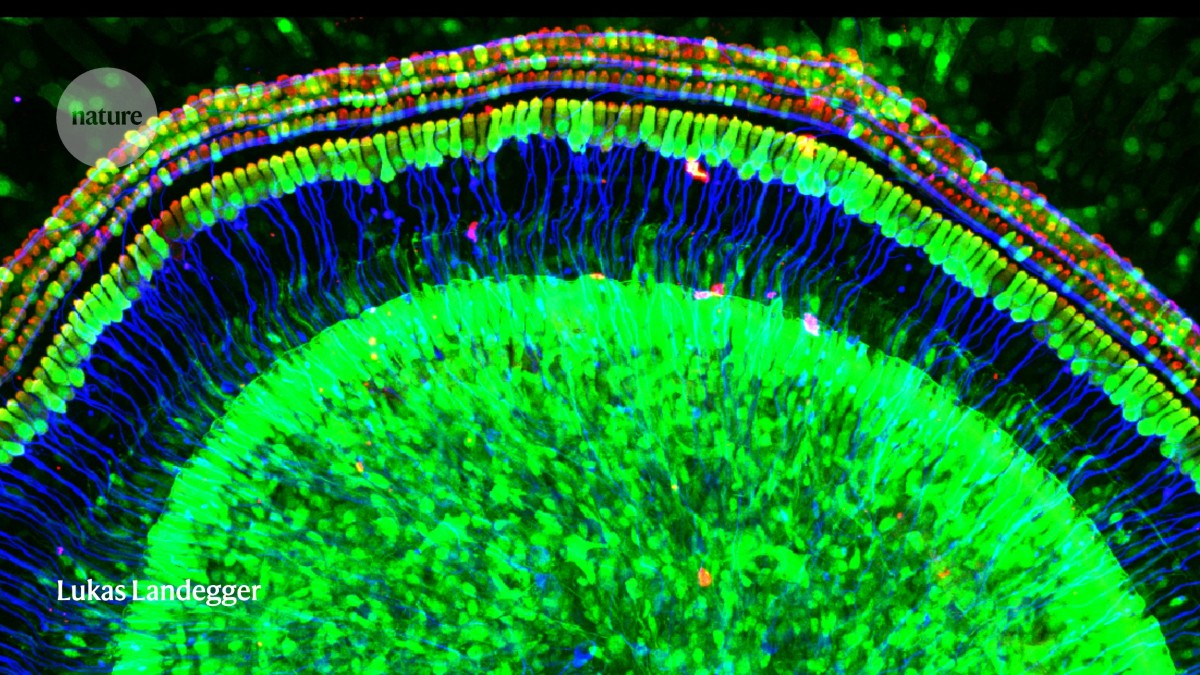
A confocal microscopy image of cochlear tissue from the inner ear shows cells successfully transduced by the viral vector Anc80L65, which carries a fluorescent marker that glows green.Credit: Lukas Landegger
This form of deafness is caused by a mutation in the otoferlin gene (OTOF), which encodes a protein that is crucial for transmitting sound signals in the inner ear to the auditory nerve for processing. One in 500 babies is born with congenital hearing loss and, of those, between 1% and 8% have OTOF-associated hearing impairment. (Nature acknowledges that many Deaf people do not consider the condition to be a disability that requires a cure, and that individuals often identify as being a part of Deaf culture.)
Earlier in 2025, the boy was one of 24 participants, all aged between 10 months and 16 years, in the CHORD clinical trial1. The ongoing study seeks to test the effectiveness and safety of Otarmeni, a gene therapy designed to deliver a functional copy of the OTOF gene to hair cells in the inner ear.
During the trial, half of the participants received a single infusion of Otarmeni, delivered through surgery into one ear, and the other half received a one-time dose in both ears. Around 80% experienced improved hearing within 24 weeks of receiving the gene therapy. Forty-two per cent have since regained their hearing.
In April this year, Otarmeni became the first gene therapy for hearing loss to be approved by the US Food and Drug Administration (FDA). Before this, the last major breakthrough for people with the condition was the cochlear implant, a microchip that can restore hearing, which was approved by the FDA for children aged 12 months and over in 2000.
Otarmeni, made by US-based Regeneron Pharmaceuticals, is one of several gene therapies for OTOF-associated hearing impairment — although some are still in development. Akouos, a US precision-medicine company owned by the drug maker Eli Lilly, has started an early-phase clinical trial to test an OTOF gene therapy, as have both the French drug maker Sensorion and Shanghai Refreshgene Therapeutics in China, the latter with the aid of government funding.
Why has this form of congenital deafness attracted so much attention? OTOF is one of more than 150 genes tied to non-syndromic genetic hearing loss — deafness that occurs independently of a broader syndrome. According to Dylan Chan, a paediatric otolaryngologist at the University of California, San Francisco, OTOF is a relatively low-hanging fruit for treatment.
“This is a unique situation in hearing loss, where everything in the ear is formed normally, everything functions normally, except there’s one missing protein that makes the synaptic transmission not function,” says Chan. “It’s a huge breakthrough because we’ve never been able to treat the inner ear before.”