// NATURE NEWS — SPAZIO & SCIENZA
Prion-like transmission of human tau strains in the mouse brain
Nature
(2026) Cite this article
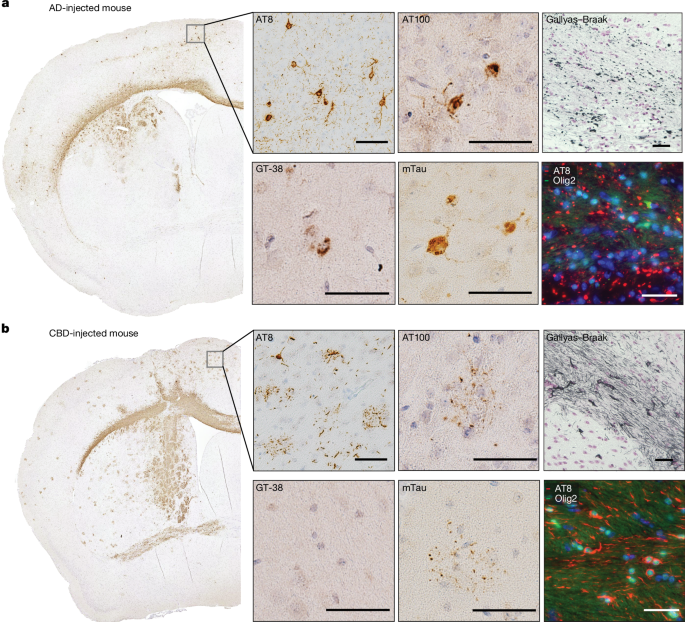
Most neurodegenerative diseases are thought to spread through the brain by prion-like mechanisms, in which filamentous protein assemblies self-propagate by templated seeding1. Distinct conformations of amyloid filaments may provide the physical basis for the strains that lead to different diseases2. However, a central pillar of the prion hypothesis, that strains retain their structural identity upon transmission, has not been demonstrated. Here we show that the injection of tau filaments from the brains of individuals with Alzheimer’s disease or corticobasal degeneration into the brains of wild-type mice leads to the seeded assembly of amyloid filaments made of mouse tau with the same structures as those of the seeds. Thus, we show that, similar to prion strains, tau filaments propagate through templated seeding, and that the mouse is a suitable model to study the molecular mechanisms by which distinct tau folds drive disease-specific pathology in the brain.
Misfolded filamentous aggregates of the prion protein cause neurodegeneration in diseases such as kuru, Creutzfeldt–Jakob disease (CJD), variant CJD, bovine spongiform encephalopathy, chronic wasting disease and scrapie3,4. Misfolded prion protein assemblies are believed to self-propagate by templated seeding, by which small amounts of filaments induce the misfolding of the native prion protein into filaments with the same conformation. This ability to self-propagate underlies the prion spread within tissues, between individuals of a given species and, depending on the prion protein sequence similarity, between individuals of distinct species. Various misfolded conformations of the prion protein give rise to prion strains that lead to different incubation times, lesion profiles and clinical phenotypes. Cryo-electron microscopy (cryo-EM) structures of prion filaments have shown that distinct amyloid folds provide the physical basis for prion strains5,6,7,8,9.
More than 20 neurodegenerative diseases are defined by the filamentous assembly of hyperphosphorylated tau10. Most disease cases with abundant tau filaments are sporadic, with Alzheimer’s disease (AD) being the most common tauopathy. Mutations in MAPT, the gene encoding tau, cause dominantly inherited forms of frontotemporal dementia with abundant tau inclusions, consistent with tau filament formation causing neurodegeneration. Cryo-EM structures of tau filaments from human brains have shown that distinct tau folds also characterize different diseases11 and that filaments with a single tau fold accumulate in the brains of individuals with a given tauopathy12. Moreover, small amounts of tau filaments can induce the assembly of normally disordered tau monomers into new filaments13,14.
Further support for the prion-like spreading of tau is provided by seeding animal models, in which tau filaments are injected into the mouse brain. Filaments are taken up by brain cells at the injection site, after which tau pathology spreads to distal regions, suggesting cell-to-cell propagation of tau filaments in the brain14,15,16,17,18,19. Seeding with human-brain-derived tau from different tauopathies recapitulates the cell-type-specific characteristics of those diseases15. Subsequent studies showed that these inclusions are robustly recapitulated in the wild-type mouse brain17,20,21 and in mice expressing all six human brain tau isoforms22. Moreover, the injection of AD tau seeds into mice with abundant amyloid-β plaques led to a marked enhancement of tau inclusions compared with injections into wild-type mice23. The injection of filaments assembled from recombinant tau into the brains of wild-type mice and of mice expressing all six human brain tau isoforms confirmed that tau filaments are the seeding species and showed that filaments with the AD-specific fold seed better than filaments with folds that have not been observed in human brains24.
However, it has so far no