// NATURE NEWS — SPAZIO & SCIENZA
Self-aligned optical microcomb emerging between octave-separated lasers
Nature
(2026) Cite this article
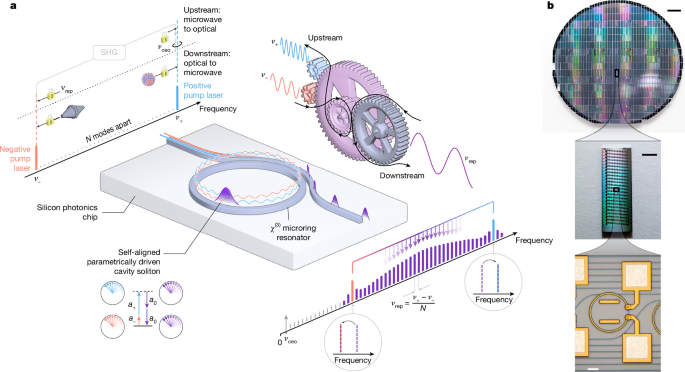
Optical frequency combs (OFCs) are frequency rulers essential for precision metrology, next-generation navigation and testing of fundamental physics1. Despite intense efforts, chip-integrated OFCs remain laboratory-bound, unable to fulfil their promise of compact and cost-effective deployment. Although improvements in fabrication and integration are important, a conceptual limitation has stymied progress: on-chip OFC architectures have aimed to miniaturize their table-top counterparts and relied on cascading outward from a single pump2,3. In integrated platforms, this approach does not readily generate the strong, low-noise, octave-spaced signals crucial for robust zero-frequency offset detection4. Here we overcome this limitation through an architectural inversion, in which an optical microcomb fills the spectrum between two octave-separated pumps. The two pumps generate a parametrically driven cavity soliton5 in an integrated χ(3) resonator6, which robustly self-aligns to both pumps across multiple foundry-fabricated devices and operating configurations. This produces a single octave-spanning comb from telecom to visible wavelengths, whose zero-frequency offset is defined by the harmonic offset of the pumps and can therefore be reliably detected and stabilized. We showcase the capabilities of our platform by executing all of the three core tasks of OFC metrology: optical frequency synthesis, low-noise millimetre-wave generation and integrated optical clock readout, using the same self-aligned microcomb with only its input locks changed.
This is a preview of subscription content, access via your institution
Access Nature and 54 other Nature Portfolio journals
Get Nature+, our best-value online-access subscription
Prices may be subject to local taxes which are calculated during checkout
The data that support the plots within this paper and other findings of this study are available from the corresponding authors upon request.
The simulation code used for the Lugiato–Lefever and thermal modelling presented in this work is available from the corresponding authors upon request.
Diddams, S. A., Vahala, K. & Udem, T. Optical frequency combs: coherently uniting the electromagnetic spectrum. Science 369, eaay3676 (2020).
Article
CAS
PubMed
Google Scholar