// NATURE NEWS — SPAZIO & SCIENZA
RNA catalysis emerges from dynamic structural ensembles
Nature
(2026) Cite this article
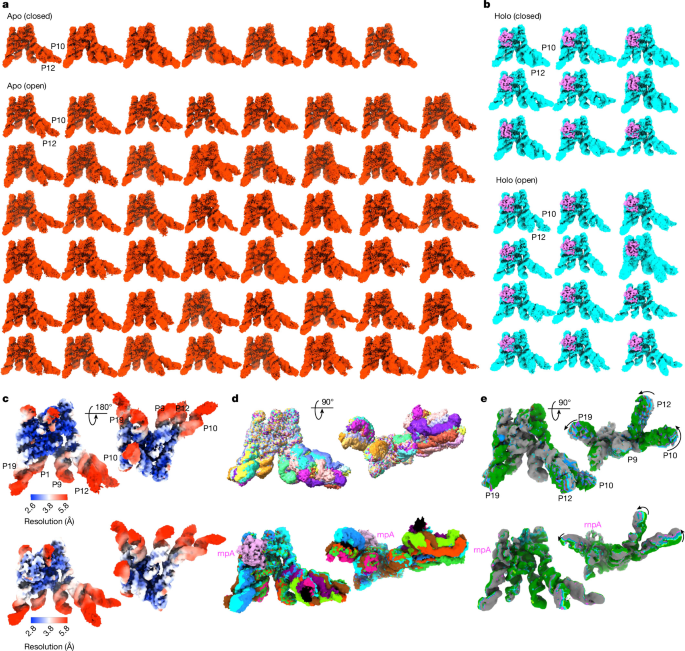
The dynamic interplay between RNA structure and its associated Mg2+ ions is central to RNA function yet remains poorly understood at a near-atomic level1,2,3,4. Here, using a heterogeneity-focused protocol for cryo-electron microscopy data analysis of conformationally flexible RNA particles, we determined the structures of RNase P RNA ensembles composed of 76 coexisting active and inactive conformers that differ in a transient tertiary interaction that is critical for activity. The binding of the accessory protein does not change the local structure but induces thermodynamic allostery that enhances catalysis by altering the dynamics of the tertiary interaction. Four distinct classes of Mg2+ ions have critical roles in the structure, dynamics and catalysis of the conformational ensembles. Together, these findings establish a new paradigm in which catalysis is regulated through multimodal communications coupled with the dynamics of RNA–Mg2+ conformational ensembles, rather than a single static catalytic structure in a single action mode.
RNA structure and dynamics are crucial to its function. Despite decades of development in structural biology, the structural dynamics of RNA and its associated Mg2+ ions have never been directly visualized at near-atomic resolution. High-resolution techniques, such as X-ray crystallography and cryo-electron microscopy (cryo-EM), have largely emphasized resolution over dynamics, averaging vast numbers of particles or molecules in lattices, often stabilized in non-physiological Mg2+ environments, to obtain a single consensus structure. The NMR approach largely relies on probabilistic inference models that satisfy measurements5,6,7. Conversely, computational methods describe atomistic motions using force fields that remain approximate, particularly in modelling electrostatic interactions and Mg2+ coordination8,9. As a result, the conformational ensembles of RNA and dynamics of Mg2+ ions in its native ionic conditions remain unresolved. Recent efforts to visualize RNA heterogeneity, including atomic force microscopy combined with machine learning (AFM–HORNET)10,11, have revealed the breadth of conformational sampling but not the distinct structures with associated Mg2+ ions, in the presence or absence of accessory proteins, at near-atomic resolution. Thus, the structural basis and mechanistic relationship between the conformational dynamics of all components and their functions or activities are unclear. In particular, Mg2+, a central determinant of RNA folding and catalysis, has been studied only in the context of static structures or through molecular dynamics simulations, and, to our knowledge, its dynamic trajectories within flexible RNA frameworks in the absence and presence of protein factors have not been experimentally mapped, so its roles in RNA conformational dynamics are poorly understood.
Cryo-EM is particularly well-suited for large protein assemblies with a large rigid structural core, but it also holds promise for exploring conformational dynamics12,13,14,15. Nevertheless, its full capability has yet to be demonstrated for the structure determination of highly heterogeneous RNA conformational landscapes that contain less populated but functionally important conformers. The bacterial Geobacillus stearothermophilus RNase P RNA (GstRPR) exemplifies this problem. It is an especially informative test case, because the RNA itself provides much of the structural scaffold. Accordingly, the conformational plasticity resolved here is likely to reflect intrinsic properties of the RNA scaffold that are more protein-constrained in other lineages. It has a specificity domain (S-domain) (residues 87–249) and a catalytic domain (C-domain) (residues 1–86 and 250–417). Although well-folded, more than 80% of its residues remain flexible under physiological Mg2+ concentrations11, and the mechanistic coupling between its conformational sampli