// NATURE NEWS — SPAZIO & SCIENZA
Hydrogen bonding in water under extreme confinement
Nature
(2026) Cite this article
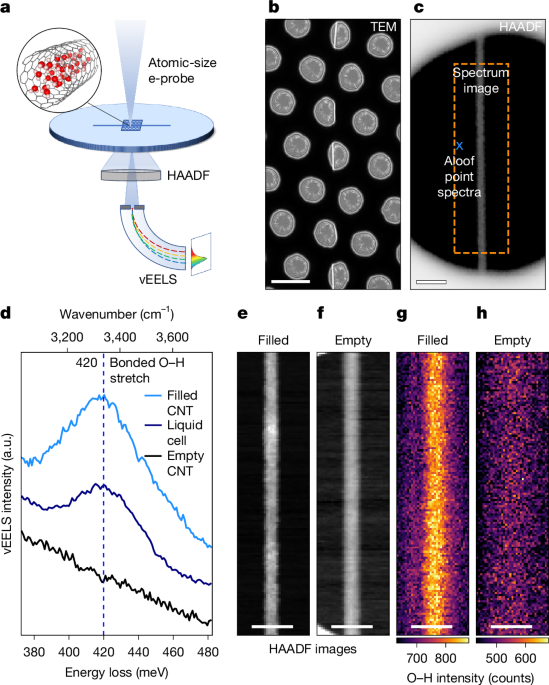
Fluids under extreme confinement or near interfaces exhibit molecular structures and intermolecular bonding distinct from their bulk analogues. Optical vibrational studies have shown that interfacial and confined water can exhibit altered intramolecular O–H stretching frequencies, a sensitive spectral signature of changes in intermolecular hydrogen bonding1,2,3,4. Investigating confined water experimentally at the length scale of intermolecular and surface forces has, however, remained a challenge. Here we report direct molecular-level observations of hydrogen bonding in water confined inside individual carbon nanotubes (CNTs), enabled by in situ vibrational electron energy loss spectroscopy (vEELS) with nanoscale resolution. Water in larger CNTs exhibits the bonded O–H vibrations of bulk water, but at smaller diameters, and the frequency blueshifts to near the free O–H stretch found in water vapour and water located near hydrophobic surfaces, indicating a highly dispersed, non-H-bonded environment. Theoretical analysis based on quantum vibrational oscillators links the observed spectral features to local hydrogen-bonding configurations, consistent with the experimental observation. Furthermore, cryogenic experiments provide insights into complex structural phase transitions of confined water. This research reveals the quantum and dynamic nature of hydrogen bonds under confinement and the potential impact of unveiling molecular-level structure and bonding in confined fluids.
This is a preview of subscription content, access via your institution
Access Nature and 54 other Nature Portfolio journals
Get Nature+, our best-value online-access subscription
Prices may be subject to local taxes which are calculated during checkout
The raw data examined in the figures in the main text have been made available at the following Zenodo repository: https://zenodo.org/records/20534179 (ref. 66). The Jupyter Notebooks used to process and visualize the figures in the main text have been made available at the following GitHub repository: https://github.com/hachteja/HydrogenBonding_MainTextFigures. All other codes and data are available on request from the corresponding authors.
Scatena, L. F., Brown, M. G. & Richmond, G. L. Water at hydrophobic surfaces: weak hydrogen bonding and strong orientation effects. Science 292, 908–912 (2001).
Article
ADS
CAS
PubMed
Google Scholar
Montenegro, A. et al. Asymmetric response of interfacial water to applied electric fields. Nature 594, 62–65 (2021).