// NATURE NEWS — SPAZIO & SCIENZA
A 7-eV bandgap semiconductor based on silicon-doped α-(AlxGa1−x)2O3
Nature
(2026) Cite this article
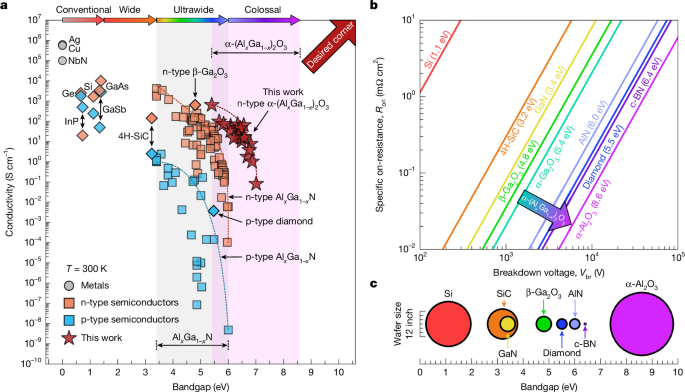
In rectifying power electronics, wider-bandgap (Eg) semiconductors allow higher efficiency and power density with the Baliga figure of merit proportional to Eg5.5 (refs. 1,2). Unfortunately, the unique ability of semiconductors to have their conductivities controllably modulated over orders of magnitude by equilibrium doping methods becomes increasingly elusive as the bandgap increases. Increasing demand for wider-bandgap semiconductors has led to many materials previously considered insulators—including GaN, SiC, AlN, Ga2O3 and GeO2—to emerge as useful semiconductors after decreasing defect densities and finding appropriate dopants. Here we report silicon-doped α-(AlxGa1−x)2O3 films with bandgaps exceeding 7.0 eV grown by suboxide molecular-beam epitaxy, surpassing that of cubic boron nitride, the next-widest-bandgap semiconductor known3,4,5. In the colossal-bandgap regime, >6 eV, our silicon-doped α-(AlxGa1−x)2O3 films have room-temperature conductivities over 100 million times higher than all previous reports6. We fabricate a Schottky diode and a field-effect transistor (the AlphaFET) with colossal-bandgap channels. These α-(AlxGa1−x)2O3 films and devices use sapphire, an abundant, inexpensive substrate with excellent quality that is produced at massive scale, facilitating the development and adoption of colossal-bandgap electronics. Our achievement breaks the trend of increasing synthesis difficulty, cost and small size of ever-wider-bandgap semiconductors, for example, diamond and cubic boron nitride.
This is a preview of subscription content, access via your institution
Access Nature and 54 other Nature Portfolio journals
Get Nature+, our best-value online-access subscription
Prices may be subject to local taxes which are calculated during checkout
The data supporting the results of this study are available in the paper, its Extended Data figures and the Supplementary Information. The raw data used to create figures are available upon request to the corresponding author.
Baliga, B. J. in Fundamentals of Power Semiconductor Devices 14–16 (Springer, 2019).
Slobodyan, O. et al. Analysis of the dependence of critical electric field on semiconductor bandgap. J. Mater. Res. 37, 849–865 (2022).
Article
ADS
CAS
Google Scholar