// NATURE NEWS — SPAZIO & SCIENZA
A gut microbial odd-chain fatty acid alleviates atherosclerosis in mice
Nature
(2026) Cite this article
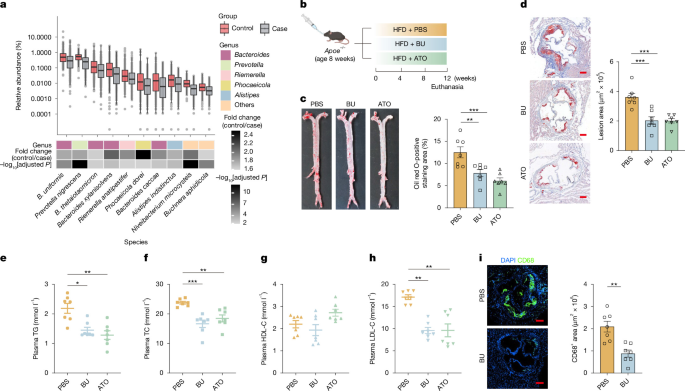
The gut microbiota plays a pivotal part in human health, yet the molecular mechanisms that underlie its effects are largely unexplored. Bacteroides, a dominant genus in the human gut microbiota, is depleted in patients with atherosclerosis1, but its causal relationship with disease remains unclear. Here, using a mouse model, we show that administration of Bacteroides uniformis alleviates atherosclerosis through the upregulation of hepatic low-density lipoprotein receptor expression. Bioactivity-guided screening revealed pentadecanoic acid (PA, C15:0), a saturated odd-chain fatty acid, as a principal bioactive metabolite. PA supplementation reduced atherosclerotic plaque burden by around 50% and significantly improved plasma lipid profiles, a result that underscores its therapeutic potential. Mechanistically, PA enhances cholesterol clearance by directly inhibiting HMG-CoA reductase, suppressing hepatic cholesterol biosynthesis and promoting plasma low-density lipoprotein cholesterol removal. Analyses of 100 gut bacterial strains revealed that PA production occurs across multiple Bacteroidota genera. Notably, PA is markedly depleted in patients with dyslipidaemia. In summary, a Bacteroidota-derived odd-chain fatty acid regulates gut–liver crosstalk, and modulation of the microbial–metabolic axis has atheroprotective potential.
This is a preview of subscription content, access via your institution
Access Nature and 54 other Nature Portfolio journals
Get Nature+, our best-value online-access subscription
Prices may be subject to local taxes which are calculated during checkout
All data supporting the findings of this study are available in the Article, its Supplementary Information and the public repositories described below. The RNA-seq data generated for this study are available at the NCBI under the accession number PRJNA1213157. Metagenomic datasets and human gut metagenomes and metagenome-assembled genomes from publicly available databases were used in this study, and raw data were accessed under the BioProjects PRJNA615842 (‘Alteration in gut microbiota composition and functional relevance in subclinical carotid atherosclerosis in the general population’), PRJEB21528 (‘The gut microbiome in atherosclerotic cardiovascular disease’) and in the European Nucleotide Archive under accession number ERP116715 for the UHGG catalogue. The human HMGCR structure used for molecular docking is available from the RCSB PDB under accession 1HW8. Source data are provided with this paper.
Jie, Z. et al. The gut microbiome in atherosclerotic cardiovascular disease. Nat. Commun. 8, 845 https://doi.org/10.1038/s41467-017-00900-1 (2017).
Article
ADS
PubMed
PubMed Central
CAS
Google Scholar
Chakaroun, R. M., Olsson, L. M. & Backhed, F. The potential of tailoring the gut microbiome to prevent and treat cardiometabolic disease. Nat. Rev. Cardiol. 20, 217–235 https://doi.org/10.1038/s41569-022-00771-0 (2023).