// NATURE NEWS — SPAZIO & SCIENZA
Rh3+ stabilized in KRh@MFI catalyses regioselective hydroformylation
Nature
(2026) Cite this article
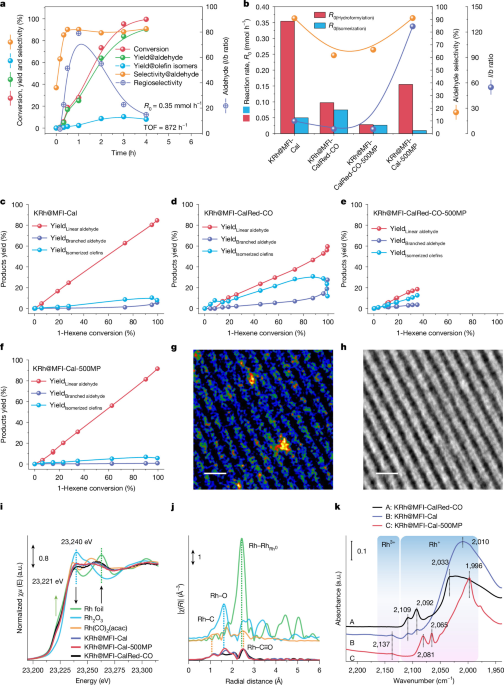
Hydroformylation has been a cornerstone of industrial organometallic catalysis, with regioselectivity being a critical aspect in this process1,2. Present industrial systems use homogeneous Rh-based catalysts with expensive and toxic phosphine-containing ligands, underscoring the need to develop alternative heterogeneous catalysts that could compete with the actual homogeneous ones3. In this direction, atomically dispersed Rh catalysts have been proposed as promising candidates for hydroformylation4,5. However, achieving high regioselectivity at high conversion is still a big challenge. Here subnanometre Rh2O3 clusters are confined inside the channels of the MFI zeolite, which under reaction conditions disrupt into isolated Rh3+ and Rh+ species. Density functional theory (DFT) investigations combined with spectroscopic and catalytic studies demonstrate that Rh3+-mediated hydroformylation is energetically plausibly similar to Rh+, with Rh3+ being intrinsically more selective for hydroformylation and less selective for double-bond isomerization than Rh+. In the coexistence of both Rh3+ and Rh+ species, we demonstrate the possibility to selectively inhibit Rh+ sites through the addition of N-containing molecules such as N-methylpyrrolidine (MP) or 1-methyl-2-pyrrolidone (NMP), which preferentially coordinate to Rh+ inside MFI zeolite channel, thereby suppressing its isomerization function while leaving Rh3+ sites catalytically accessible. This strategy results in a notable enhancement of regioselectivity, with a state-of-the-art reported highest linear to branched aldehydes (l/b) ratio of 817 with 96% undecanal selectivity at 99.8% 1-decene conversion, using NMP as additive.
This is a preview of subscription content, access via your institution
Access Nature and 54 other Nature Portfolio journals
Get Nature+, our best-value online-access subscription
Prices may be subject to local taxes which are calculated during checkout
All data generated in this study are provided in the Supplementary Information and the most relevant are included in the Source Data files. All relevant data are available from the corresponding authors on request. Source data are provided with this paper.
Cornils, B., Herrmann, W. A. & Rasch, M. Otto Roelen, pioneer in industrial homogeneous catalysis. Angew. Chem. Int. Ed. Engl. 33, 2144–2163 (1994).
Franke, R., Selent, D. & Börner, A. Applied hydroformylation. Chem. Rev. 112, 5675–5732 (2012).
Article
PubMed
CAS
Google Scholar