// ARS TECHNICA — MOBILE & WEB
What did the Liberty Bell sound like? Science is on the case.
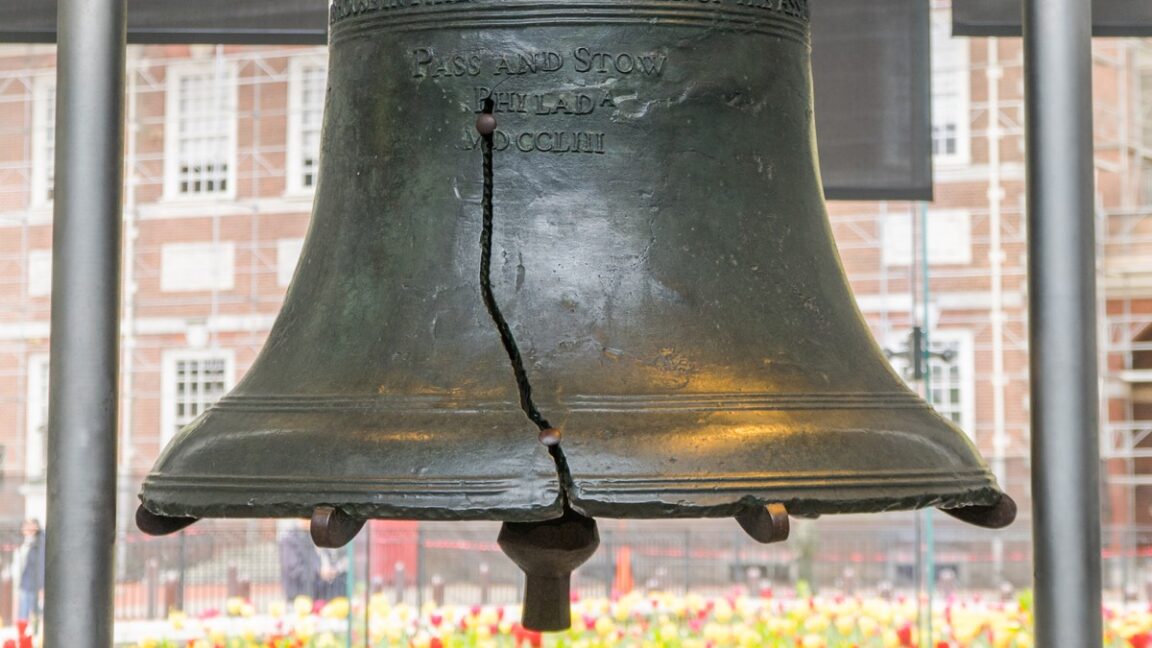
Researchers hunted for clues in modal analysis of 20th-century replica bell at Penn State Behrend.
The Liberty Bell, with its famous crack, hasn’t been rung in 180 years, but that hasn’t stopped scientists from pondering what the bell might have sounded like when tolling. In honor of the nation’s 250th anniversary, researchers at Penn State University have modeled its acoustic properties, drawing on data collected from one of the bell’s replicas. The work was first presented at a meeting of the Acoustical Society of America in Philadelphia earlier this year, followed by an article in Physics Today.
Historians aren’t sure exactly when the Liberty Bell acquired its distinctive crack, just that it occurred sometime between 1817 and 1846. An 1846 account in the Public Ledger described the ringing of the bell on February 23 that year and mentioned that the bell had developed a crack, which someone had attempted to fix by filing the sides down. But it didn’t work: The February 23 ringing extended the crack even more, so much so that “the old Independence Bell … now hangs in the great steeple irreparably cracked and forever dumb.” Nobody has heard it ring since.
This wasn’t the first time the bell had cracked; the rim cracked shortly after it arrived in Philadelphia in 1752, the first time the clapper struck while testing the sound. It was recast by two local foundry workers, John Pass and John Stow, not once but twice, because the first recast produced a sound that one bystander likened to coal scuttles banging together.
The second recast’s sound was deemed acceptable, and the bell was typically used to summon the Assembly, among other purposes, until it fell into disuse after the American Revolutionary War. As for why the bell was so prone to cracking, a 1975 study of the bell’s chemical composition revealed that the metals used formed “an extremely brittle alloy” that also made it easier for souvenir collectors to chip off pieces from the rim.
We do know something about the general acoustics of bells, dating back at least to a seminal 1987 paper by Thomas D. Rossing and Robert Perrin exploring the forms and vibrational modes of church bells, carillon bells, and handbells. A given bell’s sound is determined by relatively simple geometry—which determines the vibration patterns radiating sound to listeners’ ears—and the material of which it is made (bronze), which determines the exact pitch and duration of the ring.
Per Sean Collier, co-author of this latest article, relying solely on the meager online information about the Liberty Bell to replicate its sound produces “a terrible sounding bell that in presence does not match the silhouette of the iconic bell.” There are several full-size replicas of the Liberty Bell made in the 20th century, including one housed on the Penn State Behrend campus, and one can tap that bell to produce a ring. But scientists desire more quantitative information, such as the specific notes, which notes ring the longest, and how the bell deforms as it vibrates. And that requires modal analysis, a technique used by bell manufacturers to assess tuning and make any necessary corrections.
For instance, Western church bells are typically tuned to the first five normal frequencies, according to the authors—the hum note, fundamental (the note that is most dominant to the human ear), tierce, quint, and nominal—following well-defined ideal ratios. “Musically, the frequencies sound as a minor triad, which is why church bells are commonly perceived as having a somber tone,” they wrote. Further, “The human ear perceives the pitch of a bell as a subjective tone called the strike note,” arising from the combination of how the mode shapes interact, and the listener’s own expectations.
Collier and his co-authors, Jon Young and Aaron Stearns, used the Penn State Behrend replica to collect data on mode shapes, natural frequencies, and loss factors. They glued accelerometers to different parts of the replica and then