// ARS TECHNICA — MODA & SOCIETÀ
Startup taps underwater volcano as energy source in "proof point" test
Can undersea geothermal power help Pacific Rim nations cut down on oil imports?
The world’s first demonstration of a subsea geothermal power plant has taken place near an active underwater volcano almost a mile below the ocean surface. It generated less than 10 seconds of net-positive electricity but showed the technical feasibility of tapping another form of renewable energy underwater.
The three-week test deployment of the 3-ton prototype power plant took place at the Axial Seamount in the northeast Pacific Ocean in September. Endurance Energy, the Seattle-based startup behind the effort, aims to eventually commercialize subsea geothermal power for Pacific island nations and other customers looking for alternatives to importing expensive fossil fuels.
“The deep ocean gives us unlimited cold seawater for cooling, and its weight keeps the system and the well pressurized, so our plants can be compact,” said Andrew Redd, founder and CEO of Endurance Energy, in an email to Ars.
But efforts to tap geothermal power on the seafloor face many different challenges from land-based geothermal projects, which can also add up to higher installation and operational costs. So Endurance Energy must demonstrate consistent underwater operations as well as prove the approach can be cost-effective.
“It’s probably technically feasible, but it would undoubtedly be more expensive than to do it on land,” said Roland Horne, professor of energy science & engineering at Stanford University, in an emailed response to Ars.
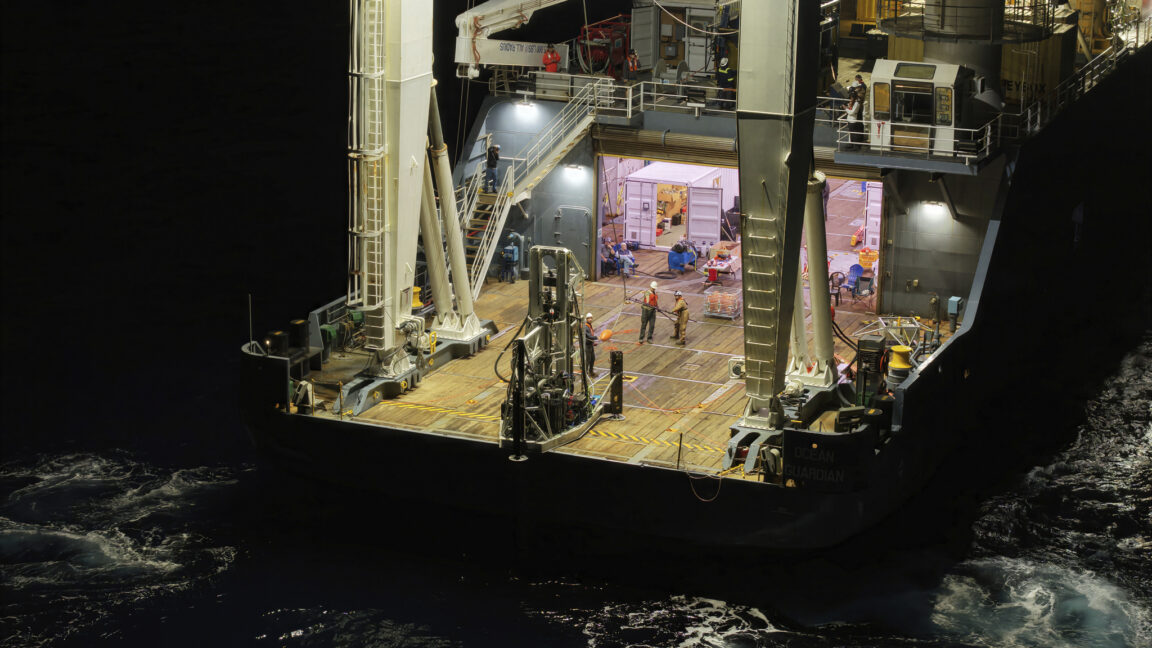
Endurance Energy’s deployment required a subsea lander drill to deploy from the ship Ocean Guardian—operated by Stabbert Maritime—and drill two holes in the seafloor at a depth of about 5,000 feet (1,524 meters). That means the test took place at a depth exceeding 2.5 times the height of the One World Trade Center building in New York City, which is the tallest building in the United States.
Both the drilled holes started venting hot hydrothermal fluid measured at a temperature of about 500° F (260° C). The Endurance Energy team proceeded to case and cement the second hole before installing a valve to create a well.
Next up, the company deployed its 100-kilowatt power plant, named Adélie, that is designed to vaporize incoming hydrothermal fluid to spin a turbine and drive an electric generator. It used the assistance of Canada’s remotely operated submersible ROPOS to help connect the power plant to the newly drilled well.
Adélie also connected to Endurance Energy’s Seattle command center by plugging into the Regional Cabled Array, a 559-mile (900-kilometer) network of undersea fiber-optic and electric cables that provides both power and connectivity to scientific sensors on the seafloor. The undersea network is funded by the US National Science Foundation and is operated by the University of Washington.