// NATURE NEWS — SPAZIO & SCIENZA
Programmable design of functional proteins from natural language
Nature
(2026) Cite this article
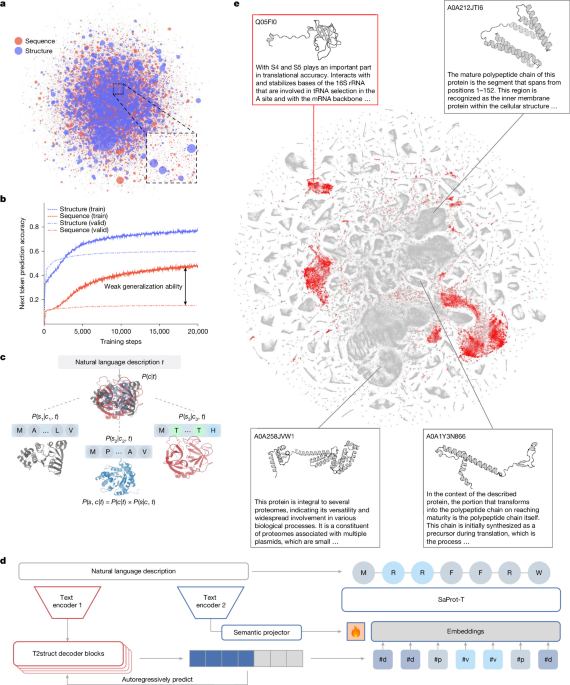
Programming biological function—designing bespoke proteins to perform specified molecular tasks—is a foundational goal of molecular engineering. However, current design models remain fundamentally limited1,2,3: they typically require either natural proteins as starting points for optimization or manual reformulation of functional goals as geometric and sequence-level constraints to guide candidate generation. Here we introduce Pinal, a 16-billion-parameter foundation model that designs candidate proteins from natural-language descriptions of desired function. Trained on 1.7 billion synthetically annotated protein–text pairs, Pinal links functional intent to protein sequence and structure. In computational evaluations, generated candidates combined high predicted foldability with functional-description alignment and sequence diversity, providing a basis for prioritizing experimentally testable designs. We applied Pinal to four distinct design tasks—a fluorescent protein, a polyethylene terephthalate hydrolase, an alcohol dehydrogenase and a metabolic H-protein—and experimentally observed the intended function in each case, including catalytic activity for both designed enzymes. Without iterative experimental optimization, a Pinal-designed H-protein increased product titre by 1.7-fold relative to the corresponding native Escherichia coli H-protein in a multi-enzyme CO2 fixation pathway. These findings support natural language as a high-level interface for candidate generation in protein design, enabling programmable exploration with reduced reliance on manually specified structural or sequence constraints.
This is a preview of subscription content, access via your institution
Access Nature and 54 other Nature Portfolio journals
Get Nature+, our best-value online-access subscription
Prices may be subject to local taxes which are calculated during checkout
Protein sequences were obtained from UniProtKB/Swiss-Prot and UniProtKB/TrEMBL (https://www.uniprot.org/, release 2023_03). Predicted protein structures were obtained from the AlphaFold Protein Structure Database (https://alphafold.ebi.ac.uk/). Functional annotations and keywords were obtained from InterPro (version 101.0; https://www.ebi.ac.uk/interpro/), and enzyme classification information was obtained from the ENZYME nomenclature database (https://enzyme.expasy.org/). Experimentally determined protein structures used for structural comparisons were obtained from the Protein Data Bank (PDB; https://www.rcsb.org/). UniRef100 (https://www.uniprot.org/help/uniref) was used for sequence-similarity analyses. Fluorescent-protein reference information was obtained from FPbase (https://www.fpbase.org/). The pretrained Pinal weights can be downloaded from https://huggingface.co/westlake-repl/Pinal. All the other data are available within the paper and the Supplementary Information. Source data are provided with this paper.
Pinal is open-sourced under the Apache 2.0 license. The code repository is available at GitHub (https://github.com/westlake-repl/Denovo-Pinal). The Pinal web server is located at http://www.denovo-pinal.com/. The SaProt-T/O server, corresponding to the second component of Pinal, is linked from the Pinal web server and can also be accessed directly at http://113.45.254.183:9527/. The release of large-scale training resources for generative protein design requires careful consideration of potential dual-use biosecurity risks. In developing Pinal, the large-scale structural component of the training corpus was derived from AFDB, whose released protein-structure collection does not include viral proteomes. Accordingly, Pinal was not trained or intended for viral protein design. Nevertheless, unrestricted public release of the full pretraining corpus together with the complete training pipeline could lower the barrier for adapting similar systems to sensitive biological datasets. To mitigate this risk,