// ARS TECHNICA — MOBILE & WEB
Crows can evaluate visual info twice as fast as mammals
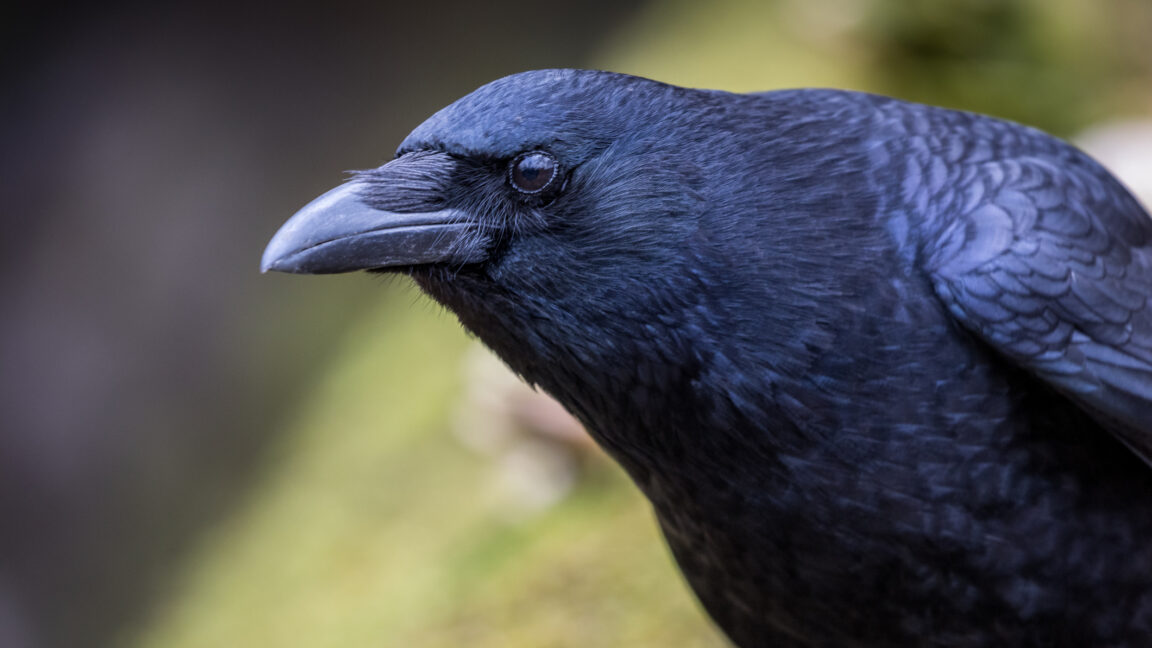
Birds’ compact nervous system seems to help them handle tasks very quickly.
Much of what we know about how a brain makes decisions comes from studying monkeys watching dots. In a task known as a random-dot-motion task, a cloud of flickering specks drifts weakly in one direction while the subject tries to determine whether—and in which direction— it’s moving. The task has shown that in the primate neocortex, neurons gather visual evidence over time, with their firing rates climbing until they cross a threshold, when the animal commits to a decision.
But avian brains don’t have a neocortex, so it wasn’t obvious how they made similar decisions.
“This was the big question,” said Andreas Nieder, a neurobiologist at the University of Tübingen. “How [would] a differently organized avian brain encode decisions?”
To find out, Nieder and his colleague Philipp Schmidbauer put two carrion crows through the same task the monkeys faced, recording their brain activity along the way. The crows solved the task the same way primates do, using the same mathematical logic despite having a very different brain structure. And they did it two times faster.
Nieder and Schmidbauer put two hand-raised crows in front of a touch-sensitive monitor showing a cloud of white dots on black, with some fraction of them drifting coherently left or right or up or down. The birds’ job was to report the overall direction by pecking one of the targets that flanked the display. Correct answers earned them a mealworm.
“We intentionally wanted to have exactly the same random-dot motion task,” Nieder said. “The only difference was that the crows had to peck to indicate their decision, whereas monkeys were indicating by making an eye movement.”
The researchers varied how many dots moved together, ranging from 81 percent of the dots coherently moving together, which is trivially easy to determine, down to 3 percent, which is barely distinguishable from noise. They also included a zero percent condition, in which there was no correct answer.
Both birds scored better than chance, even when only three percent of the dots were moving.
While the crows worked at the task, the team recorded from 248 neurons in the NCL (nidopallium caudolaterale)—a region at the top of the avian processing hierarchy that is widely regarded as the functional counterpart of the primate prefrontal cortex, despite being built differently.