// NATURE NEWS — SPAZIO & SCIENZA
Tandem repeat variation shapes immune cell type-specific gene expression
Nature
(2026) Cite this article
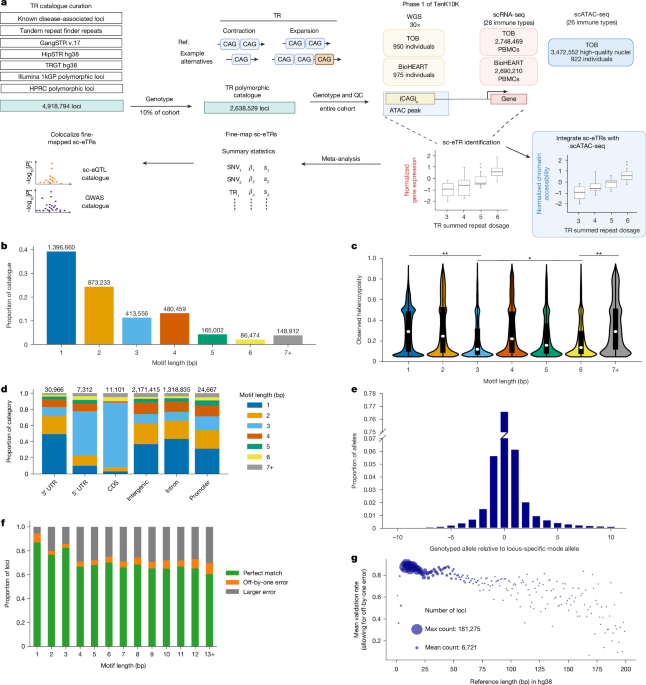
Tandem repeats (TRs)—highly polymorphic, repetitive sequences across the human genome—are important regulators of gene expression but remain underexplored due to challenges in accurate genotyping and analysis1. Here we generate whole-genome and single-cell RNA sequencing from more than 5.4 million blood-derived cells across 1,925 individuals in two cohorts2, and perform meta-analysis to characterize the impact of variation in more than 1.7 million TR loci on immune cell type-specific gene expression. We identify more than 69,000 single-cell expression quantitative trait loci, 30.7% of which are specific to 1 of 28 immune cell types, and reveal dynamic regulatory effects using cell-state inference. Matched single-cell assay for transposase-accessible chromatin with high-throughput sequencing profiles from more than 3.4 million nuclei in 922 individuals3 uncover chromatin accessibility quantitative trait loci for nearly one-third of expression-associated TRs, supporting coordinated effects on cis-regulatory architecture. Fine-mapping implicates 1,490 TRs as candidate causal drivers of gene expression in 6.1% of tested genes, and colocalization analyses highlight more than 200 genes in which TRs likely mediate genetic associations with immune and haematological traits. Together, these results provide a genome-wide, multiomic view of TR-mediated regulation in the human immune system, establishing TRs as key contributors to cell type-specific regulatory variation and complex trait architecture.
This is a preview of subscription content, access via your institution
Access Nature and 54 other Nature Portfolio journals
Get Nature+, our best-value online-access subscription
Prices may be subject to local taxes which are calculated during checkout
Genomic coordinates and variant annotations were defined relative to the human reference genome GRCh38 (Genome Reference Consortium Human Build 38), obtained from the Genome Reference Consortium available at https://www.ncbi.nlm.nih.gov/grc/human. Gene annotation was performed using GENCODE v.44/Ensembl 110. sc-eTRs were annotated with ENCODE (v.3) cis cCREs available at https://hgdownload.soe.ucsc.edu/gbdb/hg38/encode3/ccre/encodeCcreCombined.bb and MANE (v.1.0) available at https://ftp.ncbi.nlm.nih.gov/refseq/MANE/MANE_human/. Summary-level association statistics are provided in the Supplementary Tables. Raw summary association statistics and the polymorphic variant catalogue are available at Zenodo (https://doi.org/10.5281/zenodo.15009519)95. WGS data and genotypes are available through the European Genome–Phenome Archive (EGA) under accession no. EGAS50000001654, under controlled access for non-commercial research use. scRNA-seq data are available under EGA accession no. EGAS50000001653, under controlled access for non-commercial research use. Summary-level TR genotypes and association statistics for sc-eTRs are accessible at trexplorer.broadinstitute.org.
Single-cell expression processing and downstream analyses are available through GitHub at https://github.com/powellgenomicslab/tenk10k_phase1. WGS data processing pipeline is available through GitHub at https://github.com/populationgenomics/production-pipelines/tree/main/cpg_workflows/large_cohort. TR genotyping, quality control and association analysis pipeline is available through GitHub at https://github.com/populationgenomics/sv-workflows/tree/main/str. TR merging and catalogue curation is available through GitHub at https://github.com/broadinstitute/str-analysis. scDeepID pipeline is available through GitHub at https://github.com/powellgenomicslab/scDeepID_TenK10K_manuscripts.
Tanudisastro, H. A., Deveson, I. W., Dashnow, H. & MacArthur, D. G. Sequencing and characterizing short tandem repeats in the human genome. Nat. Rev. Genet. 25, 460–475 (2024).
Article
PubMed
Google Scholar