// NATURE NEWS — SPAZIO & SCIENZA
T and B cells recognize splicing-derived neutrophil neoantigens in lupus
Nature
(2026) Cite this article
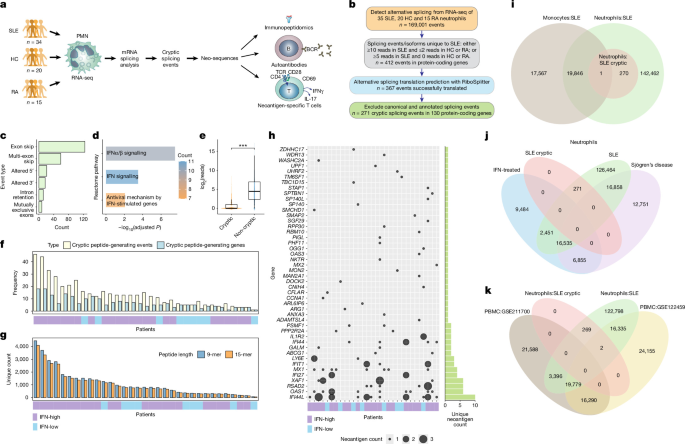
Proteome diversity is generated through alternative mRNA splicing1. In tumours, mis-spliced transcripts that contain intronic sequences, skipped exons or noncanonical donor/acceptor splice junctions resulting in frameshifts are often translated into neoantigens that drive anti-tumour immunity2,3. Here we report that neutrophils from patients with systemic lupus erythematosus (SLE), unlike neutrophils from healthy donors or patients with rheumatoid arthritis, contain many aberrantly spliced gene transcripts, the translation of which was predicted to result in novel amino acid sequences that are absent in normal splice variants or any other proteins. Twenty-one peptides derived from these novel amino acid sequences were detected by mass spectrometry on class I major histocompatibility complex molecules in patient samples. Co-culture of T cells from patients with overlapping sets of 15-mer peptides from the novel sequences resulted in the expansion of CD4+ and CD8+ T cells that were rapidly reactivated to secrete interferon-γ. T cell antigen receptor sequencing and re-expression transferred neoantigen reactivity to a reporter T cell. Serum from patients with SLE also contained IgG autoantibodies that recognized epitopes within the novel amino acid sequences. Our findings demonstrate that dysregulated mRNA splicing in SLE neutrophils generates neoantigens that have caused T and B cell activation, clonal expansion, IgG class-switch and autoimmunity.
SLE is a debilitating autoimmune disorder of unclear aetiology4,5,6. SLE involves multiple organs and is characterized by the presence of autoantibodies against nuclear proteins, nucleic acid-associated proteins and double-stranded DNA7. Although antigen-specific T cell responses8 have a substantial role, it is largely unknown what antigens the T cells respond to9. Mounting evidence also suggests that innate immune cells have a central role in driving the underlying mechanisms of SLE10,11,12,13,14, including the elevated levels of type I interferons found in most patients with SLE15. Neutrophils are increasingly implicated11,12,13,16,17,18 as sources of SLE autoantigens, including both nucleic acids and proteins, that are released during inflammatory cell death via processes such as NETosis13 and ferroptosis19. Although neutropoiesis is accelerated in SLE15, many patients are neutropenic, indicating increased neutrophil consumption. Neutrophils in SLE display widespread genomic hypomethylation, leading, in part, to a distinctive type I interferon-weighted transcriptional profile20, which differs from that in other autoimmune diseases, but bears much resemblance to that in neutrophils from SARS-CoV2-infected individuals21.
Alternative RNA transcript splicing begins during gene transcription and results in the nuclear export of mature mRNA variants that profoundly contribute to proteome complexity and molecular diversity1. Proteins that are translated from alternatively spliced mRNA often display substantial differences in molecular functions, stability and interactions with other proteins or nucleic acids. Alternative splicing can also modulate mRNA disposition, including degradation through nonsense-mediated decay (NMD)22. Alternative splicing occurs more frequently in autoantigen transcripts20 than in randomly selected proteins, and escape from NMD has been shown to cause autoimmunity23. Neutrophils represent an abundant reservoir of intracellular proteins and nucleic acids that potentially function as autoantigenic sources.
To comprehensively analyse alternative mRNA splicing, we created the RiboSplitter24 pipeline, which yields the translated protein products of splice variants. With this tool, we characterized 65,730 high-confidence alternative splicing events in 5,697 protein-coding genes in neutrophils from patients with SLE, of which 521 events in 356 genes were significantly different from healthy donors25. Here we