// NATURE NEWS — SPAZIO & SCIENZA
MCT1-dependent mitochondrial lactate import sustains cardiac metabolism
Nature
(2026) Cite this article
The heart possesses a dynamic capacity to oxidize a variety of fuels, including glucose and lactate, to meet its energetic demands under diverse dietary, exertion and injury stressors1. Oxidation of carbohydrate substrates is thought to converge on the cytosolic generation of pyruvate, which is transported by the mitochondrial pyruvate carrier (MPC) for entry into the tricarboxylic acid cycle2. Here we find that glucose-derived carbon is oxidized in mouse myocardium even when the MPC is genetically ablated. Using genetic and pharmacological tools, we demonstrate that lactate monocarboxylate transporter 1 (MCT1, encoded by Slc16a1) is required for the oxidation of glucose carbon by MPC-deficient myocardium. We further observe that MCT1, traditionally localized to the plasma membrane, also resides in the inner mitochondrial membrane of mouse and human cardiomyocytes. Together with matrix-localized LDHB, MCT1 enables mitochondrial lactate conversion to pyruvate and NADH, directly fueling the electron transport chain. Loss of MCT1 impairs lactate oxidation, disrupts metabolic flexibility and accelerates the development of heart failure with increased mortality after hyperactivation of the neurohormonal axis or ischemia–reperfusion injury. Thus, the existence of a parallel lactate-based pathway for carbohydrate oxidation can sustain cardiac energetics and maintain myocardial structure and function under diverse stress conditions.
The oxidation of carbon fuels within the mitochondria is responsible for more than 95% of human ATP production1,3. Dietary carbohydrates supply energy beginning with glycolysis, producing pyruvate that is either reduced to lactate in the cytosol by lactate dehydrogenase (LDH), which also regenerates NAD+, or is imported into the mitochondria for oxidation by the tricarboxylic acid (TCA) cycle4. Circulating lactate turnover exceeds that of glucose in mammalian physiology5,6, establishing lactate production as the dominant mode of cytosolic NAD+ regeneration. Lactate has the same oxidation state as glucose, is a major circulating oxidative fuel source in both fasted and fed mammalian physiology, and is consumed primarily by the heart, skeletal muscle and kidney7,8,9.
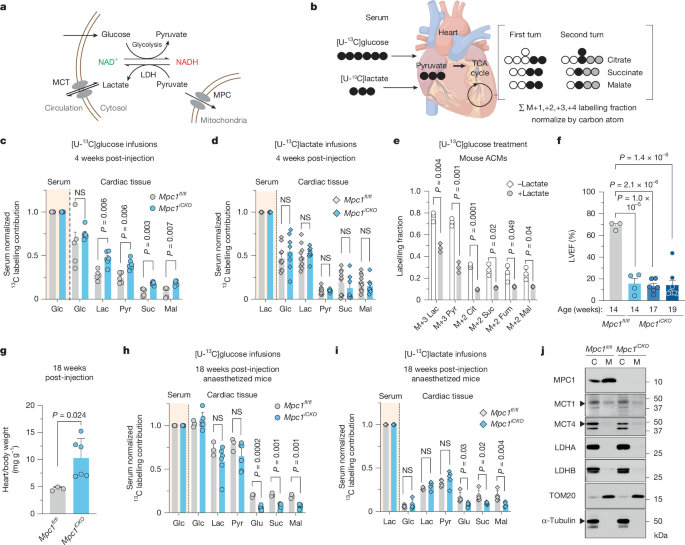
Conventional models posit that lactate oxidation starts with the generation of cytosolic pyruvate by LDH, which is subsequently imported into the mitochondria by the obligate heterodimeric mitochondrial pyruvate carrier (MPC, encoded by Mpc1 and Mpc2)2,10. This arrangement leads to competition between LDH and glycolytic enzymes for NAD+, restricting flux through these pathways when metabolic demand is high (Fig. 1a). However, the heart can oxidize both lactate and glucose simultaneously in response to energetic demand11,12,13, suggesting that there might be distinct routes for pyruvate and lactate oxidation14,15.
a, Schematic representation of the competition for cytosolic NAD+ between glycolysis and lactate oxidation, illustrating that redox-balanced metabolism produces lactate. MCT, lactate monocarboxylate transporter. b, Simplified schematic of carbon labelling of heart TCA cycle metabolites resulting from infusion of [U-13C]glucose or [U-13C]lactate. If the second turn (light grey) incorporates an unlabelled acetyl-CoA, M+1 labelling becomes dominant as is observed in vivo. Created in BioRender; Visker, J. https://BioRender.com/kl2xa6y (2026). c, Myocardial 13C labelling of lactate, pyruvate and TCA cycle metabolites following [U-13C]glucose infusion in awake 12-week-old 4 wpi Mpc1iCKO (n = 10) and Mpc1fl/fl (n = 8) mice. Glc, glucose; Lac, lactate; Mal, malate; Pyr, pyruvate; Suc, succinate. d, Myocardial 13C metabolite labelling following [U-13C]lactate infusion in awake 4 wpi Mpc1iCKO (n = 10) and Mpc1fl/fl (n = 8) mice. e, 13C labelling of metabolites from primary cultured ACMs incubated with [U-13C]glucose with or without 1.6 mM lactate in DMEM, n = 3 wells. f, LVEF at 14