// NATURE NEWS — SPAZIO & SCIENZA
Eukaryotes’ closest relatives are internally simple syntrophic peptidotrophic archaea
Nature
(2026) Cite this article
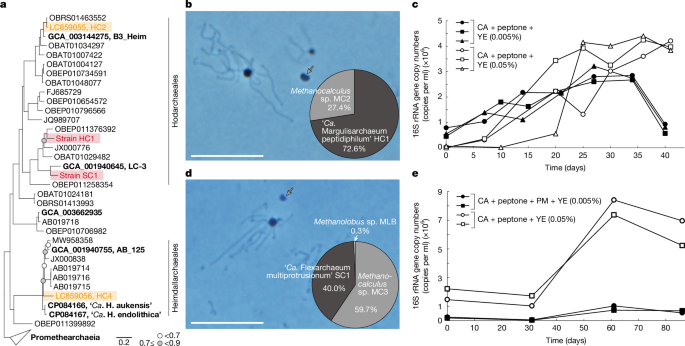
Eukaryotes are theorized to have an origin associated with the archaeal phylum Promethearchaeota (formerly Asgard archaea)1,2,3. The first cultured representatives revealed valuable insights4,5 but are still distantly related to eukaryotes, leaving many unknowns regarding eukaryogenesis. Here we report the isolation of two strains, HC1 and SC1, that belong to the archaeal lineage that branches closest to eukaryotes (Heimdallarchaeia);6,7,8 these isolates are members of a pure co-culture and a tri-culture with methanogenic partners. Both are obligately anaerobic, syntrophic, peptide-degrading and mesophilic archaea that produce protrusions and vesicles but lack persistent internal membrane structures, like Promethearchaeales4,5. All Promethearchaeota isolates demonstrate behaviour focused on cell construction and membrane structures rather than division, in contrast to typical prokaryotes9. Strain HC1 possesses genes associated with aerobic lifestyles (such as cytochrome c oxidase (Cox)) but co-cultures cannot grow under (micro)oxic conditions. Meanwhile, the strain demonstrates growth under microoxic conditions when in the presence of aerobes, suggesting that Cox supports oxygen detoxification rather than respiration. Comparative genomics provides evidence that, like HC1, Cox-possessing Heimdallarchaeia studied to date probably do not respire oxygen. The wide conservation of anaerobiosis, cell structure without persistent intracellular membranes and membrane protrusions across Promethearchaeota suggest that the archaeal ancestor of eukaryotes may have had such physiological features. In this cultivation-informed scenario for eukaryogenesis, the archaea–eukaryote transition would involve a steep transition in cell structure and physiological shift from anaerobiosis to (facultative) aerobiosis10, with early interactions between the archaeal host and mitochondrial ancestor probably occurring under low-oxygen conditions and at least partially mediated by oxygen detoxification.
Understanding how complex eukaryotic cells emerged from their prokaryotic ancestors is a fundamental challenge in biology. The widely discussed endosymbiotic theory posits that the last eukaryotic common ancestor was derived from a host cell that had taken up an alphaproteobacteria-related symbiont that later became the mitochondrion11,12,13,14. Although the identity of the putative host cell in this theory has long been enigmatic, recent metagenomic and phylogenetic analyses indicate that eukaryotes probably evolved from a lineage closely related to members of the archaeal group Asgard archaea2,6,7,15,16,17, which has now been formally classified as the phylum Promethearchaeota within the kingdom Promethearchaeati3. This relationship is further reflected in the presence of abundant eukaryotic signature proteins (ESPs) in their genomes15,16,18. Moreover, several of these ESPs exhibit structural and functional similarities to those found in eukaryotes19,20,21,22.
What has remained unclear was the cell structure and physiology of the archaeal group; both have important implications for how archaea may have transitioned towards eukaryotes. On the basis of the presence of abundant and diverse ESPs in these archaea, studies hypothesized that the archaeal ancestor to eukaryotes may have already evolved a complex internal cell structure (that is, an endomembrane system) before endosymbiosis of the alphaproteobacterial ancestor of mitochondria (that is, mito-intermediate or mito-late)1,23,24,25. Cultivation efforts yielded one isolate, Promethearchaeum syntrophicum strain MK-D13,4, as well as enrichment cultures predominated by ‘Candidatus Lokiarchaeum ossiferum’5 and ‘Candidatus Nerearchaeum marumarumayae’26, all revealing a typical prokaryotic internal structure without a persistent eukaryote-like endomembrane system4,5,26 and potential evidence for an actin-based cytoskeleton5,27. All of the Promethe