// NATURE NEWS — SPAZIO & SCIENZA
Flexible rubber blades for tidal turbines
Nature
(2026) Cite this article
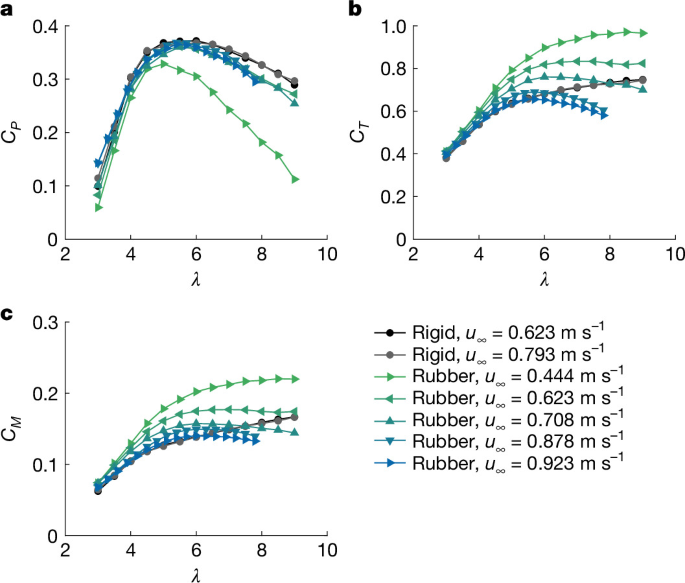
The global transition towards sustainable energy systems has identified tidal power as a uniquely predictable and substantial renewable energy resource1. However, the highly unsteady sea environment subjects turbines to severe hydrodynamic loads, greatly increasing capital and maintenance costs2,3. Large-scale state-of-the-art turbines at present rely on complex, expensive active pitch systems to mitigate these fluctuations. Here we present a reliable, passive alternative: flexible rubber blades featuring chordwise trailing-edge deformation. We experimentally demonstrate that these flexible blades achieve an equivalent total energy yield over simulated tidal cycles compared with rigid blades with active pitch control, while mitigating high-frequency fatigue-inducing load fluctuations by up to one-third. This passive load regulation arises from aeroelastic deformation that flattens blade camber under load, enabling structural robustness without added mechanical complexity. These findings suggest that chordwise-flexible blades can enhance the durability and performance of tidal turbines, offering a promising pathway towards more reliable and cost-effective tidal energy generation.
The global imperative to transition towards sustainable energy systems has intensified research and development in renewable energy technologies. Among these, tidal energy presents a uniquely predictable and substantial resource. Unlike other renewables such as wind and solar, tidal currents are governed by an astronomical cycle, which offers a consistent and forecastable power source4,5. The scale of this resource is significant. Tidal power is estimated at 50 TW h yr−1 in Europe6 and as much as 220 TW h yr−1 in the USA alone7. Near-term deployment targets are 1 GW by 2035 in the UK3, with international roadmaps project deployments eventually exceeding 300 GW worldwide by 20508. These highlight the potential of tidal energy in contributing to energy security and renewable energy portfolios.
Despite their promise, the harsh hydrodynamic environment presents an important barrier to the economic viability of this renewable energy source. A primary challenge is the hydrodynamic load fluctuations that arise from large variations in flow velocity, turbulence, turbine yaw with respect to the incoming stream, velocity shear along the water depth2, wave-induced oscillating currents9, and wake interaction within turbine arrays10. These fluctuating loads are a primary design consideration and are associated with accelerated fatigue, reduced operational lifespans and unplanned downtime. These reliability concerns result in blade and turbine designs with high capital costs, which directly increase the levelized cost of energy (LCOE)3.
To address the challenge of the dynamic loads, various mitigation strategies have been developed. Active control typically deploys systems to actively regulate the pitch11 or camber12 of the blades, therefore, to regulate power output, control mean loads and improve start-up performance. Although the active control systems are effective in certain operational envelopes, the reliability of sophisticated sensors and actuators in the harsh undersea environment remains a concern. Furthermore, the response times of the activator limit effectiveness against rapid, high-frequency load fluctuations13,14.
To address these concerns, there has been an increased focus on developing passive control mechanisms. Passive control is mainly realized in two ways: introducing changes in the blade pitch or modifying the blade camber. Passive pitch control involves designing blades that can rotate around their spanwise axis in response to changing hydrodynamic loads, thereby altering their angle of attack. This is typically achieved by incorporating a pre-loaded torsional spring mechanism at the blade root. Theoretical work in refs. 15,16 are among the first to introduce the concept. Both d