// SPACE.COM — SPAZIO & SCIENZA
This supernova impostor baffled astronomers for 15 years — until they found a hidden black hole feeding on an unstable star
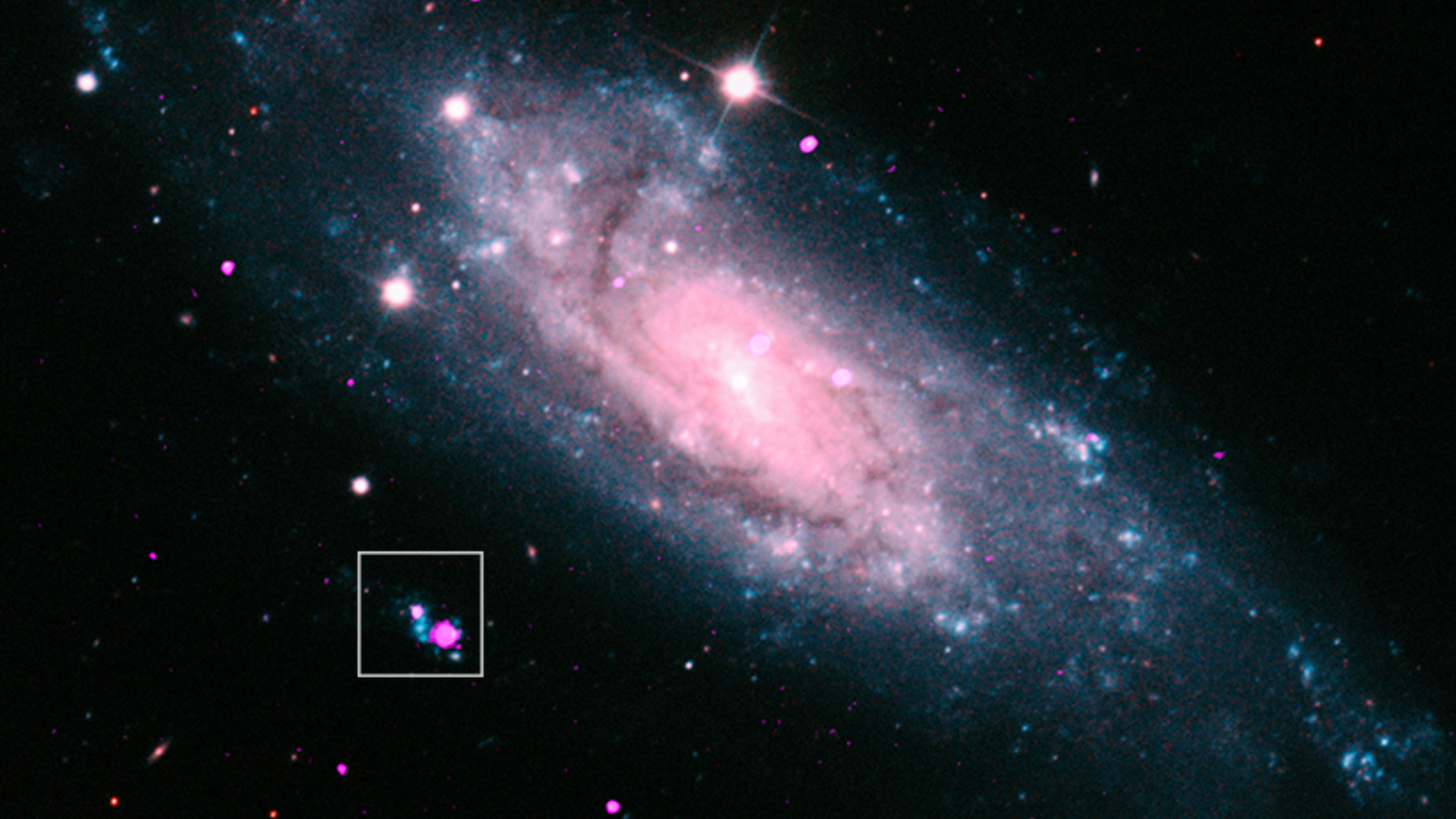
This supernova imposter erupts every 113 days as the compact object gets close to the unstable massive star.
When you purchase through links on our site, we may earn an affiliate commission. Here’s how it works.
A cosmic imposter that has faked being a supernova 27 times and counting is actually a hot, luminous, and decidedly unstable star that is being fed on by a vampiric black hole or neutron star, NASA’s Chandra X-ray Observatory has discovered.
When a massive star reaches the end of the road and runs out of nuclear fuel to power fusion reactions in its core, the star is destroyed in a supernova explosion. That’s what astronomers thought they had found on 11 January 2012, when they observed what appeared to be a supernova on the outskirts of the spiral galaxy NGC 4559, which is about 25 million light-years away in the constellation Coma Berenices.
Yet when the light of the 'supernova' faded, the star was still there, only to continue bursting into light every 113 days.
"For 15 years, astronomers have been watching this star get really bright and then dim again on a regular basis," Mojgan Aghakhanloo of the University of Virginia in Charlottesville said in a statement.
Several other supernova imposters have been observed over the past decade or two. Until now, no one knew what causes these stars to repeatedly cry wolf. Thanks to Chandra’s X-ray vision, Aghakhanloo has led a team of astronomers who think they have now uncovered an explanation.
The supernova imposter is named AT 2016blu, and is a type of star that we call a 'luminous blue variable,' or LBV. These are the most massive and luminous stars in the universe and their extreme characteristics result in them being highly unstable, undergoing intermittent bouts of mass loss as they eject material from their outer layers into the surrounding space.
However, faking a supernova is not part of their typical behavior, so a new way of looking at AT 2016blu was needed.
"To understand the cause of these eruptions, we realized that we needed X-ray data that was timed so that we’d observe the star when it was in an outburst," team member Núria Torres-Albà, also from the University of Virginia in Charlottesville, said.