// ARS TECHNICA — MONDO
Specialized’s Tarmac SL9 S-Level is built to wreck your Zone 2 ride
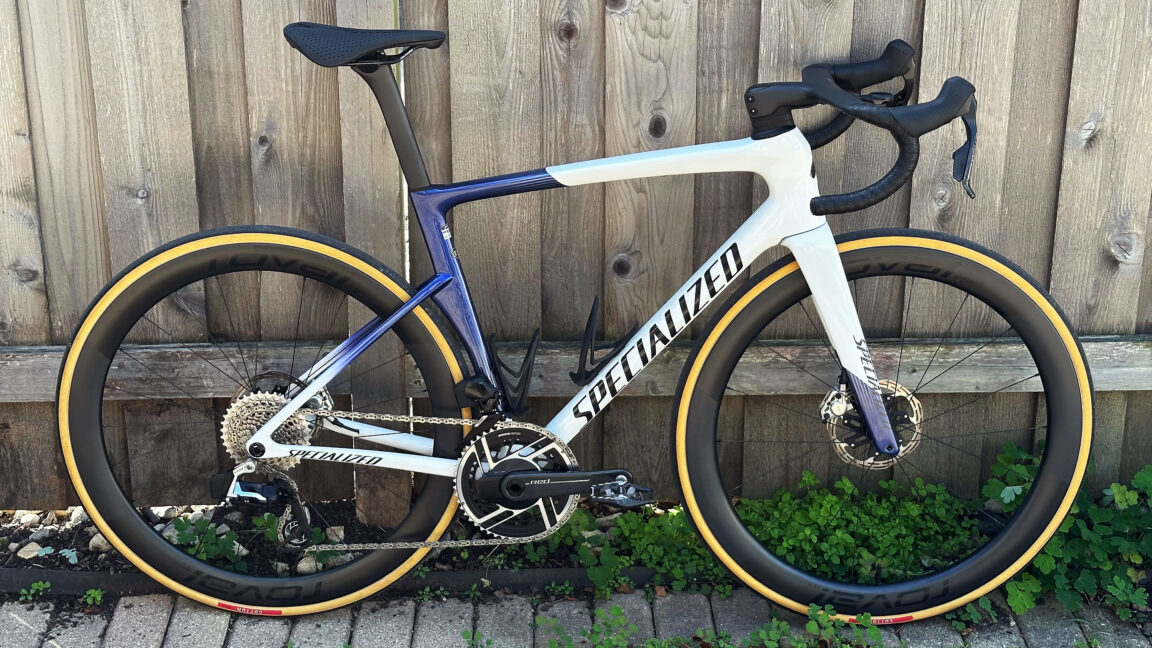
Specialized’s second-fastest bike may be the smart buy.
I love a good Zone 2 ride. There’s nothing like getting on the bike, settling into a groove, and letting the miles (and hours) flow by. But sometimes when I hopped on the Specialized Tarmac SL9 S-Level, Zone 2 would turn into a tempo ride. It was like having a little imp—the stereotype dressed in red with the pitchfork—on my left shoulder whispering into my ear: “Go fast. This bike was built to go fast. Speed is good. You can do a Zone 2 ride tomorrow.” Normally, I’d count on the good imp—the dude with the harp and wings—on my right shoulder to restrain these urges. But the Tarmac is so seductive that he would just shrug and say “he’s got a point.” And in a moment of weakness, I would drop the hammer and head into the red, just because the SL9 makes that so rewarding.
The Tarmac SL9 is Specialized’s aero road bike, with the S-Level sitting just below the S-Works in Specialized’s top tier of carbon, aero road bikes, where it replaced the Tarmac SL8 Pro. After it got an update this year, I spent several weeks riding it, putting nearly 1,000 miles on it
Specialized offers the Tarmac SL9 in four models, all available with SRAM and Shimano drivetrains (Ars tested the SRAM version). Notably, you don’t need to buy the top-of-the-line bike to get the top-of-the-line groupset. Here’s the breakdown of the Tarmac SL9 lineup (note that the Shimano versions of the Expert is 20 g lighter and Comp is 70 grams heavier than the SRAM versions):
The $10,500 S-Level offers the top-of-the-line SRAM Red groupset and integrated cockpit, just like the $14,000 S-Works. But the frameset, wheelset, and saddle differ. The major difference is the frame: the S-Level gets the same carbon-fiber FACT 10r frame as the Expert and Comp. At 822 g for a 56 cm frame, the FACT 10r is 135 g heavier than the FACT 12r used on the S-Works. Despite the weight difference, Specialized says the FACT 10r offers the same stiffness and comfort characteristics as its lighter sibling. Along with the frame, different wheelsets and saddles make the S-Level 500 g heavier than the S-Works. With bottle cages, a Garmin mount, and my preferred Shimano XTR XC PD-M9200 MTB pedals, the S-Level I tested weighed in at 7.98 kg. By way of comparison, my own road bike—a Gen 8 Trek Madone—weighs in at 7.71 kg.
I rode the S-Level all around the Chicago suburbs as well as in central Illinois. Unlike the Diverge 4 Pro, I wasn’t able to test its climbing ability in the Rocky Mountains. All we’ve got in most of Illinois are short, punchy climbs … and a lot of long flats. I rode The S-Level on everything from freshly laid asphalt to freshly laid chipseal, including a couple of 60-mile-plus rides on the country roads downstate.
Visually, the S-Level is striking. The blue-on-white with gray striping is one of Specialized’s better-looking colorways. And it looks aerodynamic. Indeed, Specialized says the Tarmac SL9 is the most aerodynamic road bike it has ever made. Notable changes from the previous-generation Tarmac SL8 to SL9 involved tweaking the head tube, rerouting the rear hydraulic brake hose to accommodate the narrower head tube, and moving to a dropped-down tube for improved aerodynamics. But the most visually striking change is the Win Fin. As the seat tube rises from the bottom bracket, it deviates from the vertical to follow the curve of the wheel as it approaches the seat stays. When riding with just a single water bottle on the downtube—common in pro races where a full bottle is just a team car away—Specialized claims Win Fin saves riders half a watt.
The S-Level I tested came with Specialized’s 30 mm Specialized Cotton TLR tires—used by Red Bull-BORA-hansgrohe on the UCI World Tour—in a tubeless setup. According to Bicycle Rolling Resistance, the Cotton TLR outperforms the much-loved Continental GP 5000 S TR tires when it comes to rolling resistance (at 28 mm). Using Silca’s tire pressure calculator, I rode with the tires infla