// ARS TECHNICA — SPAZIO & SCIENZA
Artist brings old Space Shuttle tank back to life
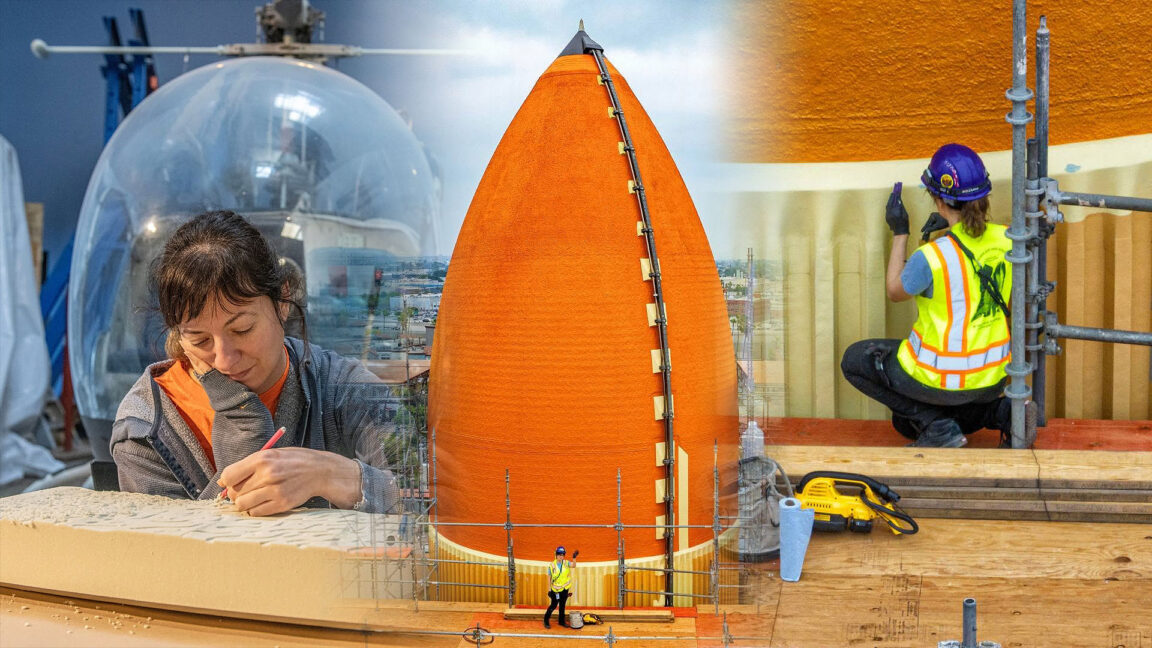
“It’s definitely the largest art project I’ve ever worked on.”
Natalie Rosen is not the type of specialist you immediately associate with being one of the key people behind the new exhibit of the space shuttle Endeavour.
She is not a former NASA technician or engineer, as many of her colleagues have been for the past several years, nor is she a curator or conservator. Before this job, she had no experience working on any aircraft or spacecraft, as the new Samuel Oschin Air and Space Center, an extension of the California Science Center, opened in Los Angeles on November 13.
Without her expertise and artistry, however, the largest component of Endeavour‘s “stack” would look nothing like it did when the shuttle was flying.
“My background is in the fine arts. I have my bachelor’s and my master’s in fine arts from Cal State Long Beach,” Rosen told collectSPACE.com. “When I came in on this project, they were looking for a sculptor, and I had been sculpting.”
Rosen had been working with mixed media for her thesis project and had experience sculpting foam. As it happened, the California Science Center had a lot of foam that needed shaping.
For those unfamiliar, the space shuttle was assembled from three primary launch components. The orbiter and its solid rocket boosters were reusable, given the time needed to inspect, service, and, in the case of the solid-fuel motors, refurbish and refill between flights.
The 154-foot-tall (47-meter) external tank was the only major part of the stack that was disposed of with each launch. After providing propellant for the orbiter’s three main engines, the tank was jettisoned and disintegrated while reentering the atmosphere.
To protect the orbiter from the extreme cold of the cryogenic liquid oxygen and liquid hydrogen in the external tank and to keep the propellant and oxidizer from boiling off too quickly, the ET was covered in insulating foam. (Some of that foam became liberated during ascent and was what caused the loss of the space shuttle Columbia and its crew in 2003.)
The only flight-worthy tank to remain at the end of the program was ET-94. A so-called lightweight tank, it was built at a time when NASA was transitioning to a super-lightweight model and was therefore set aside. Originally slated to support a science mission on Columbia, it instead became a testbed after the tragedy, having its foam stripped off and tested to better understand what had happened.