// NATURE NEWS — SPAZIO & SCIENZA
Host–microbe interactions in engineered immunocompetent human gut tissues
Nature
(2026) Cite this article
As a primary port of pathogen entry, the intestinal mucosa has developed a sophisticated set of defences to ward off infections. Investigating the human-specific intestinal barrier responses to pathogens is limited by the lack of models integrating the necessary architectural complexity with an autologous immune compartment1. Here we developed engineered barrier models of the human small intestine and colon combining a multilineage epithelium, mucus layer, accessible microbial compartment and autologous tissue-resident immune cells. These tissues recapitulate morphological and functional properties that are region specific and compare with those of the native organ. We use the model to characterize the human epithelial response to Salmonella enterica subsp. enterica serovar Typhimurium at the single-cell level, uncovering the distinct gene regulatory networks that underpin luminal versus intracellular pathogen presence. Invaded epithelial cells initiate an IL-18 signalling axis that triggers cytotoxic T cell activation, resulting in epithelial shedding and barrier disruption. Overall, this work allows for the modular integration of epithelial, microbial and immune compartments, providing a versatile system for studying human intestinal physiology and pathologies.
The human intestine coordinates nutrient absorption with immune surveillance of luminal commensal and pathogenic microorganisms2. Controlled host–microbe interactions shape diverse aspects of human biology, including epithelial maturation and systemic immunity while maintaining a protective barrier against infection3. Conversely, dysregulated interactions contribute to pathologies such as inflammatory bowel disease and colorectal cancer4.
This context-dependent crosstalk is executed through a multi-barrier system comprising a patterned epithelium, a protective mucus layer and specialized tissue-resident immune cells5. Integration of these three components is required to meaningfully capture intestine–microbe interactions in a human-relevant setting1.
Intestinal stem cell (ISC)-derived organoids provide key inroads into human epithelial biology6. However, intestinal organoids face limitations recapitulating intestinal physiology, owing to an inaccessible lumen, culture heterogeneity, lack of biomimetic morphology and absence of non-epithelial lineages7,8. Although bioengineered 3D extracellular matrix (ECM) scaffolds have helped to overcome some of these challenges by establishing crypt–villus architecture and apical–basal access9, physiological integration of epithelial, tissue-resident immune and microbial compartments remains a major challenge1,10.
Here we established engineered immunocompetent human intestinal models composed of autologous tissue-resident memory T (TRM) cells and small intestinal or colonic ISC-derived epithelia amenable to luminal manipulation. Multiplex immunofluorescence (mIF) and single-cell RNA sequencing (scRNA-seq) characterization of these barriers reveal region-specific spatial niches, mucus layer formation and immune–epithelium interactions. Applying this system to Salmonella Typhimurium (S.Tm), we provide a single-cell multiomic view of the epithelial responses to luminal and intracellular infection. Finally, we modelled the pathogen–epithelial–immune axis, demonstrating that TRM cells respond to S.Tm invasion by cytokine release and concomitant epithelial damage, which may facilitate pathogen clearance and infection resolution.
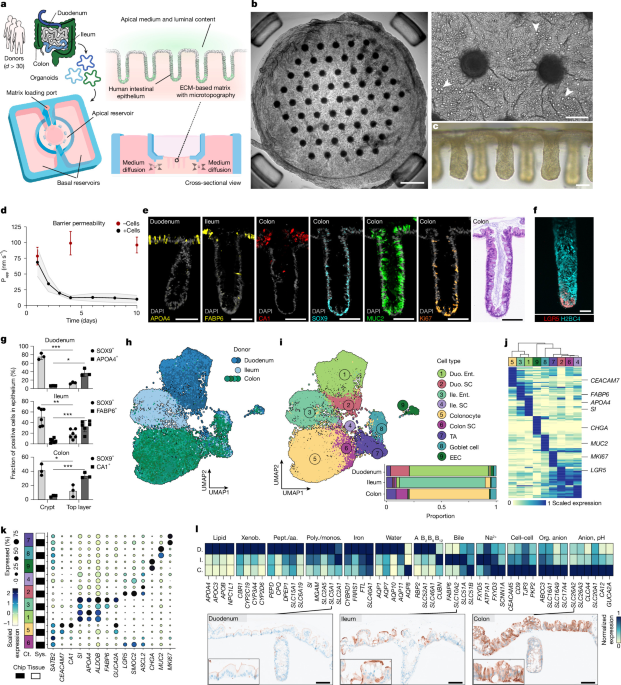
To model the human intestinal epithelium, we developed a fluidic device and microstamping technology to impart crypt-mimicking topography on an embedded ECM-like hydrogel (Extended Data Fig. 1a). Human intestinal organoids were seeded into the top reservoir of the device, where they formed a tight, polarized barrier comprising crypt units sustained by basal nutrition (Fig. 1a–d and Extended Data Fig. 1b–e).
a, Overview of the engineered intestine