// ARS TECHNICA — SALUTE
The "shameful" measles data that lost the US its elimination status
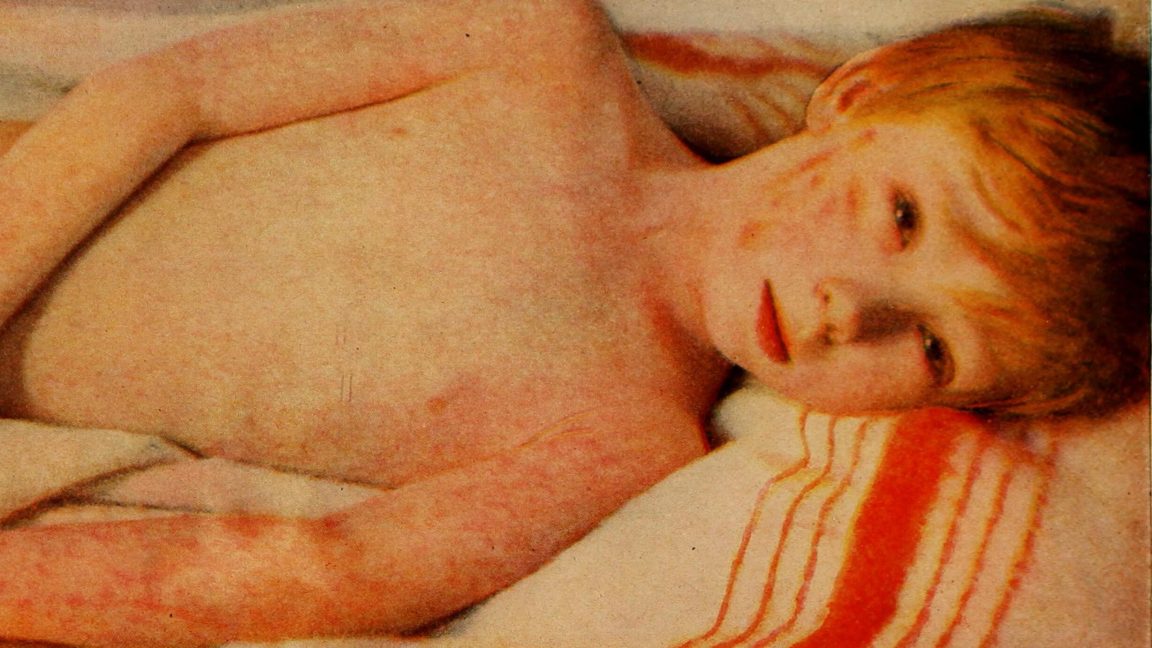
Measles became endemic in the US months ago—and it’s only accelerating.
International health authorities formally announced on Tuesday that the US has lost its measles elimination status, a hard-fought public health triumph won in 2000 after decades-long vaccination efforts. The loss had been widely expected by public health experts for months, and the decision was leaked by the press last week. Still, having the designation officially stripped stings.
After the announcement Tuesday, public health experts, doctors, and political leaders decried the dramatic backslide for the US, calling it “shameful” and a “national embarrassment.” News articles point to the staggering vertical rise of measles cases this year, currently over 5,400 cases, more than any other year since 1991. An explosive measles outbreak in Pennsylvania accounts for over 1,500 of those cases. There have been 10 confirmed deaths across three states, several deaths just in the last week.
But the measles data that caused the US to lose its status—the bits of it that are public at least—paint a darker picture of where the US is in its rematch with measles, the most contagious virus known on Earth. For one thing, almost none of the data from this year—the cases, the explosive Pennsylvania outbreak, the deaths—factored in to the loss. It was lost earlier. What’s happening now is a runaway epidemic.
The US measles elimination status is a designation granted by the Pan American Health Organization (PAHO), which is a regional division of the World Health Organization. Last week a committee of experts assembled by the PAHO, called the RVC, met to review measles data for countries across the region, including the US. (RVC is short for the Measles, Rubella and Congenital Rubella Syndrome Elimination Regional Monitoring and Re-Verification Commission.)
For their review of the US data, the RVC heard from an independent committee of experts from the US, called the NSC, which presented measles data collected from January 2025 onward. (The NSC is short for the US National Sustainability Committee for the Elimination of Measles, Rubella, and Congenital Rubella Syndrome.)
According to the PAHO, an elimination status is lost when epidemiological and laboratory data shows that a single viral lineage has spread continuously for at least 12 months within a country. At this point, the virus is considered to be reestablished or endemic. So, to withdraw the US elimination status, the RVC needed to see evidence that a single introduction of a measles virus led to a 12-month-long chain of cases, which requires a lot of data.
The full set of data the NSC presented to the RVC is private for now. The US Centers for Disease Control and Prevention needs to review and approve such data for public release, which can be a lengthy process that has not yet occurred.
The Department of Health and Human Services, which oversees the CDC, did not respond to a question from Ars Technica regarding when the data may be released.
But Ars Technica spoke with the chair of the NSC, Noel Brewer, who tried to talk through the pieces of data in the NSC report to the PAHO that he could discuss—these are pieces that have already been made public at some point by others, such as by state health officials or researchers. Brewer said the NSC presented the PAHO with genetic data spanning January 2025 to January 2026, and also epidemiological data that extended to June 2026.