// SPACE.COM — SPAZIO & SCIENZA
Einstein was right! Scientists verify 1st image of a black hole ever captured
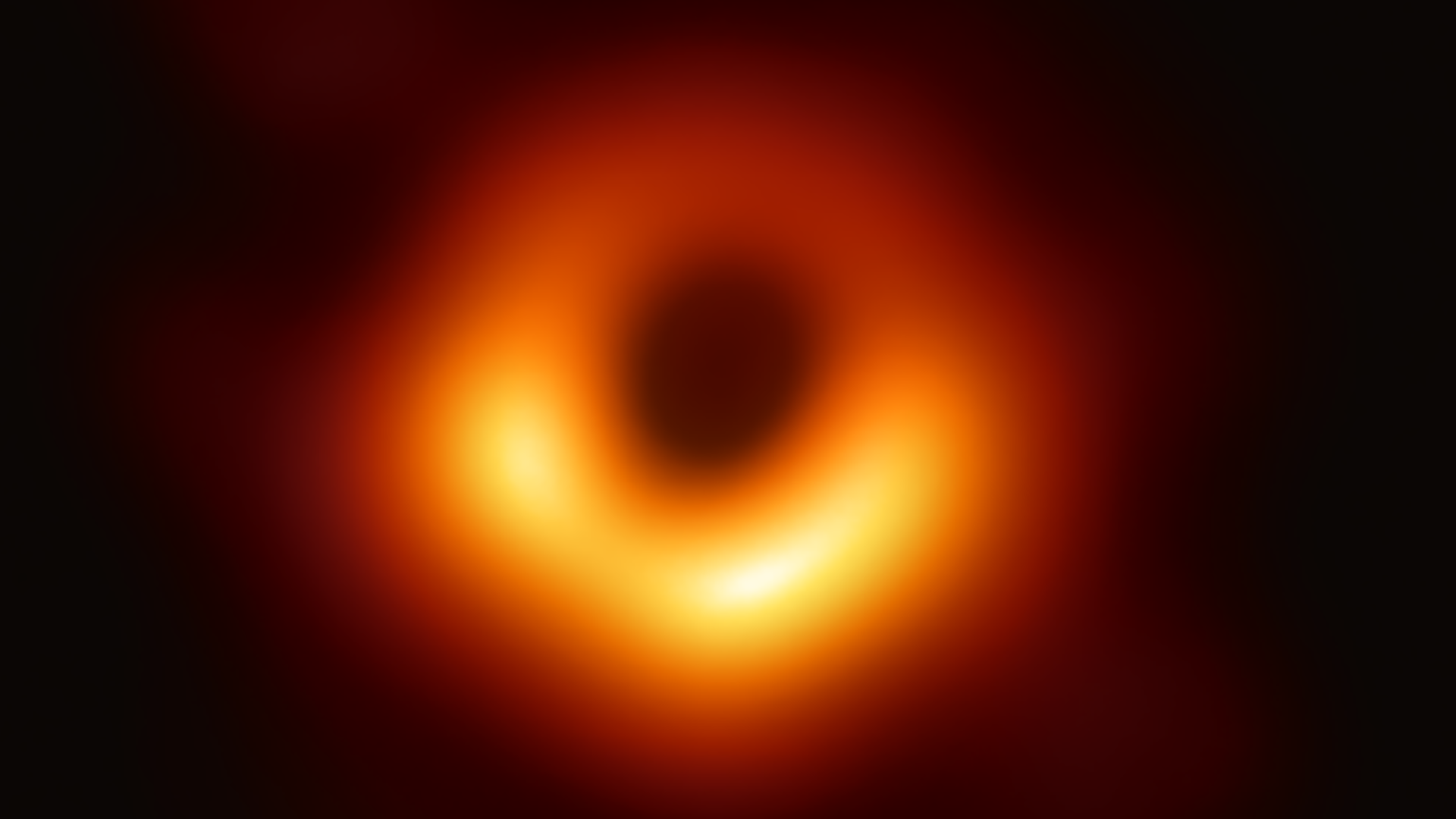
"It is like standing in your backyard and trying to take a photo of a doughnut on the moon."
When you purchase through links on our site, we may earn an affiliate commission. Here’s how it works.
An independent team of researchers has validated the first image of a supermassive black hole captured by humanity. That, in turn, verifies Einstein's greatest theory, general relativity, which first predicted the existence of black holes and what their immediate surroundings would look like.
Captured by a global network of telescopes forming an interferometer called the Event Horizon Telescope (EHT) and revealed to the public in 2019, the image shows the supermassive black hole at the heart of the galaxy Messier 87 (M87), located 55 million light-years away.
The image of this black hole, designated M87*, with a mass around 6.5 billion times that of the sun, was an immense scientific achievement. That may lead to the question: why did it need verifying at all?
Team leader and researcher with Australia's Commonwealth Scientific and Industrial Research Organisation (CSIRO), Samuel Lai explained why capturing the image of a distant black hole is so tricky.
"It is like standing in your backyard and trying to take a photo of a doughnut on the moon," Lai said in a statement sent to Space.com via email.
Lai and his small Australian team developed advanced machine learning and artificial intelligence techniques to capture information about the black hole's structure and filter out interference resulting from the fact that the EHT was viewing M87* from within our planet's atmosphere. The machine-learning technique called GenDIReCT also accounted for biases introduced by combining telescopes to create an Earth-sized interferometer. "When we applied it to the original EHT dataset, we found a black hole almost identical in size and shape as the historic EHT image. Importantly, our model had no idea what a black hole looked like when we applied it to the M87 data," Lai continued. "This is the first truly independent validation of the EHT image, an important step in the scientific process."
This could settle the questions of just how the final image of M87* was influenced by both atmospheric effects and the processing methods needed to reconstruct pictures from telescope data.
That's not just good news for the EHT; it's good news for Einstein.