// ARS TECHNICA — HARDWARE & GADGET
Porsche 718 Boxster prototype drive: This electric roadster is real
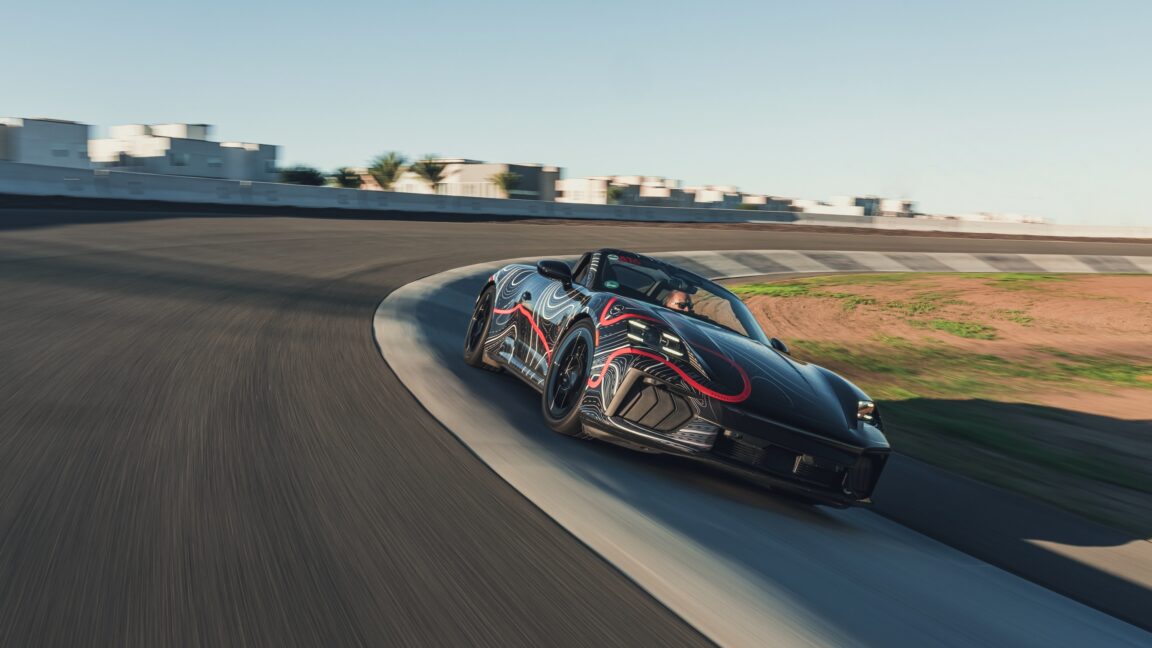
Technical details are still limited, but we already know it’s fun to drive.
It wasn’t until I was stuck in traffic on the way back from a run up and down some canyon roads that I realized just how low Porsche’s upcoming all-electric 718 Boxster truly is. I was idly looking around at the other cars, doing the math on the EV adoption rate in this small sample of Los Angeles gridlock (roughly 50 percent, impressively) when I noticed that I was eye-level with a Tesla Model Y door handle.
That’s not particularly low for a sports car, but it’s practically unheard of for an EV. Nearly all modern electric cars are built atop a skateboard-style battery pack, a stack of cells that elevates the seating position by a good 3 inches. In these SUV-heady days, that’s usually not a problem, possibly even an advantage. But, in a car like this, the closer you can get your keister to the road, the greater the sensation of speed.
So, for the company’s first all-electric sports car, the 718 Boxster that will be fully revealed next year, Porsche engineers put the battery pack behind the driver. That powers a single motor spinning the rear wheels and creates a driving experience that both honors the simple joy of motoring in a mid-engined Boxster while pushing the 718 to new heights of power and performance.
That EV battery layout, stacked behind the two-seat cabin rather than sandwiched below it, isn’t novel. It’s the same setup that Tesla used on the original Roadster back in 2008. Back then it was done for cost reasons as much as anything, enabling Tesla to repurpose a Lotus chassis meant to hold an internal combustion engine in the middle.
For Porsche’s new Boxster (and the Audi Concept C, which is built on the same platform), that pack enables the low seating position and also delivers a rearward weight bias (40:60 front/rear) that’s in keeping with the last-generation 718 Boxster, the internal combustion model killed by EU cybersecurity regulations last year.
Porsche isn’t saying how big the new roadster’s battery is in terms of charge capacity, only that its size was chosen to balance range and weight. We also don’t have an idea of rated range, charging speed, nor battery composition, but I can say the battery pack is based on an 800 V architecture like the electric Macan, so hopefully we can expect charging performance that at least matches that SUV’s 270 kW.
The new Boxster also shares a motor with the Macan. Porsche is not quoting any specs yet, but it puts out about 500 hp (370 kW) to the rear wheels on the Macan Turbo. You can place your bets on whether the Boxster application will result in more or less power. I’d take the over, but regardless, it’s enough to sprint this electric roadster to 62 mph (100 km/h) in under 3.0 seconds, making it the quickest Boxster ever.
But it’s also the largest and heaviest. I was told the new Boxster’s curb weight will be somewhere in the ballpark of a current-generation 911, so in the region of 3,300 to 3,700 pounds (roughly 1,500 to 1,700 kg), meaning it has gained at least a few hundred pounds. That’s light for an EV but heavy for a roadster. Its wheelbase has grown accordingly.
You can absolutely feel that on the road. The 718 just doesn’t have the same buzzy eagerness as the latest 718 Boxster or Cayman. But that doesn’t mean it’s less fun to drive. In fact, I think most people would say it’s much more fun. Nearly doubling the old car’s base power output will do that.