// SPACE.COM — SPAZIO & SCIENZA
Is the Nocs Provisions Lite View spotting scope a good alternative to a traditional telescope?
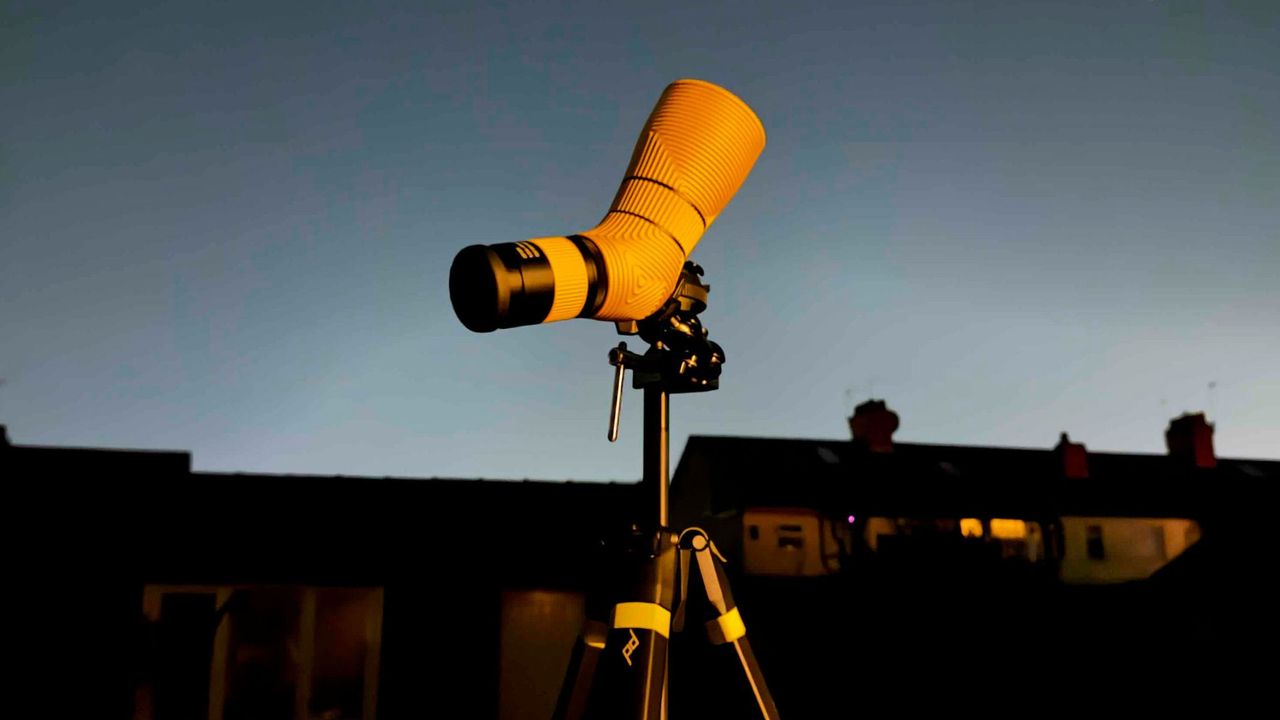
With sharp views of the moon and open clusters of stars, smooth zoom control and a highly portable design, the Nocs Provisions Lite View is a decent companion at night — provided you use it on a tripod.
Why you can trust Space.com
Our expert reviewers spend hours testing and comparing products and services so you can choose the best for you. Find out more about how we test and review products.
Spotting scopes are typically used by birders and for hunting, but under a dark sky, the Nocs Provisions Lite View reveals a different personality. With a 56mm objective lens and a versatile 9x-27x zoom range, this compact spotting scope is surprisingly capable when turned toward not just the moon, but bright star clusters, too.
Key to its attraction is its small size, carry case and shoulder strap, which makes it possible to sling over a shoulder. Its rugged, wave-textured housing and bright color options? Not so much. However, with just enough optical performance to satisfy casual astronomers — particularly those focused on lunar observing — it makes a good option for astro-travel. Is it a replacement for one of the best telescopes? Absolutely not — but for close-up views of the lunar disk (particularly lunar eclipses), Jupiter and its moons, and bright open star clusters such as the Pleiades — this lightweight scope offers an appealing balance between portability and power if, and only if, you mount it on a tripod.
Field of view: 78–39 m at 1000 m / 234–117 ft at 1000 yds
What's immediately noticeable about the Lite View is its rubberized, wave-textured exterior, which feels solid and secure in the hand. It's impact-absorbing and confidence-inspiring — important if you're heading out to a field for a late-night lunar eclipse, perhaps — though it will jar with anyone used to the mono, metallic designs favored by telescope designers. As a bonus, the IPX4 water-resistant rating means it will tolerate drizzle and damp conditions, though it's not fully waterproof or fogproof. Are we fans of its two color choices, Ochre Yellow and Saguaro Green? Not so much, though; with the popularity of stargazing-themed travel, the differing tones of astronomy scopes and spotting scopes no longer make sense.
At 192 mm long and weighing 567 g / 1.2 lb, the Lite View lives up to its name. It's small enough to fit into a larger jacket pocket and comes with a protective carrying case and shoulder strap, making it ideal for grab-and-go observing sessions. Its focus wheel and eyepiece zoom ring are logically placed, but while the former can feel slightly stiff at first, the latter is much looser. After some use, the focus wheel loosens and becomes smoother to operate. Meanwhile, the twist-up eyecups offer 18 mm of eye relief, making it comfortable to wear with spectacles.
Crucially for astronomy, the scope includes an integrated tripod mount. At higher magnifications, it proves essential.
Turn the Lite View toward a first-quarter moon, and it quickly justifies its place in a basic travel astronomy kit. At 9x magnification, the lunar disk appears crisp and bright against the night sky, with strong contrast across the dark maria and a pleasingly wide field of view that makes locating and centering it effortless. Increase the magnification to around 20x, and the view becomes more immersive, with crater chains and rugged terrain along the terminator snapping into satisfying relief as shadows sculpt the surface into dramatic texture.
At the full 27x magnification, crater rims and fissures become more pronounced, and for a 56mm spotting scope, the overall sharpness remains impressive. However, this is also where the scope’s limitations begin to surface. A trace of purple fringing and faint yellow coloration appear along the lunar limb in high-contrast areas, but it's not severe. Sharpness softens slightly compared to the sweet spot around 20x magnification, and in darker conditions, chromatic aberration becomes more noticeable around the moon.