// KOTAKU — GAMING
Big Walk: The Kotaku Review
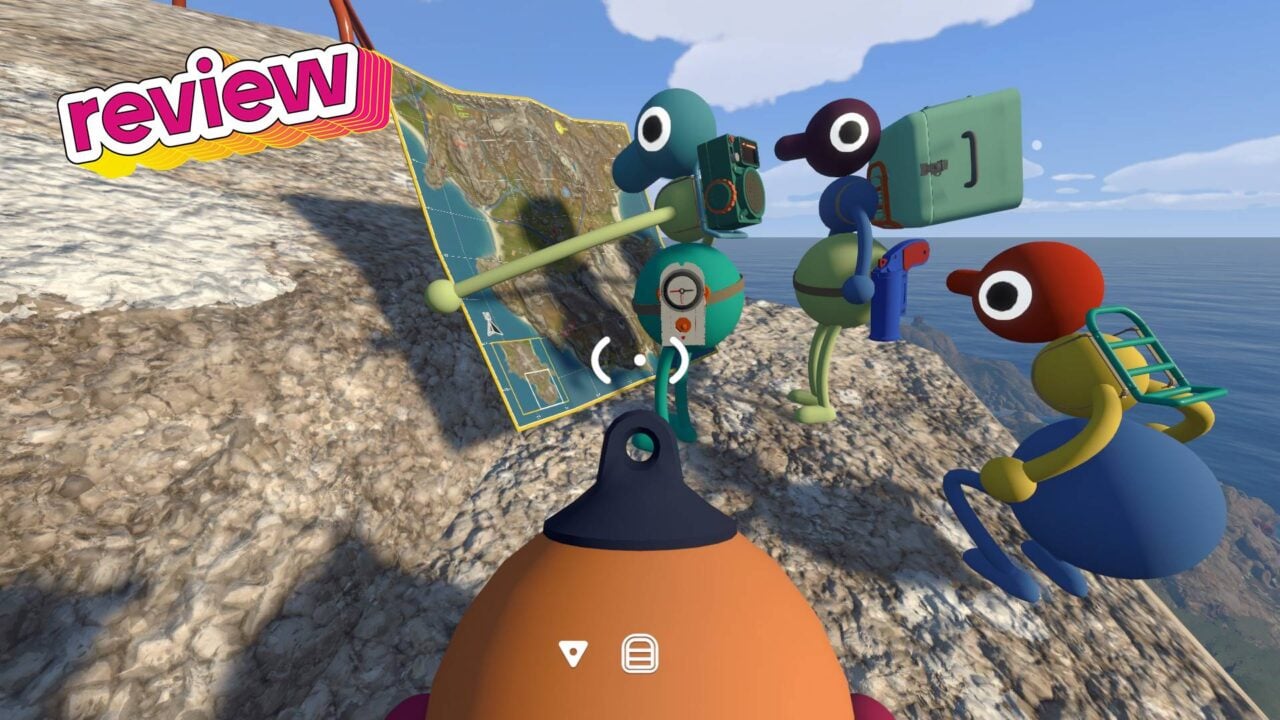
Love or hate the terminology, we’ve recently seen a rise in something folks are calling “friendslop”—generally indie games intended to be played with friends that encourage communication, teamwork, and silliness. Games like Meccha Chameleon, Among Us, and Peak are prime examples, and have gained rapid popularity thanks both to being very well-designed, fun games, and also to their facilitation of positive human relationships. At a time when everyone is feeling increasingly isolated, these games encourage us to play together.
I guess, by this definition, Big Walk is another prime example of friendslop. But I just can’t bring myself to use that term for it, especially with the somewhat messy connotations of the “slop” suffix. There’s something about Big Walk that defies the “slop”ness of the word: something clean and clear, something aggressively earnest and even loving. Whatever that something is, it’s been making me tear up every time I have thought back on moments in my own Big Walk. It’s made me want to message the friends I walked with, excitedly beginning with “Hey, remember when-?”
In Big Walk, you and your friends go on a big walk. It’s set on an uninhabited island: you and your companions are the only ones there. There are lots of trees, a few mountains of varying heights, valleys, rivers, coasts—you know, things you see on a hike. There are no signs or trail markers, no wildlife to be seen, though you can hear birds.
There are large, Fischer-Price-looking monuments spaced out across the landscape, brightly colored, built like giant toys. Normal stuff.
Inside almost all of them is a puzzle, always one that requires more than one person to solve and almost always one that requires thoughtful communication and teamwork. For instance, the very first puzzle we encountered in the tutorial area was a giant crane with a button on top, far out of our reach. To get to it, the six of us had to stack on top of one another, with the bottom person lining the tower up correctly and the top person hitting the button. Another very early one had one person push a button to light up and activate an objective across the valley, and the other person had to follow the light and run over to the correct spot. These were simple, early game puzzles, but everything grew increasingly complex from there.
The reward for solving most puzzles is a weird little nub that our group unfortunately immediately dubbed a “nipple.” You can call it what you like. The goal, very roughly, of Big Walk is to collect a lot of nipples (sorry, I won’t do it again).
In this regard, I guess I should describe Big Walk as a puzzle game primarily. It is certainly the puzzle game that finally made it click for me what it is that makes a really good puzzle game. It’s not about puzzles being difficult, or easy enough, or especially intricate, or anything like that. A good puzzle game makes you, the player, feel like a genius. Big Walk does one even better. It puzzles are almost universally so well-paced and well-designed that it makes a group of people feel like a collective genius. It even celebrates that genius appropriately: I love that every time you finish a puzzle, there’s a little party horn “honk!” noise and a bunch of confetti is spit out at you. A mini-celebration, every time, with you and your friends jumping up and down and waving your arms and yelling into the mics because you got it, you did it!
Big Walk is also explicitly a cooperative game. By that I do not mean that it is a single-player game with optional co-op. I mean you must, must play it with at least one other friend, up to 11 others if you like, and ideally at least five or six if you want the richest experience possible. You don’t need to play it with the same people every time: the start of each session lets the host choose between a game for 2 people, 3 people, and 4+, which adjusts some of the puzzles to ensure they’re solvable by the number of folks available. I don’t recommend having diff