// ARS TECHNICA — MONDO
The ultimate eclipse chase: A Concorde raced against the Moon's shadow
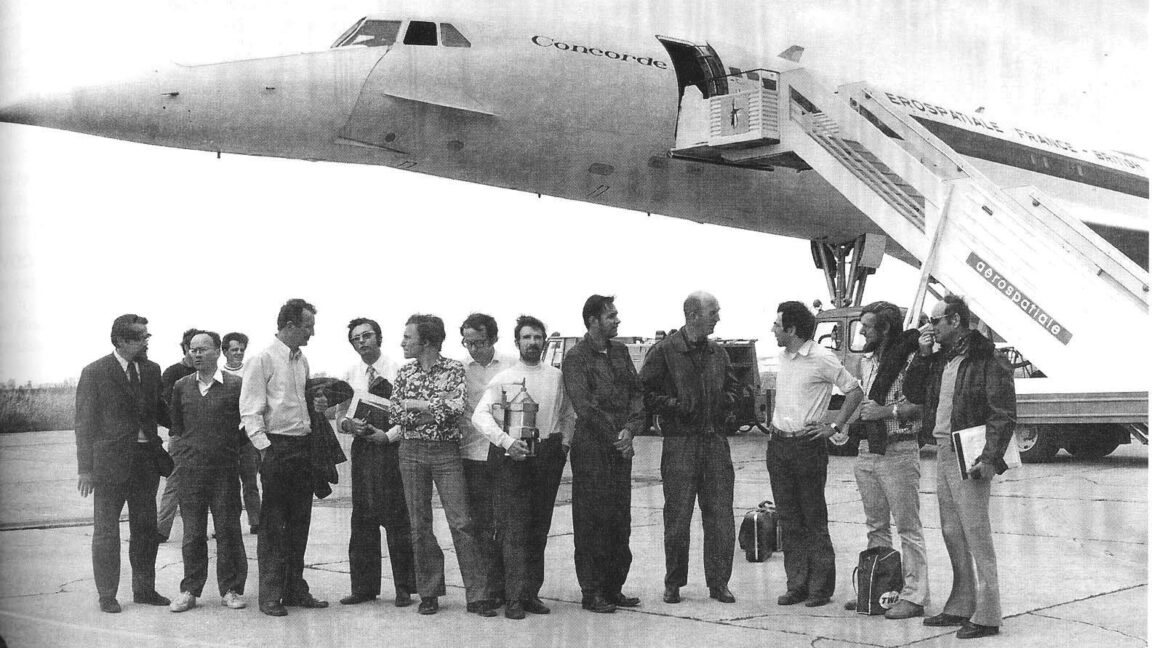
Fitted with telescopes, the plane did our longest imaging of the Sun’s corona.
A walk down the tarmac at the National Air and Space Museum of France is guaranteed to thrill aviation enthusiasts. Several civilian and military aircraft of the past and the present are showcased in this museum, located at the Paris-Le Bourget airport. One of them is the legendary Concorde F-WTSS 001 prototype, the sight of which should give goosebumps to science enthusiasts as well.
That’s because right behind its long nose is a painted map that traces the path of a June 1973 total solar eclipse across Africa. It’s there on the Concorde 001 prototype because a group of eight scientists set a new world record of observing a total solar eclipse for 74 minutes by flying this aircraft at more than twice the speed of sound.
To put this figure into context, the maximum duration of totality on the ground is around 7.5 minutes when an eclipse is observed in the equatorial regions. For the upcoming solar eclipse of August 12, which can be seen from parts of Europe, the maximum duration of totality from the ground will be slightly more than two minutes.
One of the scientists, and the initiator of the record-creating project, was Pierre Léna. A year before June 30, 1973, Léna, who had carried out astronomical observations from high-altitude aircraft, came up with this idea.
Since the 1973 eclipse was going to be near the equator, the Moon’s shadow would move at a relatively slower speed, although still more than 2.2 times the speed of sound. There was only one big aircraft that came close to matching this speed: The Concorde.
“In 1970, the Concorde 001 prototype flew supersonic for the first time,” Léna told Ars. “The newspapers were full of these results. By 1972, I thought it was worth trying to approach André Turcat, the chief of test flights at Aerospatiale in Toulouse, and ask him about the possibility of using the 001 prototype to follow the June 1973 eclipse. He was very interested.”
With his plan accepted, Léna began organizing experiments for the historic flight. Flying at nearly 17 km above the Earth’s surface had many benefits. “Flying very high in the stratosphere had several advantages, including no humidity, which meant an excellent infrared transmission of the solar light.”
“I had planned an experiment to study the particles of dust in the corona in the infrared wavelengths. However, it would have been presumptuous to use this big aircraft only for a single experiment. So the first thing we did, after we got a feeling that the project would go ahead, was to propose to other scientific groups in France, the UK, and the United States a seat on this flight to carry their own observations,” he said.
While Léna was from the Paris Observatory, the other scientists came from the French National Centre for Scientific Research; Queen Mary College in London; Kitt Peak Observatory in Arizona; Los Alamos National Laboratory; and the University of Aberdeen.