// SPACE.COM — SPAZIO & SCIENZA
Sky-Watcher SolarQuest mount head review
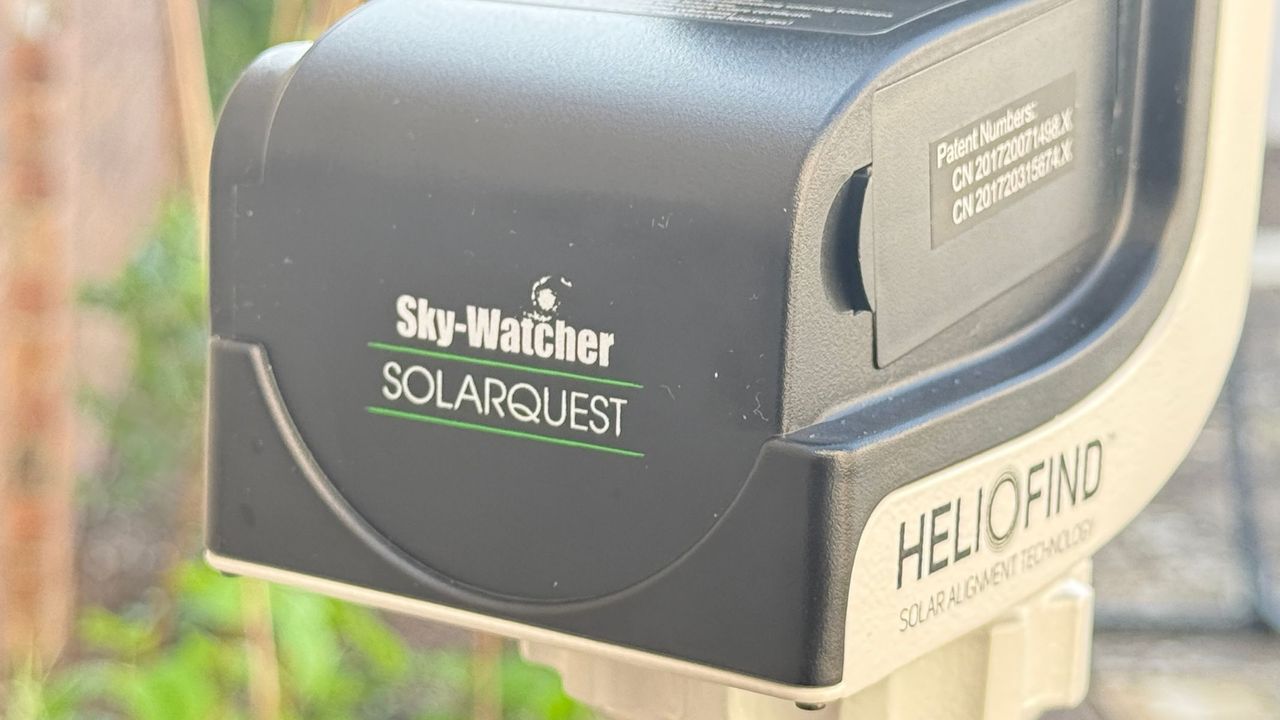
The Sky-Watcher SolarQuest solar-tracking alt-az mount is a specialist product with one job: find the sun safely and keep it centered. It does that extremely well, using built-in GPS, its HelioFind solar alignment tech, a solar sensor and basic alt-az tracking. It's lightweight, easy to use and super-fast at what it does.
Why you can trust Space.com
Our expert reviewers spend hours testing and comparing products and services so you can choose the best for you. Find out more about how we test and review products.
Power: 8x AA batteries (not supplied)/external 12V DC via adaptor panel
Tripod: 31.7-59.8 inches/80.5-152cm adjustable aluminum tripod with accessory tray, bubble level and 3/8-inch screw fitting
Finding the sun sounds easy, right? Many people think of the sun as big and bright, but it’s actually rather small in the sky — it’s got an angular diameter of just half a degree, in fact, the same as the moon. Put an all-important solar filter on a telescope, and you’re left with the challenge of finding a tiny orange or white circle in a sea of black. Even if you manage to find the sun, nudging a solar telescope back into position every few minutes to keep it in the field of view quickly gets irritating.
Cue the Sky-Watcher SolarQuest mount, a simple grab-and-go product that exists to solve exactly that problem. Costing around $585/£259-£359 (the latter with a tripod), it is not a general Go-To astronomy mount and it is not trying to be one. It is best understood as a dedicated solar tracking platform for small solar telescopes. That could range from regular telescopes wearing solar filters, most likely during a solar eclipse, to dedicated solar telescopes such as white-light-filtered refractors and H-alpha (Hydrogen-alpha) telescopes designed specifically for viewing the sun.
The SolarQuest mount head weighs just 2.9 lbs/1.3 kg, accepts standard 45mm Sky-Watcher/Vixen-style dovetails and can be fitted to a tripod using a 3/8-inch screw. Meanwhile, the optional tripod is lightweight and easily adjustable, with a bubble level and accessory tray. Whatever tripod you use, it’s imperative to get it stable before using the SolarQuest because its ability to track the sun successfully depends on it.
With the optional aluminum tripod — which we used in our review — the total setup is still only around 9.9 lbs/4.05 kg, making it easy to set up inside and carry into the garden. Eclipse chasers travelling abroad will easily be able to store it in a carry-on camera bag.
The mount itself has very few controls: A power button and an 8-way sliding switch. A long press of the power button finds the sun, with the second used to make manual adjustments. There are no menus and no alignment tasks.
At first glance, the promise of the Sky-Watcher SolarQuest mount head is so simple: you level the tripod using its built-in bubble or spirit level and point the attached telescope somewhere to the left of the sun. You then long-press the power button and step back. The built-in GPS calculates the date, time, and location, as well as the sun’s altitude and azimuth. The mount levels the telescope, pauses, then slews to the right altitude. Then its photodiode solar sensor (a small camera) hunts for the solar disc and locks on. In practice, the system gets impressively close to that ideal — but with some small caveats.